
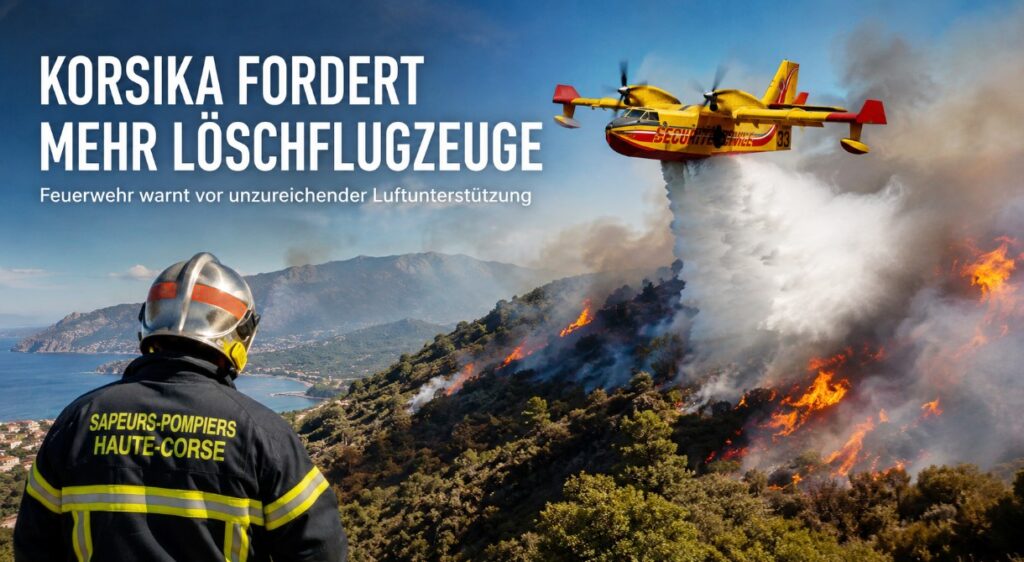
Large-scale forest fires in the Haute-Corse department have sparked a new debate about the equipment of the French civil protection forces. While drought, high temperatures and strong winds are contributing to the spread of the flames, the president of the administrative board of the Haute-Corse Fire and Rescue Service (SIS 2B), Giacinthe Vanni, is making serious accusations against the state. In his view, the national aerial firefighting resources currently deployed are no longer sufficient to meet the increased needs on the Mediterranean island.
Criticism of aerial support
Giacint Vannì paints an alarming picture of the current situation. The available firefighting aircraft, although deployed, are only available intermittently and do not provide continuous support for firefighting operations. Particularly in large vegetation fires, a constant aerial presence is crucial to contain the spread of the fire and prevent already extinguished hotspots from reigniting.
According to the president of SIS 2B, this situation forces ground units to operate under significantly more difficult and dangerous conditions. Without regular aerial support, firefighters often have to get closer to the flames, while the fire can spread rapidly due to wind and difficult-to-access terrain.
Vanni emphasizes that the department’s firefighters have been working continuously for several days under extremely exhausting conditions, risking their own safety. However, their exceptional dedication cannot replace the lack of technical resources in the long term.
Demands on the French state
Against this backdrop, the president of SIS 2B is calling for a substantial strengthening of state firefighting capabilities. Specifically, this concerns:
- increasing the number of available firefighting aircraft,
- the seamless organization of flight rotations to ensure continuous aerial support,
- closer coordination between national response forces and regional fire services.
The aim must be to maintain continuous pressure on the fire hotspots. Interruptions in aerial support could jeopardize firefighting success and significantly accelerate the spread of the fire.
Forest fires are becoming a constant challenge for Corsica
The criticism was voiced not by chance during a period of particularly difficult weather conditions. Corsica has for many years been among the French regions with the highest risk of forest fires. Several factors significantly increase the danger.
The mountainous terrain makes it difficult for firefighting equipment to reach many fire sites. Added to this are dense maquis scrublands, whose dry vegetation easily catches fire in summer. At the same time, high temperatures, low rainfall and strong winds regularly cause fires to spread over large areas within a short period of time.
Experts have observed for many years that climate change is lengthening and intensifying the wildfire season in the Mediterranean region. France has therefore also gradually adapted its wildfire-fighting strategies. However, fire services and local politicians repeatedly point out that the available aerial firefighting capacity may reach its limits under extreme weather conditions.
Repeated calls for modernization
The current criticism is part of a debate that has been ongoing for years. Officials in Corsica regularly demand that the island’s particular geographical conditions be taken better into account when allocating national response forces and resources.
Since France must deploy its firefighting aircraft throughout the country, different regions compete for the same resources during the summer months. If several major fires occur at the same time, this can limit the availability of aircraft.
According to Corsican fire services, the development of wildfire risk requires a long-term adaptation of the national civil protection strategy. This is not only about additional aircraft, but also about modernized operational planning and strengthened preventive measures in view of increasingly frequent extreme weather events.
The current fires once again demonstrate how closely the success of firefighting is linked to effective air support. While emergency services continue to battle the flames, political pressure is growing in Corsica on Paris to permanently adapt the available resources to changing climatic conditions.
Author: P. Tiko