
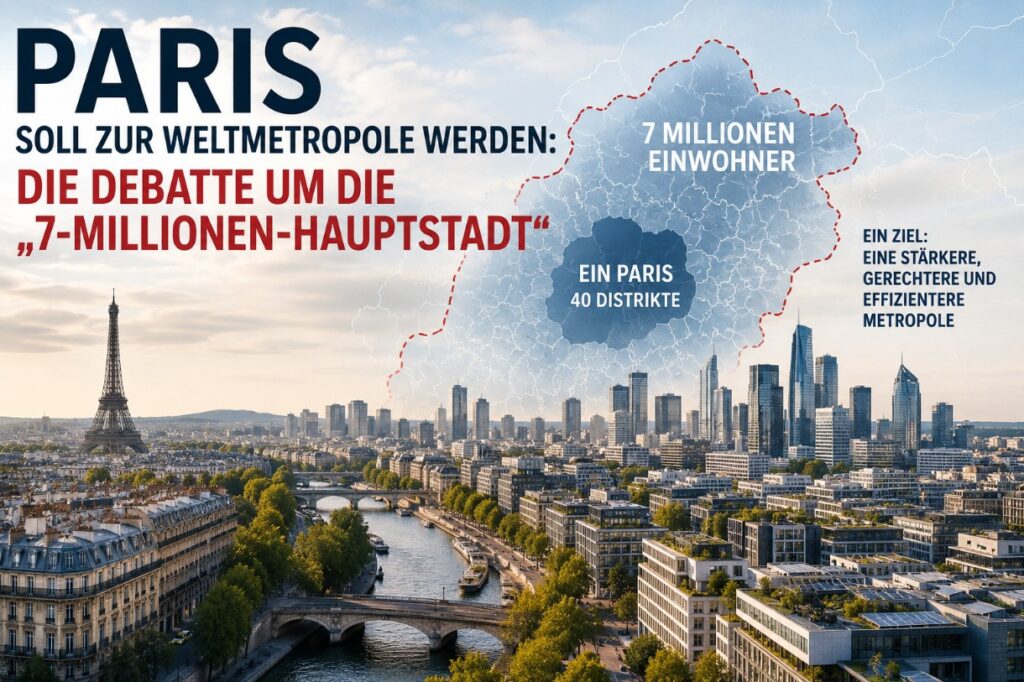
Paris is thinking big again. Very big indeed. The new reform project of the High Commissioner for Planning Clément Beaune is actively being discussed in politics and administration. The vision: a capital with seven million inhabitants, a single administration, and the end of those municipal boundaries that have shaped Greater Paris for decades.
At first glance, this may seem like a technocratic administrative reform, but in reality, it deals with one of the central issues of French urban development: how to manage a 21st-century metropolis when its political structures still originate from a time when the suburbs were much smaller and the challenges more manageable?
A metropolis that has long been united
The official city limits of Paris today encompass about 2.1 million inhabitants. However, the real metropolis has long since extended beyond the boundaries of the périphérique boulevard. Every day, millions of people travel from the suburbs to the capital and back. Jobs, transportation networks, the housing market, and economic life have long formed a closely interconnected organism.
The existing administrative boundaries now seem artificial. Although economic reality has long created a joint metropolis, political organization is distributed among numerous municipalities, departments, regional institutions, and state levels.
Bona’s proposal is precisely this: to unite Paris and the adjacent suburbs into a single political entity. Today’s three departments of the so-called “petite couronne” – Hauts-de-Seine, Seine-Saint-Denis, and Val-de-Marne – will disappear. They will be replaced by larger urban districts within the new overall metropolis.
Combating Administrative Confusion
Supporters see this as a necessary modernization. Practically no European metropolis has such a complex network of competencies as Paris. Housing construction, public transport, economic support, or adaptation to climate change are often controlled by different institutions with overlapping authorities.
The problem is particularly noticeable in the field of housing construction. While the capital suffers from a chronic housing shortage, many suburbs have their own strategies. A single metropolis could accelerate planning processes and manage investments more purposefully.
International experience confirms this idea. London and Berlin have significantly more centralized administrative structures. Paris, despite its economic importance, remains institutionally highly fragmented.
Between Solidarity and Self-Interest
However, political reality complicates implementation. Many mayors see this as a threat to their municipal autonomy. Wealthy suburbs in particular are skeptical about closer integration, fearing they will have to share the financial burden with regions that have weaker structures.
On the other hand, many suburban communities worry that they will have even less influence in a large metropolitan administration than before. The discussion concerns not only organizational issues but also sensitive relations between the center and the periphery.
Additionally, there is an emotional factor. Many suburbs have developed their own identity over decades—often consciously separated from the capital. The planned reorganization would change much more than administrative boundaries. It would call into question historically formed political and cultural images of themselves.
Paris in the Competitive Struggle of Global Metropolises
The discussion contains a strategic question: how can Paris maintain its position among the world’s major metropolises?
Competition between London, Berlin, Madrid or Milan is increasingly defined by infrastructure, innovation, housing conditions, and international attractiveness. Although the French capital has enormous economic and cultural influence, it simultaneously faces high housing costs, social tensions, and complex decision-making processes.
The idea of a “capital with 7 million inhabitants” is more than just an administrative project. It is an attempt to adapt political organization to the real scale and significance of the metropolis.
Author: P. Tiko