
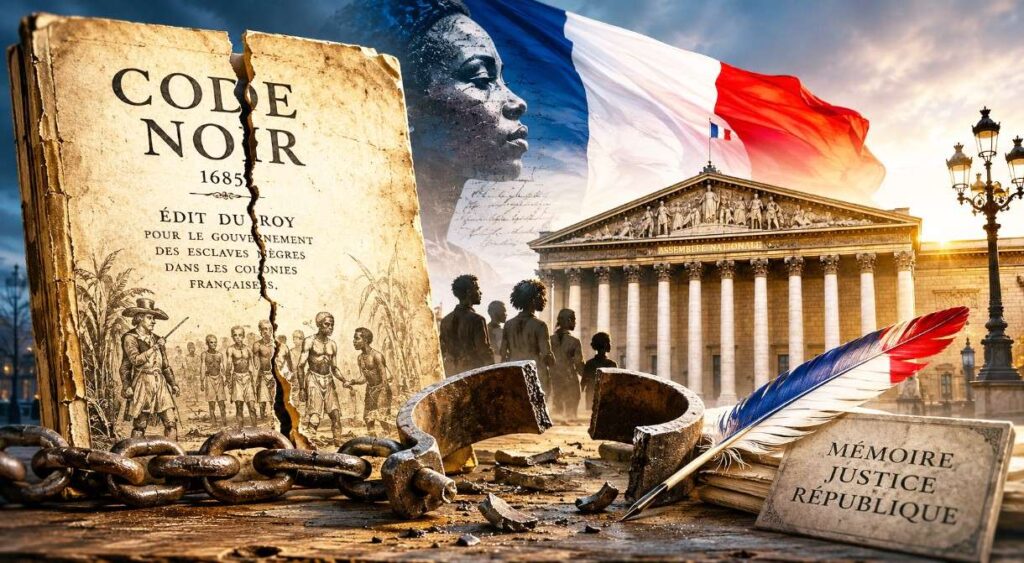
The French National Assembly is currently discussing a document that has not had legal force for almost two centuries — yet still lives in the collective memory of France like few other texts from its colonial past. The resolution on the symbolic “abolition” of the so-called Code noir may not have legal consequences. However, politically it touches upon a sensitive issue of the French Republic: how the country deals with the dark chapters of its own history without collapsing from it.
The very fact that the parliament in 2026 is still discussing the edict of 1685 says a lot about contemporary France. It is no longer just about legal techniques or the dogmatics of the law. It concerns memory, identity, and the right to interpret national history.
Code noir was one of the central instruments of the French colonial empire. Created under Louis XIV, it codified slavery in the French Caribbean islands and provided a legal framework for an economic system whose prosperity was based on deprivation of rights and violence. A person was declared movable property within it; corporal punishments, religious coercion, and social control were regulated by the state. This document was a reflection of an era in which economic rationality and monarchical political power formed an alliance with systematic dehumanization.
It is not surprising that France today tries to symbolically distance itself from this text. It is particularly notable how difficult this step still is for it.
After all, legally the Code noir no longer exists. After the final abolition of slavery in 1848, its provisions lost their validity. No court today could refer to it, no administrative action could gain legitimacy based on it. The text belongs to the historical archive, not to positive law. Anyone now demanding its “repeal” is consciously engaging in symbolic politics.
However, this is precisely the true significance of the debates. Modern democracies live not only by their institutions but also by moral self-descriptions. Parliaments adopt resolutions not only to establish norms but also to take historical positions. France does this regularly: with laws on the memory of the Holocaust, recognition of the Armenian genocide, or the Taubira law of 2001, which qualified slave trade and slavery as crimes against humanity.
The current resolution is part of this tradition. It is intended less to create law than to send a republican signal: the French state recognizes that slavery was not merely a historical mistake of individual participants, but systematically organized and institutionally legitimized.
At the same time, the debates reveal the limits of increasingly ritualized memory politics. France has been under tension for many years between the necessary historical reflection and a kind of ongoing moral self-examination. The colonial shadow extends deeply into the present — noticeable in the social inequalities of overseas territories, in the identity conflicts of the suburbs (banlieues), or in the tense controversies around national symbols and school curricula. But the more history is politicized, the greater the danger of its instrumentalization.
Critics of the resolution therefore call it symbolic waste. “Repealing” a text that has been outdated since 1848 seems to be, for the second time, a parliamentary gesture without practical consequences. It is indeed conceivable to question whether the inflationary use of historical resolutions will lead to a devaluation of political memory in the long term. If every historical guilt is symbolically debated again in parliament, it gives the impression of a republic that can never close its past.
This skepticism is not entirely unfounded. Memory politics always carries the risk of simplifying historical complexity into moral certainty. French colonialism was a system of oppression, but also part of those historical dynamics from which the modern republic emerged. The history of France is neither exclusively the history of the Enlightenment, nor exclusively the history of oppression. It is both at the same time — and it is precisely this ambivalence that complicates its political processing.
But the opposite position is also insufficient. Those who completely reject symbolic gestures as ineffective underestimate the power of political signs. States are constituted not only by laws but also by shared narratives. For many residents of Guadeloupe, Martinique, or Guyana, the Code noir is not an abstract historical document but a symbol of centuries of deprivation of rights, the social and cultural consequences of which are still felt today. The fact that the republic now clearly condemns this text has political significance — even if it does not change material reality.
So the real challenge lies not so much in the resolution itself, but in what happens next. Memory alone does not replace social policy, educational reforms, and serious work on structural inequalities. A republic that stops at symbolic acts risks moral self-satisfaction without practical consequences.
The current debate around the Code noir ultimately reveals a deeper transformation: France is in the process of rethinking its historical self-awareness. The republican model of universalism, which long assumed that individual origin does not matter in the public sphere, is coming under increasing pressure. Issues of colonial history, origin, and cultural memory can no longer be dismissed on the sidelines.
It would be a mistake to view these debates as a sign of national weakness. Democracies prove their stability precisely by remaining capable of openly discussing their own contradictions. Thus, the attitude towards the Code noir is not so much a sign of French self-destruction as it is an expression of a country that has learned to simultaneously acknowledge historical greatness and historical guilt.
Whether the resolution will be adopted legally should not matter. Politically, however, the debates represent another step in the large process by which France attempts to weave its colonial legacy into the republican narrative. This process will not be quick or uncontested. But perhaps it is this very unrest that is the price of a democratic culture of memory, which does not suppress history but discusses it publicly.