
Adding to this is the social factor: different groups of the population experience heat unevenly. Especially vulnerable are elderly people, workers with unstable employment, or residents of poorly insulated apartments. As a result, the climate discussion takes on a more social character—similar to the debate about energy prices.
Fear of a gradual wartime economy
The economy is dominated by a mixture of uncertainty and exhaustion. French media increasingly analyze the danger of a gradual “war economy” in Europe. This does not mean the classic state command economy, but rather a constant priority towards defense, energy security, and strategic industrial policy.
Russia’s war against Ukraine has already accelerated this development. The new escalation in the Middle East now heightens concerns about additional burdens on global supply chains and raw material markets. French commentators are paying especially close attention to the impact on consumer prices and state budgets.
France is in a political dilemma. On one hand, the geopolitical situation requires higher defense spending and greater strategic independence. On the other hand, pressure is simultaneously increasing to mitigate the social losses in purchasing power. However, the national debt limits financial capabilities.
Many observers see this as a fundamental change in European policy. For decades, economic globalization was considered a guarantee of growing stability and falling prices. Today, concepts such as “strategic autonomy,” “resilience,” or “energy security” dominate. France has long been trying to position itself as a leader in this new European industrial and security policy.
Security policy remains a constant background theme
The security situation is another constant focus of the French media. Following major international events and tensions in the Middle East, the media increasingly discuss terrorism prevention, the protection of public spaces, and the security architecture of Europe.
France has a special historical sensitivity on this issue. The attacks of recent years have fundamentally changed the public sense of security. Accordingly, politics and the public respond very attentively to every international escalation with potential impact on internal security.
At the same time, the discussion about France’s role in NATO and Europe is growing. Presidential strategies regarding European defense capabilities are now being discussed less theoretically than a few years ago. Geopolitical reality has shaken many of the former fundamental assumptions of European security policy.
An interesting change is the shift in the public tone. Just a few years ago, discussions about terrorism or migration were often emotional debates. Today, many analyses appear more restrained and strategic. Security is no longer perceived as an emergency state, but as a constant task of the state.
Cannes and the Cultural Self-Determination of Europe
Despite the crises, culture remains a prominent component of French public life. The consequences of the Cannes Film Festival still occupy pages in feuilletons and cultural columns. Moreover, it is no longer only about films, but about social self-perceptions and questions of cultural power.
Many commentators analyze the political messages of European cinema, social fragmentation, and competition with American platforms. The debates also touch on the question of how Europe culturally responds to global shifts.
France traditionally views culture not only as an entertainment industry but as a part of national identity and strategic sovereignty. This idea gains new significance especially in times of crisis. While economic and geopolitical uncertainty increases, culture is increasingly perceived as a space for societal self-determination.
The simultaneity of debates about crisis and cultural reflection shows the typical character of the French public sphere: even in periods of great tension, there remains a desire to interpret political processes also philosophically, historically, and culturally.
In the end, an image of the country in a constant state of combat readiness is formed — but without immediate panic. France appears exhausted, yet at the same time highly politicized and vigilant. War, climate, inflation, and security issues merge into a collective sense of structural uncertainty. The genuine concern of many commentators is therefore directed not so much at a single crisis, but at its duration. Exception increasingly becomes the political norm.
Author: Christine Macha
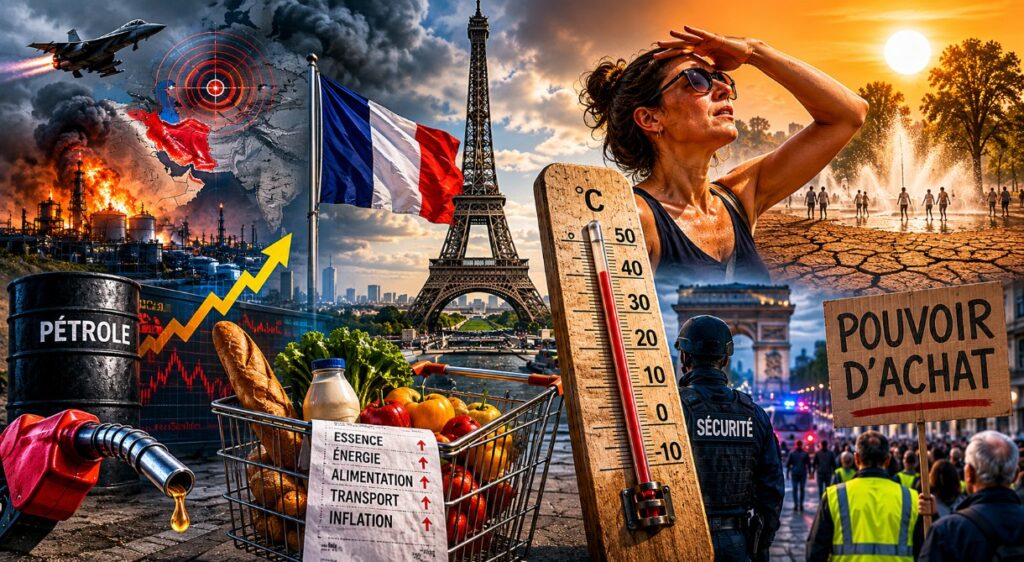
The French press on May 26, 2026, presents a remarkably coherent picture of societal tension. Almost no major publication today focuses solely on one dominant theme. Instead, foreign policy uncertainty, climate pressure, economic concerns, and security-political discussions overlap, creating a kind of constant crisis background. What stands out is not so much the presence of individual problems, but their simultaneity. France is experiencing a phase in which states of emergency are no longer seen as temporary episodes, but increasingly as a structural permanent condition.
The Middle East as an Economic Shock Factor
The focus of geopolitical coverage remains on American attacks on Iranian targets and concerns about regional escalation in the Middle East. Leading French media analyze the developments not so much from military but rather economic and social perspectives. Especially intense are discussions about the possible consequences of rising oil prices and the threat of new inflation outbreaks.
Nervousness reminds many commentators of past energy crises. France, although it has a high share of nuclear energy, is structurally less dependent on gas imports than Germany or Italy, yet the economy remains sensitive to rising costs of raw materials and transportation. Diesel fuel prices in particular carry significant political symbolism in France. Since the “yellow vests” movement, any substantial increase in fuel costs is considered a potential social explosion.
The government is therefore responding in advance. Prime Minister Sebastian Lecornu defends state support measures for particularly hard-hit sectors. Extended aid at gas stations, targeted support for the transport sector, agriculture, and crafts, as well as measures to stabilize the purchasing power of low-income households, are being discussed. The political context is clear: Paris is trying to prevent a new protest dynamic at an early stage.
Several French economic newspapers are already openly talking about an “economy of constant crisis management.” It refers to a state in which governments hardly pursue long-term reform policies, but primarily react to external shocks — the pandemic, war, energy crisis, inflation, or the effects of climate change. The political space for action is therefore significantly narrowed.
Early heat wave changes the tone of the climate debate
Simultaneously, an extremely early heat wave is shaping domestic political discussions. Temperatures significantly above seasonal averages, especially in Western and Southwestern France, are prompting meteorologists’ warnings. There is a noticeable shift in the media’s approach to extreme weather events. French newspapers no longer view high temperatures as an isolated natural occurrence, but as a manifestation of accelerated climate change.
Several commentators speak of a “summer before summer.” This term describes not only unusual weather conditions but also a feeling of increasing loss of control over climate changes. France has experienced a series of extreme summers for many years: wildfires in the southwest, water shortages, heat records, and droughts have significantly changed the perception of climate change.
The country’s infrastructure preparation is discussed particularly critically. Increasingly, the question is not whether the climate is changing, but whether the state and municipalities can cope with more frequent extreme weather conditions over a long period. Debates about water supply, power grids, cooling public buildings, and urban heat islands are gaining significant importance.
Adding to this is the social factor: different groups of the population experience heat unevenly. Especially vulnerable are elderly people, workers with unstable employment, or residents of poorly insulated apartments. As a result, the climate discussion takes on a more social character—similar to the debate about energy prices.
Fear of a gradual wartime economy
Adding to this is the social factor: different groups of the population experience heat unevenly. Especially vulnerable are elderly people, workers with unstable employment, or residents of poorly insulated apartments. As a result, the climate discussion takes on a more social character—similar to the debate about energy prices.
Fear of a gradual wartime economy
The economy is dominated by a mixture of uncertainty and exhaustion. French media increasingly analyze the danger of a gradual “war economy” in Europe. This does not mean the classic state command economy, but rather a constant priority towards defense, energy security, and strategic industrial policy.
Russia’s war against Ukraine has already accelerated this development. The new escalation in the Middle East now heightens concerns about additional burdens on global supply chains and raw material markets. French commentators are paying especially close attention to the impact on consumer prices and state budgets.
France is in a political dilemma. On one hand, the geopolitical situation requires higher defense spending and greater strategic independence. On the other hand, pressure is simultaneously increasing to mitigate the social losses in purchasing power. However, the national debt limits financial capabilities.
Many observers see this as a fundamental change in European policy. For decades, economic globalization was considered a guarantee of growing stability and falling prices. Today, concepts such as “strategic autonomy,” “resilience,” or “energy security” dominate. France has long been trying to position itself as a leader in this new European industrial and security policy.
Security policy remains a constant background theme
The security situation is another constant focus of the French media. Following major international events and tensions in the Middle East, the media increasingly discuss terrorism prevention, the protection of public spaces, and the security architecture of Europe.
France has a special historical sensitivity on this issue. The attacks of recent years have fundamentally changed the public sense of security. Accordingly, politics and the public respond very attentively to every international escalation with potential impact on internal security.
At the same time, the discussion about France’s role in NATO and Europe is growing. Presidential strategies regarding European defense capabilities are now being discussed less theoretically than a few years ago. Geopolitical reality has shaken many of the former fundamental assumptions of European security policy.
An interesting change is the shift in the public tone. Just a few years ago, discussions about terrorism or migration were often emotional debates. Today, many analyses appear more restrained and strategic. Security is no longer perceived as an emergency state, but as a constant task of the state.
Cannes and the Cultural Self-Determination of Europe
Despite the crises, culture remains a prominent component of French public life. The consequences of the Cannes Film Festival still occupy pages in feuilletons and cultural columns. Moreover, it is no longer only about films, but about social self-perceptions and questions of cultural power.
Many commentators analyze the political messages of European cinema, social fragmentation, and competition with American platforms. The debates also touch on the question of how Europe culturally responds to global shifts.
France traditionally views culture not only as an entertainment industry but as a part of national identity and strategic sovereignty. This idea gains new significance especially in times of crisis. While economic and geopolitical uncertainty increases, culture is increasingly perceived as a space for societal self-determination.
The simultaneity of debates about crisis and cultural reflection shows the typical character of the French public sphere: even in periods of great tension, there remains a desire to interpret political processes also philosophically, historically, and culturally.
In the end, an image of the country in a constant state of combat readiness is formed — but without immediate panic. France appears exhausted, yet at the same time highly politicized and vigilant. War, climate, inflation, and security issues merge into a collective sense of structural uncertainty. The genuine concern of many commentators is therefore directed not so much at a single crisis, but at its duration. Exception increasingly becomes the political norm.