
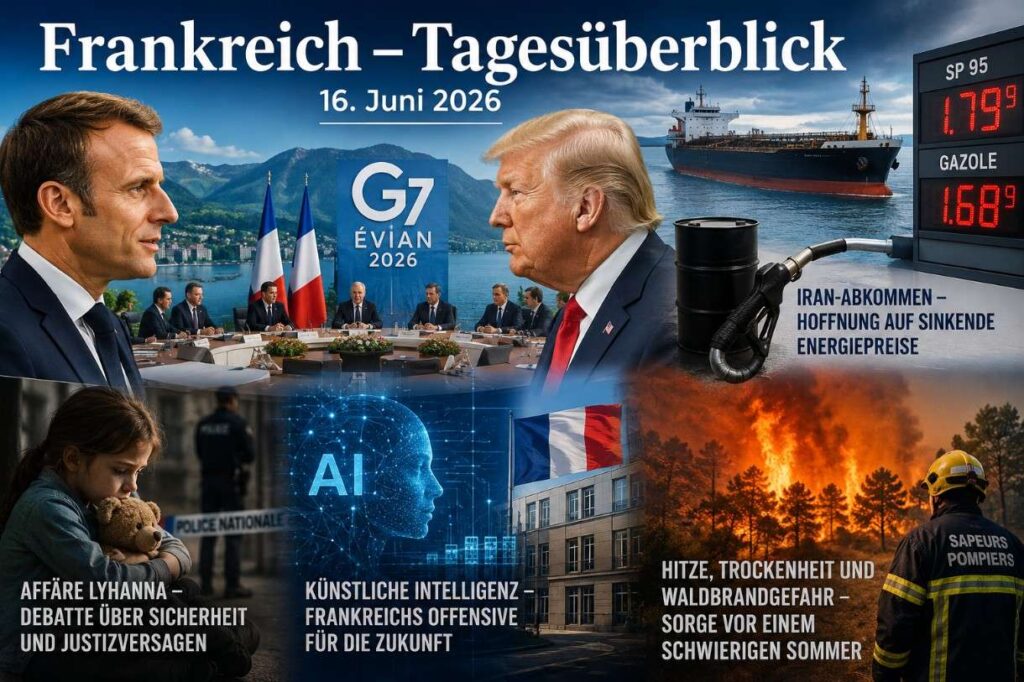
On June 16, 2026, France is experiencing an exceptionally news-packed day. International diplomacy, hopes for energy changes, domestic political disputes, and technological issues of the future dominate both major daily newspapers and regional media. It is striking how closely global events and national discussions are connected. Five topics stand out particularly clearly in today’s news.
G7 Summit in Évian sets the agenda
The central topic of the French media is undoubtedly the G7 summit in Évian-les-Bains. As host, France is trying to strengthen its diplomatic role on the international stage. President Emmanuel Macron is using this meeting to position France as a mediator and creator in an increasingly fragmented world order.
At the center of discussions are several geopolitical crises and strategic questions for the future. These include the implementation of the US-Iran memorandum following recent tensions in the Middle East, the reopening of the Strait of Hormuz, continued support for Ukraine in the war against Russia, as well as economic relations with China. Added to this is the regulation of artificial intelligence, which is taking a place as important as traditional security and trade issues for the first time.
Special attention is paid to the conversations between Emmanuel Macron and Donald Trump. Many commentators consider this an important indicator of the future course of transatlantic relations and Europe’s ability to find a balance between US interests and its own strategic goals.
Hope for de-escalation in energy markets
Closely related to the G7 summit is the situation in relations between the USA and Iran. The prospect of stabilizing the situation in the Persian Gulf attracts great attention in France.
A particularly important factor for global energy markets is the possible reopening of the Strait of Hormuz. Since a significant portion of the world’s oil trade passes through this maritime passage, a reduction in geopolitical risks could lead to stabilization of oil prices.
For France, this issue has direct political significance. High fuel prices in recent months have burdened both consumers and businesses. Therefore, many media outlets are discussing whether there will be noticeable relief at gas stations in the near future. At the same time, it is emphasized that price decreases usually reach consumers more slowly than increases.
The Lianne case intensifies security discussions
At the domestic political level, the Lianna case remains one of the key topics. Coverage of the issue is increasingly focusing on potential institutional failings related to the crime and on the question of whether the authorities or courts could have intervened earlier.
The discussion encompasses several politically sensitive areas. These include the protection of minors, the effectiveness of judicial procedures, the cooperation of state institutions, as well as political responsibility in dealing with known high-risk cases.
Practically all political camps are trying to use the case for their arguments. The government points to institutional improvements, while opposition parties demand deep reforms. There is particularly lively debate about whether this case could have a lasting impact on public perception of safety and the ability of state bodies to act effectively.
Several political experts also see the possibility that parties with a strong focus on internal security may gain additional political momentum. The debates have gone beyond the specific case and touch on fundamental issues of trust in government institutions.
Artificial intelligence is becoming a strategically key technology
In addition to classic political topics, discussions about artificial intelligence are taking up more and more space. France has ambitious plans to develop its technological competitiveness and strengthen Europe’s digital sovereignty.
The announced investments in research, infrastructure, and administration are actively analyzed by the press. Three key questions are at the center of attention: will France be able to compete globally with the USA and China? How can abuses, manipulation, and disinformation be prevented? What impact will technological changes have on jobs and public services?
The planned increased use of AI in public authorities is especially controversial. Supporters point to increased efficiency and acceleration of administrative procedures. Critics warn of a lack of transparency, risks to data protection, and possible errors of automated systems.
The fact that this topic is also on the agenda of the G7 summit underlines its growing geopolitical significance. Technological leadership is increasingly seen as a component of national power and economic competitiveness.
Dry Weather and Fire Danger Heighten Concerns
Devoid of major political debates, the focus of many regional media is directed at the weather. Many regions of France are already experiencing abnormally dry conditions for this time of year.
Following several fires in forests and vegetation in recent weeks, concerns are growing about a challenging summer season. The most affected regions are in the south and west of the country, but other parts are watching developments with increasing attention as well.
Firefighting teams and local authorities warn about the combination of drought, high temperatures, and partly strong winds. These factors can significantly increase the risk of large fires. At the same time, discussions are ongoing about the long-term consequences of climate change, which make extreme weather events and prolonged dry periods in France increasingly likely.
Recent years’ experience shows that forest fires have long ceased to be a problem only for the Mediterranean region. Even regions that were previously considered less vulnerable now have to prepare for new climate challenges.
Thus, France is experiencing a day when international crises, economic expectations, social conflicts and questions about the future all simultaneously influence public discussions. The G7 summit in Evian is undoubtedly at the center of attention, but there is also focus on the Lianna case, the government’s AI strategy, and concerns about the hot, dry summer — all of which indicate the multifaceted nature of the country’s current challenges. The French press creates an image of a state that is simultaneously dealing with global shifts in power, technological transformations, and domestic political tensions.
Author: P. Tiko