
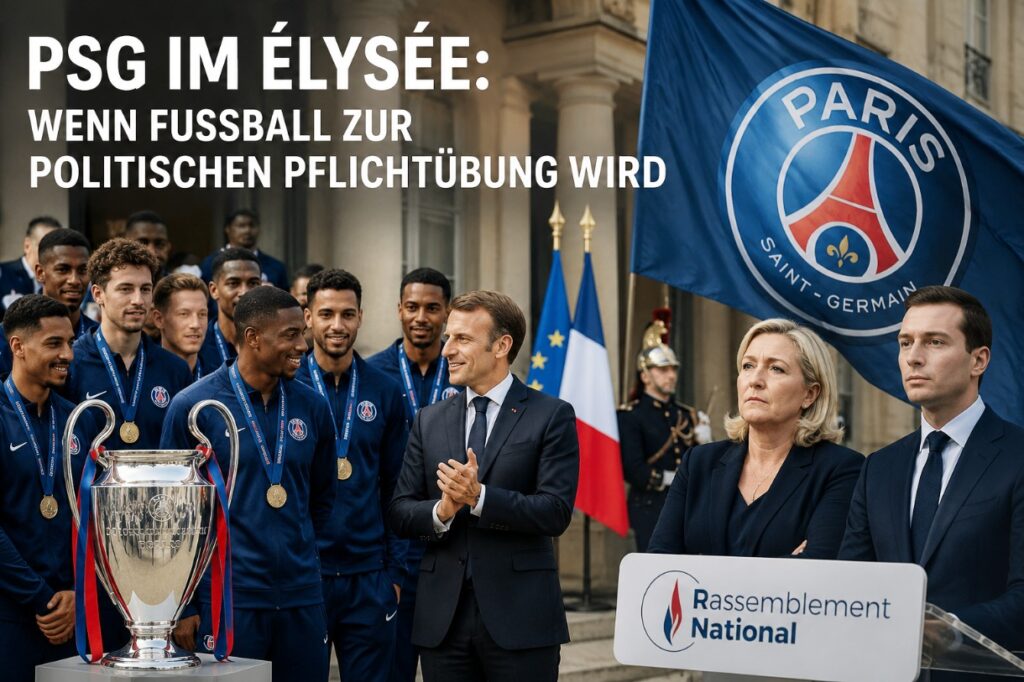
Paris Saint-Germain being welcomed at the Élysée Palace confirms a development that has become clear for many years. It is that football in France is no longer just a sport. After the Paris club won the Champions League for the second time, President Emmanuel Macron once again welcomed the team at the presidential residence. This is similar to what happened during their first European triumph. Such a gesture is no longer merely a courtesy. Rather, it reflects the special role football plays in French political life.
For politicians, it has become almost impossible to distance themselves from football. This sport provides what politics constantly demands: an image of unity, collective emotion, and a clear national narrative. Millions of people watch the same match, experience the same moments of excitement or disappointment, and share the same symbols. There are few other social phenomena with such broad influence.
Emmanuel Macron had foresaw these developments early on. Although he traditionally considers himself a fan of Olympique Marseille, he fully understands the political luster that PSG’s European title win carries. For the president, a French club reaching the pinnacle of European football provides an opportunity to speak of national recognition and pride without being suspected of partisan political performance. Thus, the club’s success is seen as France’s success.
At the same time, being close to football has become an obligation for politics. Top politicians are expected to attend major sporting moments, celebrate the winning team, and publicly demonstrate that success as their own. Refusing to do so risks being viewed as out of touch or unemotional. In this way, football has become an important part of political communication.
However, the popularity of sports also comes with risks. Behind great victories, there are often shadows cast by riots, vandalism, and clashes. Political leaders need to strike a balance. While celebrating the enthusiasm, they must guarantee order and safety. After the recent PSG victory, Macron expressed clear condemnation of the violent acts that occurred around the celebrations alongside words of congratulations.
On the other side of the political spectrum, Rassemblement National takes a different approach. Marine Le Pen and Jordan Bardella focus more on the negative aspects of the large-scale celebrations than on the excitement of sports. For them, it is not the image of success but rather images of chaos, destruction, and security issues that come to the forefront. This stance perfectly aligns with the party’s political strategy, which centers the message on social order and internal security.
Here, fundamental differences between political camps are shown. The ruling and centrist forces actively attempt to utilize the unifying power of soccer. They present sports as an expression of the national community and social cohesion. On the other hand, the Rassemblement National focuses on the shadowy side of such large events, appealing directly to citizens who are affected by the public unease resulting from them.
Soccer has thus become a political stage where different narratives compete. For Macron, it is a symbol of national unity and international influence. For the National Rally, the same events serve as evidence of deficiencies in security and public order. Both base their messages on the same events, yet arrive at completely different political messages.
This is precisely the core political significance of modern soccer. Soccer is not merely entertainment, but provides a projection surface for social debates about identity, cohesion, safety, and the representation of the nation. The ball no longer just rolls on the grass. It moves across the French political stage and has become an indispensable element in the public staging of power, community, and conflict.
Author: P. Tiko