
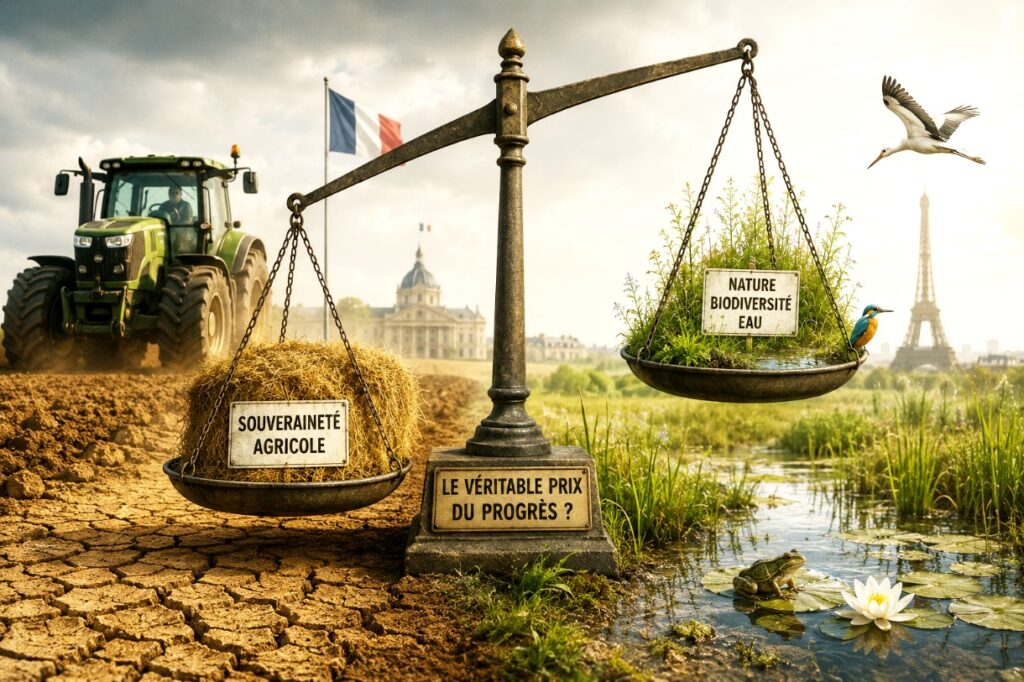
France has a new favourite phrase: “food sovereignty”. It conjures up independence, autonomy and national strength. Who could be against that? It is natural to want food grown in one’s own backyard rather than imported from abroad.
The government’s answer is extremely simple. When farmers protest, it relaxes the rules; if farmers can protest even more, it relaxes them a little further. And if wetlands disappear, rivers run dry, or animal species lose their last refuges in the process—well, nature does not block motorways or dump rubbish in front of ministries.
The greatest tragedy of this new agricultural law is not in its individual provisions. It is in its message. France is suddenly behaving as though it is being forced to choose: agriculture or the environment. Food or biodiversity. Farmers or beavers.
What a ridiculous false dichotomy.
Because nature is not agriculture’s enemy. It is its prerequisite. Without water, there is no harvest. Without pollinating insects, fruit trees bear no fruit. Without healthy soil, food sovereignty is impossible. Those who saw off the branch they are sitting on should not complain when they eventually fall.
What is particularly noteworthy is the political speed of this change in direction. For years, the public had been told that climate change was the greatest challenge of our time. That protecting biodiversity was essential. That water would become the most valuable resource of the century.
But after farmers’ protests continued for several months—suddenly politics seemed to realize that environmental regulations had apparently been little more than superficial decoration.
Nature has a structural problem. It has no lobbying like tractor convoys. Frogs do not march on Paris, nor do wetlands blockade regional government offices. Bees do not organize general strikes. They simply disappear—quietly and persistently.
Unfortunately, that is also their political weakness.
Thus, a law intended to support agriculture has turned into a document of political surrender. Not surrender to farmers—their concerns are often legitimate. But surrender to the idea that short-term conflicts can be resolved by worsening long-term problems.
Today, France is celebrating agriculture. That is understandable. But one day the price will come due. And then it may become clear that food sovereignty over parched fields is a concept no more convincing than sailing without water.
Nature makes no demands. It creates no petitions and does not vote.
It simply reacts. And its judgment is final.
Comment: C. Hatty