
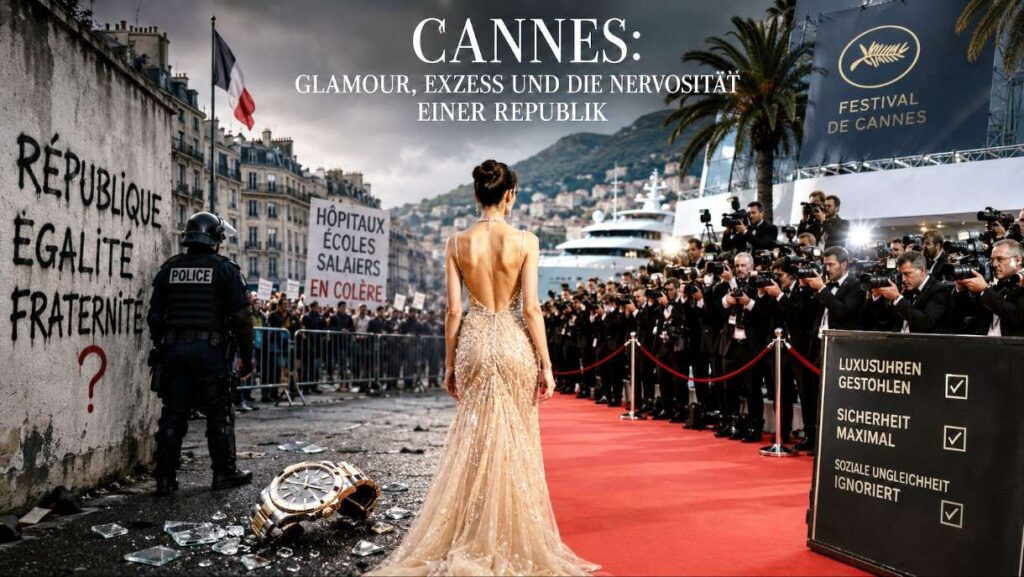
There are few places that represent France in 2026 as accurately as this. The Croisette in Cannes is exactly that. While ministers in Paris discuss austerity measures, explain fuel prices, and justify new fiscal deficits, influencers on the Côte d’Azur walk proudly down the red carpet with diamond-studded handbags, guarded by heavily armed police officers. Cannes is no longer just a film festival. It has become a political symbol and perhaps the most honest mirror reflecting the modern face of France.
At first glance, it looks like the usual scene of champagne receptions, designer dresses, super yachts, and luxury hotels. The international elite celebrate their self-indulgence amidst flashes and decadence. But behind that glitter almost tangible tension lingers. France appears like an old nobleman, showing himself to the world once more in his finest tuxedo, even though the walls of his castle have begun to crack.
The security system around the festival now resembles a mix of a high-security zone and a military parade. Roads are blocked off, bags are inspected, and cameras monitor every corner. The reason is clear. The theft of luxury watches is so characteristic of Cannes that after each festival, reports of stolen models like Richard Mille, Rolex, and Patek Philippe are nonstop. This crime is not just a mere footnote to a criminal case but has become part of the spectacle. Luxury goods attract their own shadows.
France at this time seems like a country that wants to simultaneously show off and hide.
While the president and ministers call for social unity in Sunday speeches, Cannes shows a different reality. Namely, a society where the upper class continues to live in isolated zones, while outside, anxiety is growing. This might almost be called feudalism under a republic. Inside, caviar, haute couture, cryptocurrency. Outside, alarms, social tension, and a state increasingly struggling to cope.
What makes this scene even stranger is the presence of social media mechanisms everywhere. Today’s Cannes can no longer be called a film festival, but rather a global content factory. Actors, models, and influencers, almost without rest, create images of artificial perfection that have almost no relation to the reality of many French citizens. It is as vast a difference as that between the Palace of Versailles and the suburban housing areas of Marseille.
The film itself often plays a secondary role. What matters is not the cinema, but visibility. Who wore which dress? Who kissed whom on which yacht? Who posted the moment that became the topic of the night? Cannes is exactly a time-lapse of modern France. It is the image of a nation obsessed with self-observation, barely able to solve any structural problems.
Of course, France has always been a country of staging. Louis XIV understood the power of spectacle better than any modern communication consultant. Great nations have always flourished by the myth of cultural superiority. But in the past, there was at least a political or economic foundation behind that staging. Now, it often seems that only the set remains.
Because alongside the splendor, social exhaustion is increasing. National debt continues to grow, public services are under pressure, and schools and hospitals suffer from chronic funding shortages. In many suburban areas, there is a prevailing sense of permanent detachment from the promise of the republic. Yet Cannes sends the same message every year: that France wants to keep shining no matter what.
Therein lies the real tragedy.
Cannes is not just a symbol of wealth. It reflects an extreme fear of losing meaning. France clings to its position as a cultural superpower, while economically and geopolitically it is losing influence. Thus, this festival has become like a labyrinthine mirror reflecting the country’s distorted image. Beautifully lit but containing many distortions.
Ironically, while the government debates austerity and preaches moderation to its citizens, suites costing tens of thousands of euros a night are booked in Cannes, and while labor unions protest social hardships, tech billionaires celebrate on megayachts along the coast. While the interior minister sounds the alarm over rising crime, stars pose in public wearing expensive jewelry worth more than the annual income of many French people.
That is precisely why Cannes is not just a festival. It is a symbol of Western modernity, but in France, this symbol appears particularly sharp. Perhaps because the country has historically idealized the embodiment of equality and social dignity, the contradictions there feel more intense than elsewhere.
In Cannes, one can see a France that can no longer fully believe in itself. A country that must not only be admired but also defended. Behind the red carpet are security barricades, behind the luxurious appearance lurks the fear of downfall, and behind Instagram posts lies a desperate wish to maintain presence.
Perhaps this explains the unique atmosphere of these days on the Côte d’Azur. A mixture of beauty and tension, uncertainty and wealth, glamour and latent crisis.
Cannes still shines today. But that shine is like a precious vase already fractured with fine cracks.
Comment by Andreas M. Brucker