
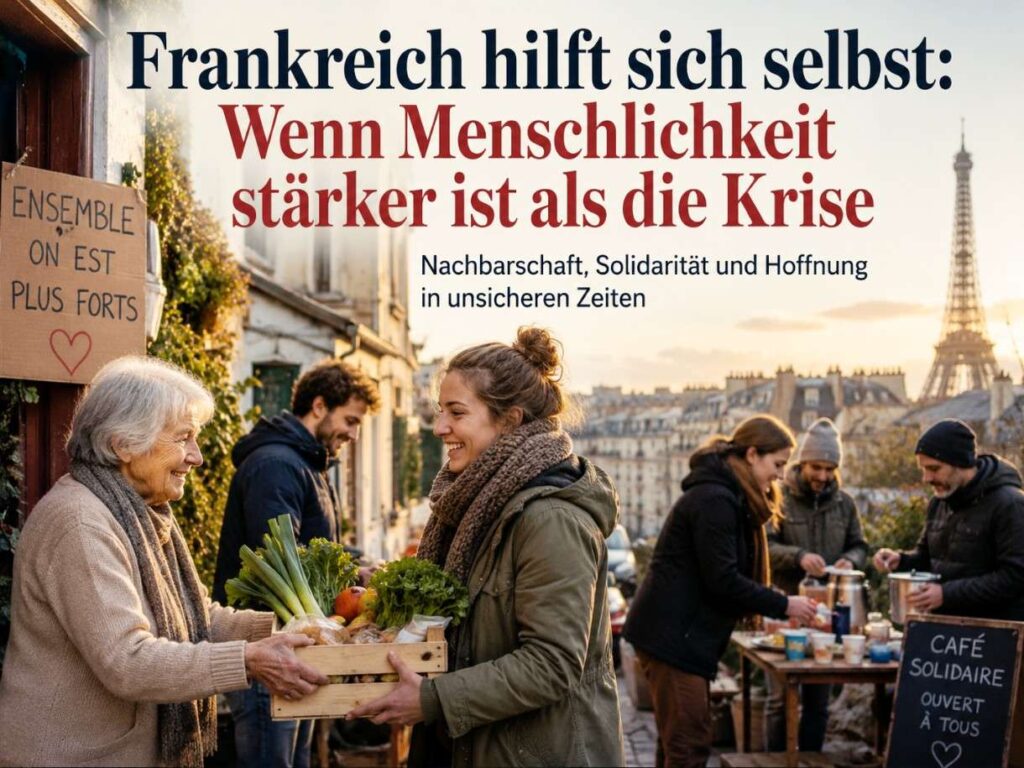
In an era marked by constant crises, wars, and anxieties, such news has become rare. For several years, inflation, social tensions, geopolitical conflicts, and economic instability have dominated public opinion. Many people have become accustomed to waking up every morning to bad news and going to bed each night with new concerns.
Amid all this, a movement quietly and almost imperceptibly progressing in France is precisely why it is very important. It is that people are helping each other again. Not out of obligation, nor because the state organizes it. But because everyone has recognized that no one can get through this unstable time alone.
It is a quiet return to humanity.
Small kindnesses that suddenly grow large
There are those who are barely mentioned in major political debates: people who take their neighbors shopping, students who provide free meals, those who care for elderly villagers, and people who look after children for single parents.
Yet, it is precisely here that France’s hope lies.
In apartment complexes, carpooling has emerged, and strangers exchange furniture, clothing, and household appliances. Young families plan joint purchases to save money, students help elderly people with digital paperwork, and in return, the elderly provide warm meals. In many neighborhoods, people have suddenly started to know their neighbors’ names again.
These are modest scenes, but precisely for that reason, they resonate deeply.
Because they contradict the image of society as being individualistic, nervous, and self-centered.
Crisis Changed People
France has experienced harsh times. The pandemic left deep scars. Afterwards, inflation, soaring energy prices, political tensions, and fears of a decline in social status followed, causing many to lose faith that prosperity automatically means security.
However, crises do not necessarily only change society for the worse. Sometimes, they remind people what really matters.
Suddenly, the value of time became more important than consumption, intimacy became more important than status, and mutual aid was prioritized over competition.
The past few years have shown many French people the fragility of modern life. How easily a life once thought stable can be shaken. From this, something that may have long been lost has emerged: genuine compassion.
Those who have experienced anxiety themselves can recognize the anxiety of others more quickly.
A society that refuses to harden
What is particularly moving is that this solidarity comes from people who have almost no possessions of their own. It is not the wealthy who support social life in many places, but those who know how difficult everyday life is.
Elderly people sharing meals despite living on small pensions, workers giving neighbors free rides to work, students sharing their last pasta, bakers distributing leftover bread for free at night.
These actions may not be flashy, but they tell something fundamental about France.
Despite political tensions, anger, anxiety, and social exhaustion, some citizens refuse to be stained by cynicism and sarcasm.
Here may lie the most important news of our time.
The return of the consciousness of “us”
For many years, the prevailing feeling was that “everyone must fight alone.” Careers, competition, meritocracy, and rising living costs created a daily life with little room for community.
However, slowly something new or very old is beginning to emerge.
People are rediscovering the value of community. Not as a political theory, but as a practical reality of life. Because they have realized that social warmth can become more important than economic success in times of crisis.
This change cannot be measured by growth rate figures, nor does it appear in the European Central Bank’s statistics. However, in the long term, it may become more important than many economic reform programs.
Society first collapses not because of inflation or crisis, but when people stop caring about each other.
Contemporary France shows the opposite.
Perhaps hope begins here
Of course, mutual help does not solve the country’s major problems. It does not replace effective social policies, fair wages, or affordable housing. Many people are still fighting insecurity in their lives.
However, something long thought impossible in this anxiety is happening. People are beginning to trust each other again.
Perhaps that is truly positive news.
Not everything suddenly got better. But many French people have not lost the power of solidarity despite difficulties.
In a world full of aggression, social coldness, and constant anger, this feels almost revolutionary.
Maybe hope starts not with a big political speech, but with a warm meal to a neighbor, a carried home shopping bag, a listening ear, and people telling each other, “You are not alone.”
And in the end, that may be stronger than any crisis.