
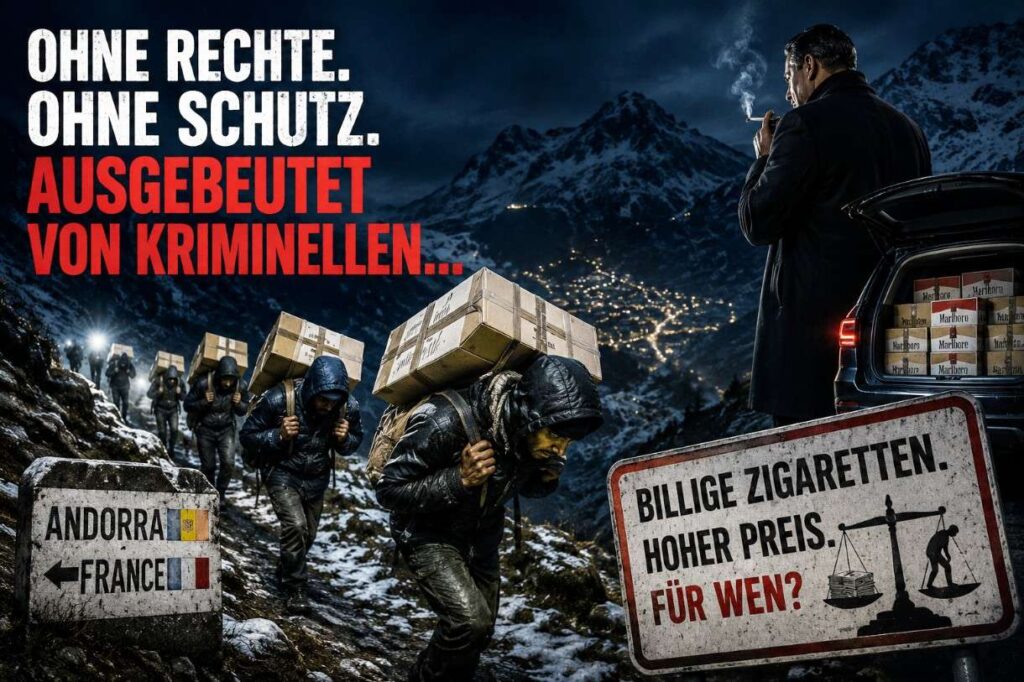
No rights.
No protection.
No voice.
But at least, enough strength to carry a pack of cigarettes on a mountain path at night. Welcome to modern Europe in 2026.
People walking through the cold of the Pyrenees, on rocky paths, carrying goods like donkeys of old—just so cheap cigarettes can pass the counters somewhere in Marseille or Toulouse. And while criminal organizations earn millions, the couriers are left with only what always remains in such a system: fear, silence, and replaceability.
One drops out?
The next one just comes.
I want you to really taste this perversion. Political debates often speak about “migration” as abstract numbers or administrative documents. But behind these words are people so desperate they carry smuggled goods over high mountains at night. Because some smuggler promised them a little money or vague hope.
And of course, suddenly everyone shows moral outrage. Politicians say they are “upset,” authorities call it a “major blow to crime.” Probably soon there will be press photos in front of maps and a few solemn words about European cooperation.
What a thing.
The smuggling group is dismantled. But the system behind it continues to live vigorously.
Because the truth is uncomfortable: these kinds of networks do not arise from nothing. They flourish where people are completely unprotected and there is a demand for cheap goods. The market regulates everything—even the exploitation of human despair. Does that sound harsh? But this is reality.
What is particularly ironic is the social double standard. The same people who consider cheaper cigarettes “practical” later express outrage about criminal organizations. As if the black market was established just for fun. But consumption, price differences, and organized crime are more closely connected than many are willing to admit.
And amid all investigative records, what ultimately disappears once again is what matters: the human being.
Not cardboard boxes.
Not tax losses.
Not diplomatic cooperation.
Human beings.
Immigrants who cross mountains at night, freeze, collapse, and might never be seen again, with names unknown—existing so that others can save a few euros and criminals can count their profits.
The truly frightening thing about this story is not smuggling itself. Smuggling has existed in all eras. What is frightening is how quickly the people of Europe are made into commodities again within the system. Interchangeable, invisible, and convenient.
Almost as it was in the old days. Only now together with modern logistics.
Comment by C. Hatty