
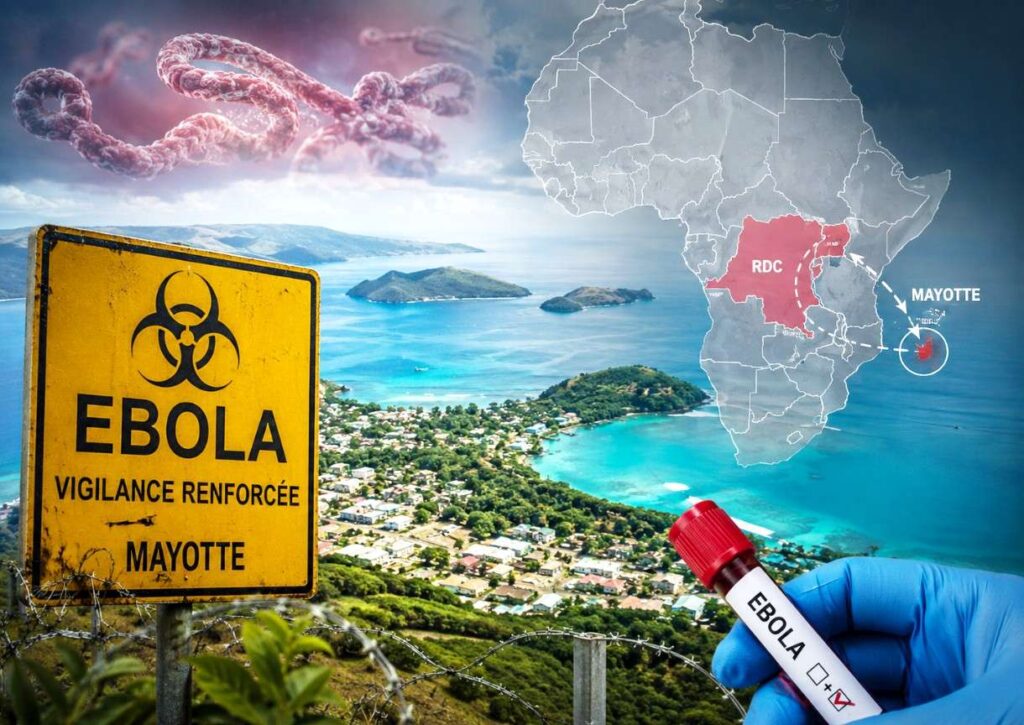
French health authorities are increasingly concerned about the Ebola outbreak in Central Africa. In particular, attention is focused on the overseas territory of Mayotte, with many experts believing that due to its geographical location and structural weaknesses, the area may be vulnerable. Although no Ebola cases have been recorded on the island so far, discussions about prevention, border control, and the resilience of the local healthcare system have gained new political sensitivity.
The concern arises from the current Ebola outbreak in parts of Central Africa, especially the Democratic Republic of Congo and Uganda. The World Health Organization assesses the situation as serious and is monitoring its spread with increased attention. The background is the spread of a particularly dangerous virus variant, which virologists believe has a higher epidemic potential.
Fragile Health System on the Edge of Europe
Mayotte has a special status among French overseas territories. This archipelago located in the Indian Ocean legally belongs to France and is therefore part of the European Union, but has suffered from severe infrastructure problems for many years. The healthcare system has long been overloaded, water supply is unstable, and the sanitary conditions in many informal settlements are very poor.
These structural deficiencies exacerbate concerns: a single imported case of Ebola could be difficult to control. French infectious disease expert Xavier Lescure has publicly warned against underestimating the risk. He points out that the key is to interrupt possible chains of infection at the “source” and to identify suspected cases early.
The French cabinet is trying to avoid causing panic. The Ministry of Health emphasizes that there is currently no imminent threat in Mayotte. However, authorities “maintain continuous communication with experts” and constantly assess the risk of virus importation.
Migration and Health Risks
The geographic location of Mayotte exacerbates the authorities’ sensitivity. The island is situated between the East African coast and the Comoros Islands, along an important migration route in the Western Indian Ocean. For years, this French territory has recorded a large number of irregular migrants, especially from the neighboring Comoros Islands.
Therefore, Paris fears that future health policy risks may become increasingly closely linked to migration flows. However, experts warn against hastily labeling Ebola as an “immigrant disease.” Past epidemic experience shows that the greatest risks usually do not come from individual travelers, but rather stem from delayed detection, inadequate medical infrastructure, and a lack of international coordination.
The West African Ebola outbreak from 2014 to 2016 still sends warnings today. International organizations’ data show that more than 11,000 people died at that time, mainly concentrated in Guinea, Liberia, and Sierra Leone. This epidemic exposed the severe deficiencies in the healthcare systems of many African countries — and also the slow international crisis response.
Political Pressure from Mayotte
At the political level, this issue is also becoming increasingly important. Member of Parliament Estelle Youssouffa has sharply criticized France’s current preparations. She points out that Mayotte “cannot stand on the front line of defense against this dangerous virus” and emphasizes the already tense situation on the island.
In fact, Mayotte has long been in a state of overlapping crises for months: high poverty rates, rapid population growth, water scarcity, and overburdened public administration. Security and health issues are gradually intertwined with social conflicts and migration policy debates.
For the Paris government, this is a sensitive issue. President Emmanuel Macron has pledged multiple times in recent years to strengthen Mayotte’s infrastructure and enhance the state’s presence. But progress remains unclear in many areas.
France Between Prevention and Reassurance
The French authorities are currently adopting two parallel strategies: on the one hand, strengthening monitoring and early detection; on the other hand, avoiding causing unnecessary panic. Health checks, epidemiological surveillance, and the preparedness of medical institutions are the focus of current measures.
Many experts still consider the probability of a large-scale Ebola outbreak within France to be low. Advanced isolation procedures, improved diagnostic techniques, and international warning systems have greatly enhanced response capacity. Nevertheless, discussions around Mayotte show that global health issues today are deeply intertwined with geopolitics, social, and immigration policy challenges.
The COVID-19 pandemic has also strengthened the awareness that even geographically distant health crises can quickly have international impacts. Therefore, authorities are now particularly sensitive to potential epidemic risks—especially in areas with fragile infrastructure.
The current discussions about Ebola around Mayotte mainly still concern precautionary scenarios. But the present warnings indicate that Europe’s peripheral regions remain vulnerable in the face of global health crises. For France, this island in the Indian Ocean is not only the focus of immigration policy but is increasingly becoming a touchstone for testing the resilience of national public health in the 21st century.
P.T.