
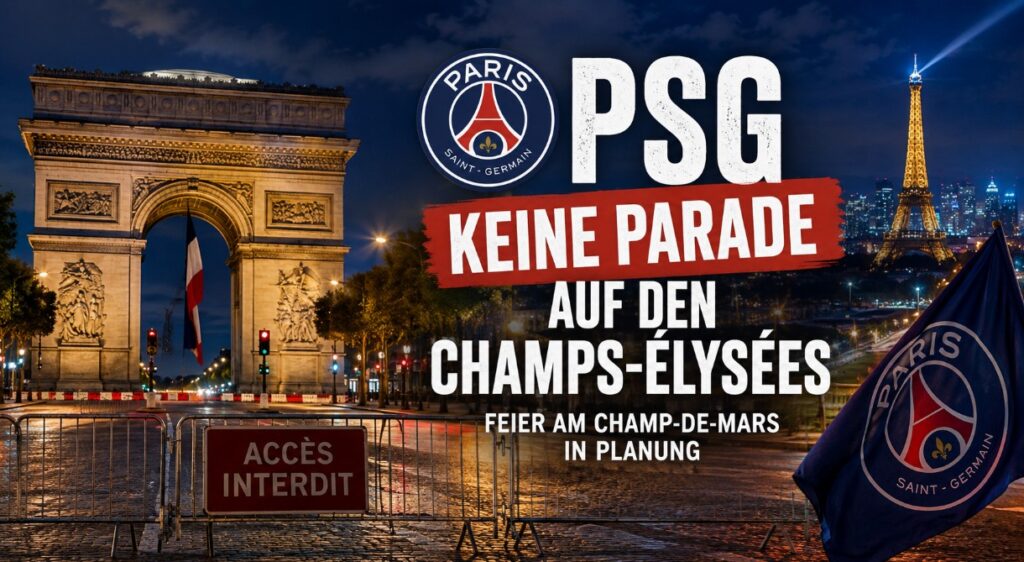
Paris loves its football nights. When Paris Saint-Germain Football Club advances to the European finals, the entire city seems electrified. Cafés stay open late into the night, convoys of cars honk their horns as they drive through the avenues lined with trees, and at every street corner people discuss, curse, and anticipate. On the eve of the UEFA Champions League final against Arsenal Football Club, the French capital’s attention is once again focused on a potentially historic night. However, one thing has already been decided before kickoff: there will be no victory parade on the Champs-Élysées this time.
This decision seems to be a small political signal amid the football frenzy.
Despite the images of celebrating crowds circulating worldwide after winning the 2025 European Championship, the city government and police department have clearly hit the “brakes” at this moment. If Paris Saint-Germain wins, France’s most famous avenue will not be empty, but an official team parade is ruled out. Instead, the authorities plan to implement extensive security measures. As early as Saturday afternoon, a parking ban will be enforced around the Champs-Élysées, followed shortly by road closures and traffic restrictions until later Sunday evening.
This sounds very calm, almost with a technocratic flavor.
And that is exactly the message behind it.
Paris wants to celebrate—but in an orderly manner.
Memories of past football nights are still vivid. Not all spontaneous celebrations end peacefully; some scenes have escalated to situations even experienced law enforcement officers struggled to handle. Broken bus stop signs, looted shops, burning trash bins — these images have influenced France’s perspective on security policies for major events. Football stirs emotions and sometimes brings chaos. Especially the Champs-Élysées is often seen as a nerve center: highly symbolic, crowded with tourists, and difficult to control.
Therefore, those responsible are apparently considering moving the celebrations to Place du Trocadéro beneath the Eiffel Tower. Access and exit there are easier to manage, and security zones are clearer. This arrangement is more like a festival site rather than a spontaneous public revelry. Some fans may be displeased, but others believe: “This is better.”
Because the enthusiasm for Paris Saint-Germain remains immense.
For years, the club has strived to rank among Europe’s football elite. Domestic championships have become almost routine, but the Champions League carries almost mythical significance for Paris. Every time they reach the final, it carries the weight of historic mission. Facing Arsenal means confronting an opponent that also craves European glory — traditional, tough to handle, and tactically dangerous.
In bars around Belleville, Saint-Germain, or Montmartre, the conversation is almost always about this match. “If they win, the whole city will go crazy,” a café owner near Place de la République said with a smile. Then he grew serious, “But maybe this time Paris really needs more order.”
Currently, the capital is walking a line between these two extremes: passion and control, football celebration and safety considerations.
Therefore, canceling the Champs-Élysées parade is not just an organizational decision. It demonstrates the extent to which major sporting events today are influenced by political and security factors. Even the celebrations begin to follow a set procedure.
However—if Paris Saint-Germain lifts the trophy again, Paris is unlikely to sleep peacefully that night.