
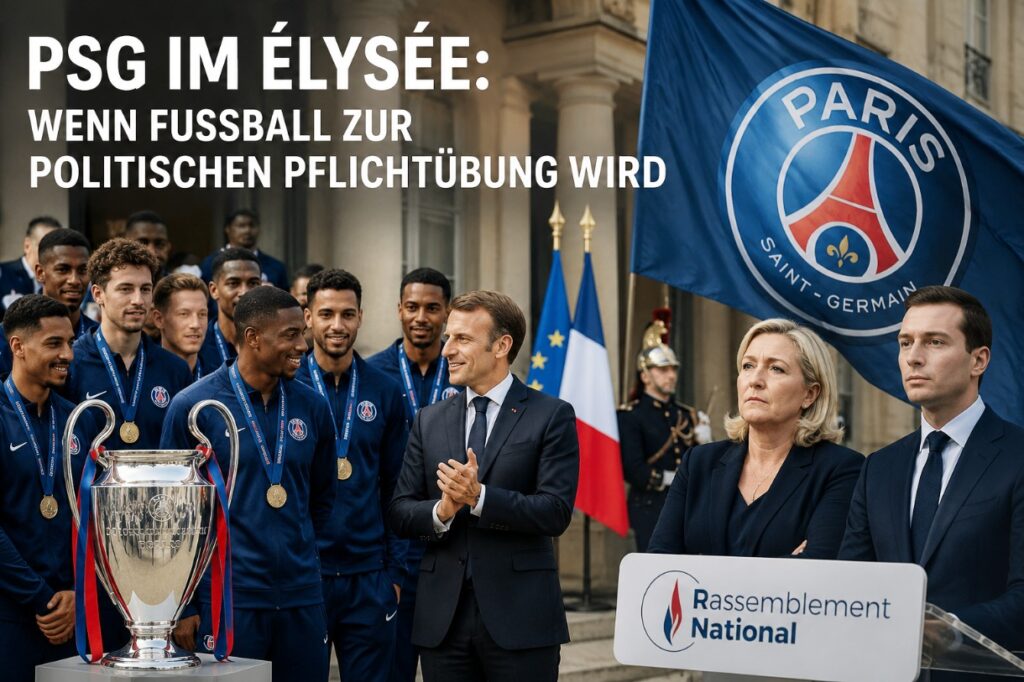
Paris Saint-Germain’s reception at the Élysée Palace confirmed a trend that has been ongoing for years: football in France has long been more than just a sport. After the Paris club won the Champions League for the second time, President Emmanuel Macron once again received the team at the presidential residence—as he did when they first won the European championship. Today, such gestures are no longer merely formal courtesies but reflect the special role football plays in French political life.
Politicians can hardly keep their distance from football nowadays. Sports provide something politics constantly seeks: images of unity, collective emotions, and easily understandable national narratives. Millions of people watch the same game, experience the same moments of ecstasy or disappointment, and share the same symbols. Few other social phenomena achieve such widespread influence.
Emmanuel Macron recognized this dynamic early on. Although he is traditionally seen as a supporter of Olympique de Marseille, he understands the political impact of Paris Saint-Germain’s success in European football. With a French club at the pinnacle of European football, the national president can speak of national recognition and pride without immediately being suspected of partisan performance. The club’s success is thus framed as France’s success.
At the same time, this closeness to football has also become an obligation for politics. Senior politicians are expected to accompany important sporting moments, congratulate the winners, and publicly endorse these successes. Those who refuse to do so risk being seen as aloof or lacking in feeling. Football has thus become a fixed component of political communication.
However, the popularity of sports also brings risks. Major victories are often accompanied by riots, property damage, or conflicts. The political leadership thus faces the challenge of balancing: appreciating enthusiasm while ensuring order and security. After Paris Saint-Germain’s recent victory, Macron expressed congratulations but also clearly condemned the violence that occurred during the celebrations.
At the other end of the political spectrum, the National Rally party has adopted a different strategy. Marine Le Pen and Jordan Bardella focus more on the negative impacts of mass celebrations rather than the excitement of sports. For them, the focus is not on images of success but on scenes of chaos, destruction, and security issues. This stance seamlessly aligns with the party’s political strategy of placing social order and internal security at the core of its messaging.
This reflects a fundamental difference between political camps. The ruling party and centrist forces try to harness football’s unifying power, presenting the sport as an expression of national community and social cohesion. Meanwhile, the National Rally party focuses more on the darker side of large events, appealing to citizens directly affected by public disturbances.
Football thus becomes a political stage where different narratives compete. For Macron, it symbolizes national unity and international influence. For the National Rally, the same event becomes evidence of the lack of national security and public order. Two interpretations based on the same event, yet conveying completely different political messages.
The political significance of modern football is reflected here. It not only provides entertainment but also becomes a platform for social discussions about identity, solidarity, security, and national representation. Football is far more than just a ball rolling on the pitch; it is active on the French political stage, becoming an indispensable part of the public display of power, community, and conflict.
Author: P. Tiko