
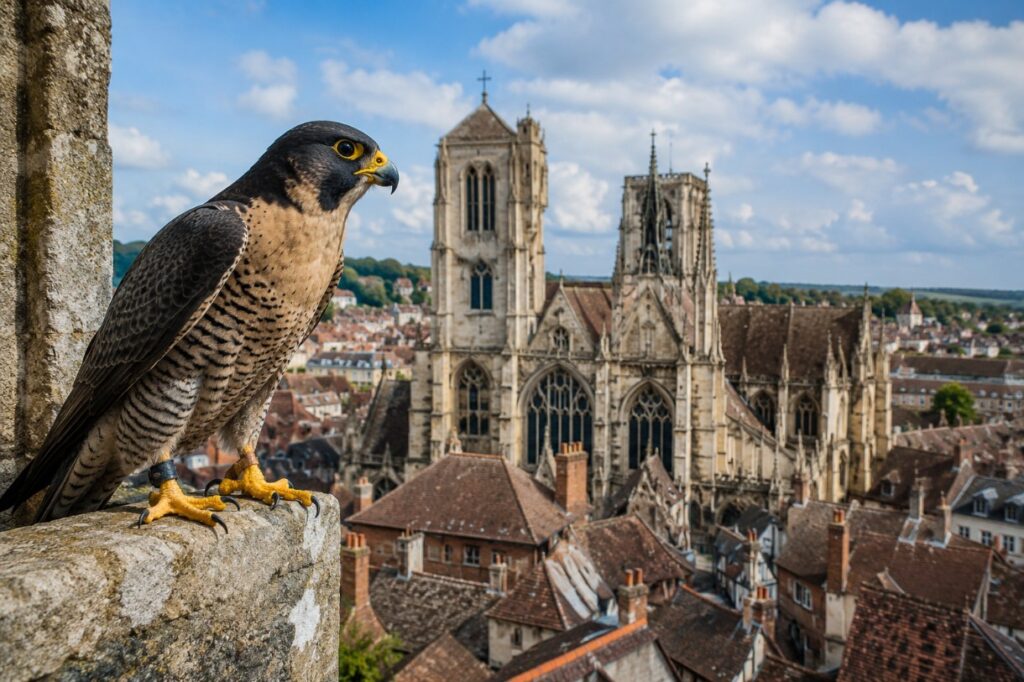
For a long time, the city center has been the domain of pigeons. They roost on eaves, surround the train station, fly over the market, and have turned historic buildings into their private residences. In many French cities, this is almost considered a natural law. However, in Troyes, another shadow now drifts across the sky: the silhouette of the peregrine falcon.
This shadow breaks the existing order.
A pair of falcons now officially roosts on the city’s large cathedral. At heights of over forty meters, a nesting box has even been installed. At first glance, this seems very romantic—as if it were a small wild return between the Gothic bell tower and the ancient roof. But in fact, there is harsh urban politics behind it.
Because pigeons cost money to maintain. A lot of money.
Their droppings corrode stone walls, dirty the squares, and damage historic buildings. Local governments invest huge sums every year in cleaning and maintenance. Especially in cities with protected historic monuments, these costs accumulate very quickly. Under such circumstances, the idea sounds very reasonable: why not introduce their natural predators?
The peregrine falcon is an excellent choice. It is regarded as one of the fastest hunters in the world, and its mere presence is enough to disturb the pigeons’ peace. Experts call this the “deterrent effect.” These birds constantly sense danger, change flight paths, and gradually leave certain areas. No large-scale capture is necessary, nor controversial sterilization programs—in nature, the problem solves itself. It’s actually very clever.
What is especially remarkable is the story of this return. In the 1970s, peregrine falcons were almost extinct in France. Pesticides and habitat destruction drastically reduced their numbers. And now, this raptor has precisely re-chosen the city. Biologically, this makes sense too: towering cathedral bell towers, modern skyscrapers, or industrial facilities resemble the cliffs where they used to nest.
The city has replaced the mountains.
Some citizens watch the falcons with almost childlike enthusiasm. Ornithologists stand in the squares with binoculars, family members suddenly stop in front of the cathedral and look up at the sky. Such scenes have also changed people’s perspective on the city. Between asphalt, vehicles, and concrete, people once again feel that nature exists not only in the countryside.
Perhaps this is its true charm. The peregrine falcon is not just an elegant pest controller. It symbolizes a new urban concept—a city that no longer completely excludes animals but tries to coexist with them.
And what about the pigeons?
They gradually realize that the sky above Troyes no longer belongs solely to them.
Andreas M. B.