
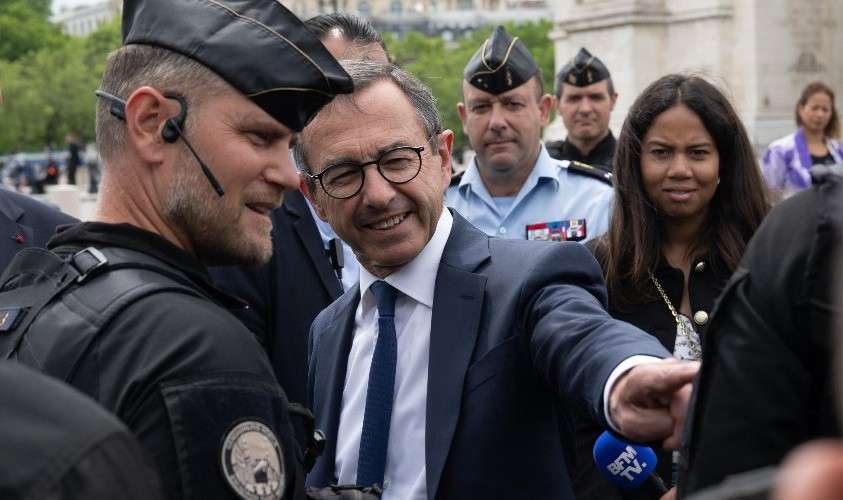
The French right-wing camp has long since made its decision — but the real contest is only just beginning. Bruno Retailleau has been officially nominated as the Republican presidential candidate for 2027, and although this is a formal threshold, from a political standpoint the task facing conservatives is more difficult: to reintegrate themselves within a fragmented party system.
A clear but limited-impact decision
At first glance, the result seems very clear. About 73% of party members support directly appointing Retailleau as the candidate, without a primary election. The party organization consciously gave up a tool that a few years ago was seen as a democratic advancement.
The experiences from the 2016 and 2021 primaries left a deep impression. Internal power struggles, damaged candidates, and lack of unity became the main reasons for the marginalization of the civic right. Therefore, opposing another “primary” reflects more strategic caution than a display of strength.
But its legitimacy is still limited. Voting was restricted to party members — a small fraction of politically active voters. A broad social base cannot be replaced by this. Retailleau is first and foremost the candidate of his party, not the candidate of the entire political camp.
Obvious Weakness: The Right’s Division
The core issue remains unresolved: the structural division of the French right. Besides Retailleau, there are several well-known figures with their own ambitions, including Laurent Wauquiez, Xavier Bertrand, and David Lisnard.
This multiple competition is not only a personal issue but also a systemic one. Since the rise of Emmanuel Macron and the simultaneous strengthening of the National Rally, the political landscape in France has undergone fundamental changes. The traditional bipolar structure of Socialists and Gaullists has been replaced by a tripartite system—a liberal center, a strong radical right, and a weakened traditional right.
In this situation, merely reaching consensus within the party is no longer enough. The key is whether the entire conservative camp can be united—including those voters who have shifted towards the National Rally in recent years.
Ideological Profile: Clear but Risky
Retailleau’s political profile is very clear. As a representative of the conservatives within the Republicans, he focuses on classic issues: internal security, immigration control, and strengthening state authority.
This approach is strategically understandable. Its goal is to regain voters who have drifted away from the more moderate right. At the same time, Retailleau tries to keep a distance from the right-wing populist rhetoric, yet does not completely abandon its themes.
However, the difficulty lies precisely here. Being too close to the National Rally’s rhetoric risks legitimizing its agenda. Maintaining a clear distance may scare off potential returnees.
The challenge of balancing this is not new, but with the strengthening of the radical right forces, its importance becomes even more prominent. France is clearly different in this respect compared to other European countries, where conservative parties sometimes manage to establish cooperation or clear boundary strategies.
The Burden of Low Visibility
Another structural disadvantage is Létayo’s limited national recognition. Major representatives like Macron or those from the National Rally have built media exposure over the years, while Létayo lacks a prominent image outside the political interest groups.
In a highly personalized presidential campaign, this is a major factor. The Fifth Republic rewards candidates who possess charisma, media influence, and a clear narrative. Party organization alone is not enough.
Moreover, there is widespread doubt about whether he can mobilize a broad electorate. Years of polls have shown that traditional right-wing candidates struggle to win support beyond their core voters.
2027: An Open but Asymmetric Contest
The scenario for the 2027 election is formally open. With Macron barred from running again after two terms, there is no dominant incumbent. Historically, this usually leads to more fragmented competition.
But this openness is asymmetrically distributed. The radical right, in particular, benefits from a stable voter base and high mobilization capacity. Meanwhile, the political center is striving to reorganize to continue the “Macronist” project in a form of transformation.
For the Republicans, this means they must hold their ground between two powerful extremes. Their traditional role as a pillar of the nation has been weakened, and their ideological stance has become unclear.
Strategy Between Responsibility and Trade-offs
The candidate from the retail sector expresses himself particularly strikingly. He repeatedly emphasizes that this is not just a personal project, but a responsibility to his political family.
This narrative aligns with classic French political rhetoric, emphasizing a sense of responsibility and understanding of the nation. At the same time, it points to a structural reality: candidacy is not due to overwhelming popularity, but a necessity within the party.
This has both advantages and disadvantages. On the one hand, it demonstrates a serious attitude and a stance away from opportunistic motives. On the other hand, it lacks the drive that is often crucial for a successful presidential campaign.
Key Issue: Unity or Division
The real test is still awaiting the right-wing. The key is not who secures the nomination first, but who can embody a credible unified candidate identity.
French history provides many examples. Candidates who are confirmed too early often fail due to lack of support within their own camp. Conversely, so-called outsiders who can generate broader momentum often succeed.
For Retailleau, this means: his nomination is necessary, but by no means sufficient. Without cross-party strategic openness and a strong response to structural changes in the political system, the path to the runoff is very likely to be blocked.
The right-wing therefore faces a fundamental choice—not just about one person, but about their role in the future political landscape of France.
Author: P. Tiko