
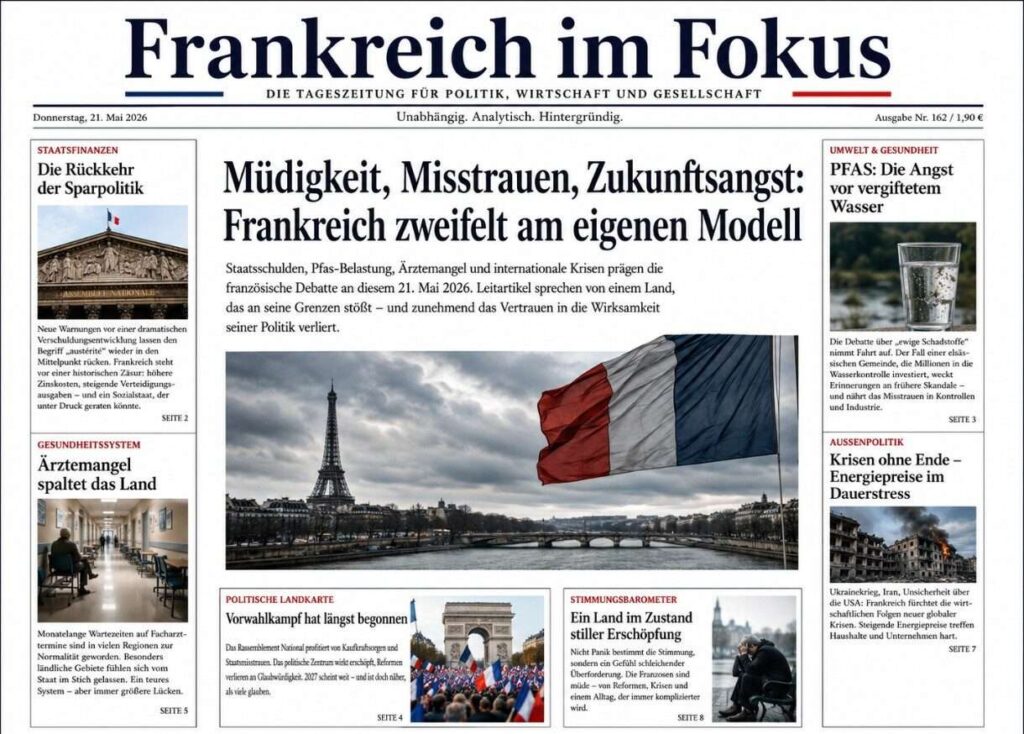
On May 21, 2026, French media conveyed an unusually consistent emotional picture. Although the topics covered ranged from national finances and environmental toxins to foreign policy, they converged into a core concern: France’s growing loss of trust in the sustainability of its own model.
Remarkably, rather than panic, there was a sense of fatigue. Political and social debates were not intense but appeared exhausted. Many editorials depicted a nation in continuous reform for years, yet the daily lives of many citizens had not improved as a result.
The Return of Austerity Policies
The focus today is on discussions about national debt. Following new warnings from government circles and the financial sector, public discourse centers on the imminent phase of severe fiscal consolidation. The word “austerity,” a long-standing political taboo, has become an important part of public discourse again.
The tension stems from a structural contradiction:
On one hand, France wants to strengthen its military role in Europe, maintain its social welfare system, and bear high public expenditures — while at the same time facing rising interest costs and weak economic growth.
Many commentators now call this a historic turning point. For decades, France has alleviated economic problems through borrowing. But currently, people increasingly feel that the room for maneuver is shrinking. In particular, the combination of high deficits and geopolitical arms pressures causes unease.
This discussion also has symbolic significance:
France traditionally views itself as a strong nation, carrying comprehensive social protection functions. Any discussion about austerity quickly evolves into a debate about national identity.
PFAS: Fear of Invisible Pollution
Meanwhile, the discussion about PFAS chemicals is receiving great attention. The so-called “forever pollutants” have now become one of the country’s most emotionally charged environmental issues.
Especially an incident in a community in the Alsace region investing millions of euros to monitor drinking water supply has reignited this debate. The issue touches sensitive nerves because it embodies a modern insecurity:
invisible, long-lasting, and difficult to monitor.
Several media outlets compare it to past health scandals in France such as asbestos or certain pesticides. The difference is that PFAS could affect entire regions, while pollution usually takes years to become apparent.
Additionally, distrust in the national regulatory system is growing. Many citizens question whether the government and industry will once again be slow to react.
Expensive and increasingly flawed healthcare system
Almost daily, reports of so-called “medical deserts” dominate local media. The shortage of doctors is becoming increasingly serious, especially in rural areas.
Waiting times for many local specialists have become routinely months long. Ophthalmologists, pediatricians, and gynecologists are most affected. Many French people therefore have a contradictory feeling:
the state invests heavily in the healthcare system — but the actual services are deteriorating.
The political sensitivity of this situation mainly manifests itself in regional imbalances. While Paris focuses on defense policies, European strategies, and international crises, many small towns experience the withdrawal of basic public services.
This perception of a “forgotten France” has for years been an important breeding ground for populist movements.
Foreign policy as an additional burden
The international situation has also intensified widespread unease. The ongoing war in Ukraine, tensions in Iran, and the unclear role of US diplomacy under Trump’s administration have added pressure.
In France, these crises are increasingly interpreted from an economic perspective. People’s concerns are not only about military conflicts, but about their fiscal consequences:
rising energy prices, increased defense spending, and new burdens on the national budget.
Therefore, France is in a difficult strategic position. On one hand, President Macron wants to position France as a geopolitical leader in Europe. On the other hand, there is a widespread feeling at home that international ambitions are increasingly detached from social realities.
The Long-term Impact of the 2027 Presidential Election
Although the next presidential election is still far off, it is already influencing political dynamics. Especially the National Rally currently benefits from widespread sentiments of purchasing power concerns, distrust towards the state, and regional frustrations.
Marine Le Pen’s political strategy is particularly coherent:
reducing ideological confrontation, focusing more on everyday issues.
The political center appears increasingly defensive. Many reforms in recent years—such as pension system and labor market reforms—though aimed at economic policy goals, have also caused social fatigue.
What many commentators describe today is precisely this gap:
France continues to reform, but fewer and fewer citizens believe these reforms are effective.
A Nation in a State of Silent Fatigue
Perhaps the most obvious characteristic of today’s debate in France is its emotional tone. The media does not portray a country on the brink of collapse. Institutions still function, the economy has not collapsed, and France remains one of the most important powers in Europe.
But beneath the surface, there is a pervasive sense of gradual powerlessness.
Many French people feel that life is more complicated, more expensive, and more unstable than it was years ago. At the same time, they also feel that national spending is continuously increasing, yet it fails to fundamentally resolve long-term problems.
This mixture of fatigue, doubt, and a potential sense of loss of control is shaping the broad atmosphere of public discourse today.
The deciding emotion is not panic.
It is the question of how much longer the current balance in France can hold.