
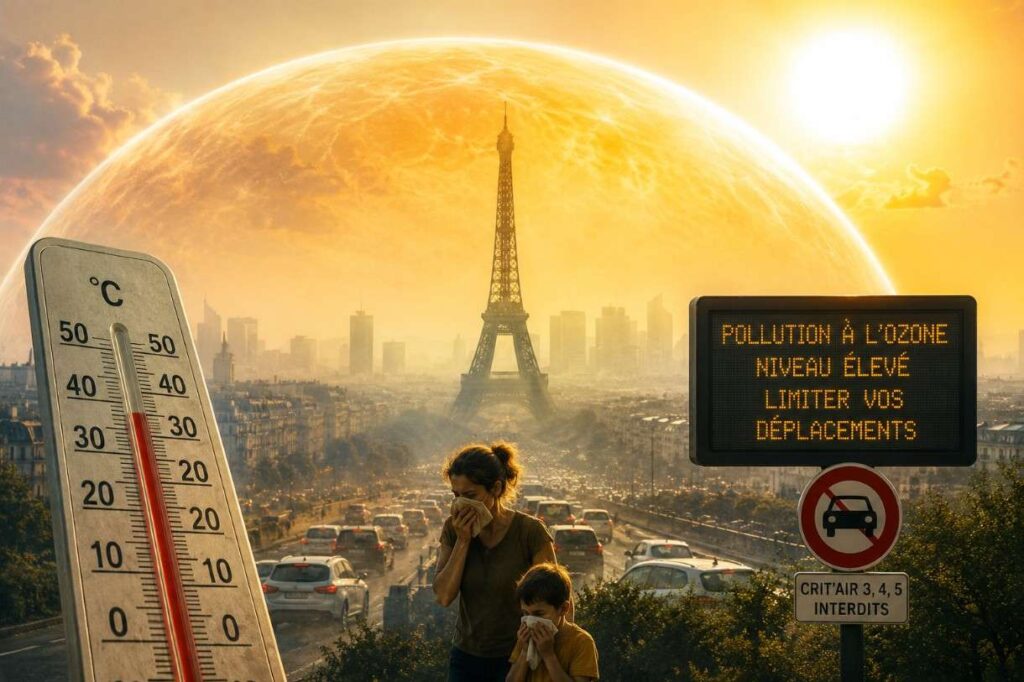
Summer in meteorology has not yet begun, but France has already experienced a weather condition usually associated with the height of summer in July or August. Temperatures far exceed 35 degrees, an unusually stable high-pressure system, combined with rapidly deteriorating air quality, have put the country under dual pressure. While the public is affected by an early heatwave, ozone levels have also risen to health-harmful levels in many areas.
The combination of heatwaves and air pollution is gradually becoming a challenge for health authorities, local governments, and transport policies. What is particularly notable is not the intensity of the event, but the timing. Even atmospheric scientists find it extremely rare to have to issue widespread ozone warnings as early as the end of May. France is thereby experiencing the climate conditions experts have predicted for years ahead of schedule.
Midsummer Phenomenon Arrives Early in Spring
Ozone concentrations measured in the Île-de-France region, Centre-Val de Loire, and Auvergne-Rhône-Alpes region have exceeded official information and warning thresholds. Normandy, Hauts-de-France, and parts of Grand Est have also reported elevated pollution levels. Meteorologists expect air quality to improve significantly only by the weekend at the earliest.
The reason lies in an unusual meteorological combination. France has been under a so-called heat dome for several consecutive days — a stable high-pressure system that traps warm air masses from North Africa over Western Europe. Several areas have broken May temperature records, with temperatures significantly above the seasonal average.
It is precisely this weather condition that facilitates the formation of ground-level ozone. Unlike the protective ozone layer in the stratosphere, this ozone is produced near the surface through photochemical processes. Nitrogen oxides from vehicle exhaust, industrial emissions, and volatile organic compounds react under intense sunlight, with high temperatures accelerating these reactions.
At the same time, stable high-pressure systems hinder air exchange, making it difficult for harmful substances to be dispersed. The atmosphere acts like a lid over urban areas, trapping and concentrating pollutants emitted in the cities. This situation leads to high pollution levels in city centers such as Paris and Lyon.
Invisible health threats
Ozone is one of the most problematic air pollutants in summer. Unlike fine particulate matter, it is hardly noticed by the public, but its health impact is significant.
Doctors point out that ozone irritates mucous membranes, triggers respiratory inflammation, and damages lung function. Children, the elderly, asthma patients, and cardiovascular disease patients are particularly sensitive. Short-term exposure can cause coughing, breathing difficulties, eye irritation, and headaches. Prolonged exposure to high concentrations increases the risk of hospital admissions for respiratory and heart problems.
Furthermore, high temperatures themselves can weaken the body. When high heat and air pollution occur simultaneously, health risks compound. The current weather conditions create a double burden, which is especially dangerous for vulnerable groups.
The effects have already begun to show, with many sporting events adjusted, postponed, or canceled. Organizers have had to increase medical support or even cancel the events entirely. This discussion highlights how extreme climate events profoundly affect areas of social life previously considered relatively safe.
Authorities respond with traffic restrictions
The Paris regional authorities have taken measures that have now become standard operating procedures for severe ozone events. The police temporarily implemented differentiated traffic bans. Vehicles with lower emission standards are not allowed to enter certain parts of the city. At the same time, speed limits were imposed on highways and expressways, home office work was recommended, and restrictions were placed on heavy transport vehicles.
The rationale behind these measures is clear: reducing traffic leads to lower nitrogen oxide emissions, which are key precursors to ozone formation. However, the effectiveness of these measures remains controversial. Air quality experts point out that ozone often does not form directly at the emission site; chemical reactions can span tens of kilometers, so local traffic restrictions have limited effects.
Nevertheless, these measures send a political signal, indicating that the authorities no longer consider the current situation a temporary weather anomaly, but rather recognize it as a structural environmental and health issue.
Climate change is changing the timeline
The timing is particularly alarming. France’s ozone peaks have traditionally been phenomena during the summer holidays, but now they are occurring as early as the end of May.
Air quality experts believe this is the earliest large-scale ozone warning since the start of modern monitoring data. Climatologists see this not as an isolated event, but as further evidence of profound shifts in European weather and climate patterns.
Since the beginning of this century, France has experienced a significant increase in heatwave events, while extreme temperature fluctuations are also rising—rapid changes from unusually cold to extremely hot weather within a few days. Prior to this current event, such rapid temperature changes were occurring.
Climate change is not the direct cause of any single weather event, but rather an amplifying factor. Atmospheric patterns have long existed, but now they encounter an overall warmer climate system, leading to heatwaves reaching critical intensity faster, lasting longer, and occurring earlier.
Therefore, the current ozone pollution events in France are not just a temporary phase of declining air quality, but represent an increasingly evident development trend: environmental and health risks that were previously limited to a few weeks in summer are now occurring earlier and affecting a larger area. Heatwaves are not only meteorological events but also signals of how quickly climate conditions are changing, reminding policymakers, cities, and health systems that urgent responses are necessary.
Andreas M. Brucker