
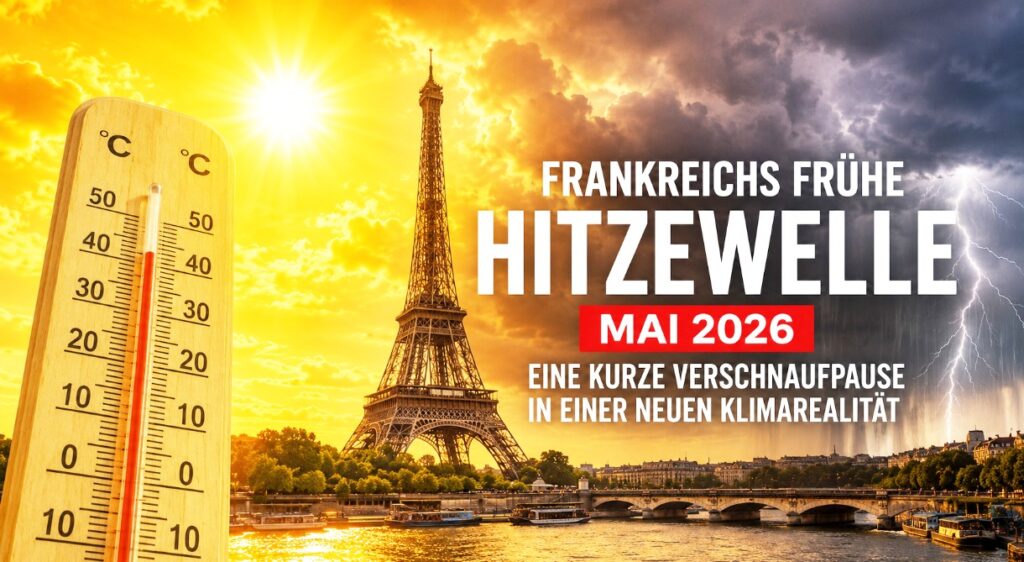
The recent extraordinary heatwave that swept across France is gradually easing. After experiencing temperatures more typical of midsummer than late May, the classic Atlantic weather is set to return. Thick clouds, thunderstorms, and noticeably cooler air are providing relief to many areas. However, this temporary cooling has not changed an almost unavoidable trend: France is entering a new climate reality.
May 2026 has already gone down in history.
Several regions have set new highest temperature records for the month. Temperatures in the south rose to nearly 38 degrees, while Paris exceeded 33 degrees for several consecutive days. Most remarkably, May 26 is now regarded as the hottest May day since the beginning of modern meteorological records in France.
Many people are surprised by this. After all, such temperatures are usually associated with summer in July or August. However, it is this shift in timing that worries climatologists. This exceptional heat is not an isolated event but a harbinger of more frequent occurrences France will face in the coming decades.
The real question is no longer whether there will be more heatwaves, but how well prepared the country is to cope with them.
Since the catastrophic heatwave in 2003 that caused nearly 15,000 deaths, France has significantly enhanced its warning and protection systems. The national heatwave protection plan, modern meteorological alerts, and targeted information campaigns have become routine. Local governments maintain registries of vulnerable populations, nursing homes have emergency plans, and hospitals prepare in advance for peak periods.
But crisis management alone is far from enough.
The real challenge is to adjust national response strategies in the long term. The situation is particularly evident in cities. Concrete, asphalt, and densely built-up areas act like giant ovens, storing heat, making it difficult for the heat to dissipate at night, and temperatures barely drop. The so-called “tropical nights,” i.e., nights when the temperature does not fall below 20 degrees, are now occurring more frequently.
This is also one of the greatest health risks. The human body needs to cool down at night to recover. Without sufficient cooling, especially the elderly and those with illnesses face an increased risk of serious complications.
Many cities have already reacted. Planting new trees, creating shaded areas, and in some places experimenting with more reflective light-colored surfaces to reflect sunlight. However, the pace of urban transformation often cannot keep up with the rate of climate change. Additionally, there is another problem: millions of residences were originally designed to retain warmth as long as possible in winter and are insufficiently equipped to withstand summer heat.
Technical infrastructure is also under increasing pressure.
The rising temperatures lead to higher electricity demand for air conditioning. Rail lines are sensitive to extreme heat as steel tracks easily deform. Energy supply also faces challenges as rivers and water bodies used as cooling sources for industrial facilities experience abnormal temperature increases.
Meanwhile, the ecological environment has also paid a heavy price. Environmental organizations have observed that many bird species are significantly affected. Nestlings suffer from lack of water or leave the nest early to escape the heat. Forests and agricultural lands are also increasingly under pressure. The traces left by repeated extreme weather events often only become apparent after several years.
Currently, many regions are still nourished by abundant spring rains, and soil moisture is sufficient, preventing severe damage to plants. But if the heat waves persist, this advantage could soon disappear.
Many experts have issued warnings about this. Early heatwaves statistically increase the likelihood of subsequent extreme heat during the summer.
France is undergoing a transition period. Existing emergency measures are clearly more effective than twenty years ago, but deep adjustments to cities, buildings, and infrastructure still struggle to keep pace with the speed of climate change.
The return of cool air in recent days, though seemingly providing relief, is more like a brief pause between two phases of climate development.
Andreas M. B.