
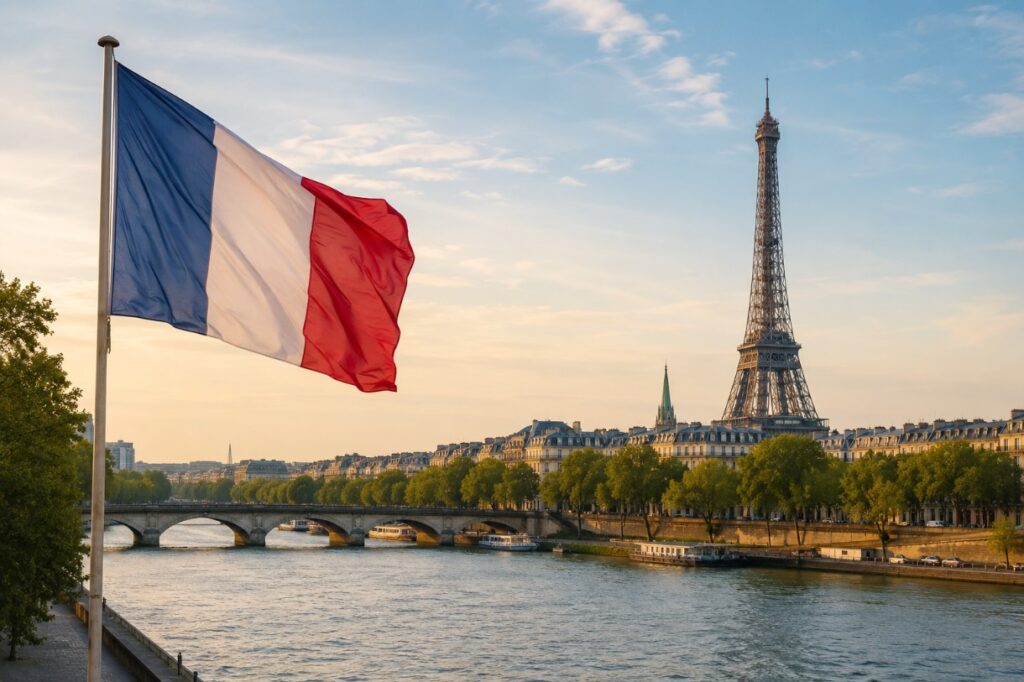
On May 27, 2026, France is experiencing a day in which political, social, and international tensions are concentrated into a single overall picture. The headlines may appear scattered—heat wave, presidential election, immigration, Middle East crisis, soccer. However, together they tell the story of a country in a period of transformation. After years of persistent crisis, the Republic is increasingly anxious about its own future.
French public opinion is marked by both fatigue and high political awareness. Many debates revolve around the same fundamental question: Is the state gradually losing its ability to guarantee order, prosperity, and security? This very feeling permeates many newspapers today.
The Long Shadow of the 2027 Presidential Election
Officially, the election campaign has not yet begun. But in reality, France has already entered the stage of political primaries. Since recent parliamentary crises, there is no longer a stable political center. The old order of the Fifth Republic, once characterized by a clear majority and a strong president, is increasingly fragmented.
The competition within the particularly moderate civic camp is drawing attention. Gabriel Attal continues to try to establish himself as a dynamic reformer. Meanwhile, Édouard Philippe is seen by many conservative voters as a symbol of the country’s political stability and administrative experience. Both are aware that the political void after Emmanuel Macron may widen.
Prime Minister Sébastien Lecornu, on the other hand, is under increasing pressure. His government appears to be demonstrating technocratic skill but is politically vulnerable. For this reason, there is a phrase that frequently appears again in many editorials. A historically significant term in France – “fin de règne (sense of an end)”. It is an expression that suggests the end of a political cycle.
At the same time, the “Rassemblement National (National Rally)” still holds a strategic advantage. This party currently has little need to govern and can dominate the debate. On issues such as immigration, purchasing power, security, and national identity. The political right benefits not from enthusiasm but from the erosion of trust in traditional institutions.
The situation is also becoming difficult for the left. Jean-Luc Mélenchon still mobilizes the support of radical urban areas and the youth, but at the same time faces strong rejection from the political center. France appears more ideologically polarized than ten years ago.
Heat wave as a political omen
Currently, the theme most strongly shaping the French media is this unusually early heat wave. Temperatures above 35 degrees Celsius at the end of May are considered a level of concern even in southern France.
However, the reporting goes far beyond the meteorological aspect. The heat is turning into a political symbol. Many commentators depict a country unprepared in terms of infrastructure for the new climate reality.
Large cities are particularly affected. Paris, Lyon, and Marseille suffer from excessive pavement, lack of green spaces, and overheating in residential areas. Many schools still do not have proper air conditioning. In many suburbs, the heat wave is further exacerbating social inequalities. The wealthy avoid the burden with holiday homes and air-conditioned residences, while the poor have no choice but to remain amid concrete.
The phrase “France suffocating” expresses not only the weather but also the social mood. France seems administratively, infrastructurally, and financially overwhelmed in many places.
Additionally, water issues are adding to the problems. Discussions on usage restrictions have begun in several regions. Agricultural workers warn of impacts on harvests, and municipalities are negotiating summer supply security. Climate change is no longer an abstract future issue in France but part of everyday politics.
Permanent Crisis of Immigration and Security
The political area currently moving French public opinion the most is immigration and security. Gérald Darmanin’s statement about a moratorium on some legal immigrants further heated the debate.
Conservative media speak frankly about a historic breaking point. On the other hand, left-wing commentators warn of a shift in discourse as far-right narratives are penetrating the political mainstream.
What is particularly notable is the connection of multiple themes. Immigration, drug crime, urban violence, and state power are increasingly discussed together in France.
The situation in Marseille is a prime example. The violence of rival drug networks has been troubling the police and judiciary for months. At the same time, the feeling of insecurity in public spaces is increasing in many places. Regardless of whether crime statistics are actually rising everywhere.
What is notable is political perception rather than objective statistics. In France, there is currently a heated debate about state control concerning borders, districts, monopolies on violence, and the effectiveness of the judiciary.
That is why security will be a central theme in the next presidential election.
France Between Global Crises and European Powerlessness
There is also an unusual tension in Paris regarding foreign policy. The escalation in the Middle East and tensions around Iran are being watched with great concern, with worries about the impact on energy prices and inflation.
The fear of a renewed economic shock is obvious. France has suffered for many years from high national debt, weak growth, and structural fiscal problems. A new energy crisis could further destabilize social conditions.
On the other hand, the international situation also exposes Europe’s strategic dilemma. Many French commentators criticize that while the European Union remains heavily dependent on the United States for foreign and security policy, China is rising economically and geopolitically.
This discussion touches the core of France’s national philosophy. The aspiration for strategic autonomy. However, today France appears weakened domestically and limited in its capacity to act externally.
The contrast could not be starker. While international crises intensify, French domestic politics are preoccupied with pension issues, violent crime, and heatwave measures.
Paris Saint-Germain and the Search for National Symbolism
Even football now has political implications in France. The upcoming Champions League final between Paris Saint-Germain and Arsenal FC is being debated beyond just sports.
For many fans, European domination will be the decisive proof of the club’s international legitimacy. On the other hand, some see PSG as an artificially created project lacking historical depth; economically massive but culturally controversial.
What is noteworthy is the role of the state. Authorities are meticulously preparing for possible celebrations or riots. Since violent incidents in recent years, a very cautious approach has been adopted. In France, large-scale sports events are now considered from a security perspective.
This symbolizes the general mood of the country. Even moments of collective joy are overshadowed amid social tensions.
On May 27, 2026, France appears as a republic caught between the art of living and fatigue. Cafés, festivals, travel, and football continue to create an image of French lightness that is internationally admired. However, at the same time, a sense of structural vulnerability is also increasing.
The major debate of the day—climate, immigration, state power, geopolitical instability, political fragmentation—ultimately boils down to the same question. Can France still promise the stability of the republic?
There is no clear answer yet. But it is precisely this uncertainty that shapes the current political atmosphere of the country.