
Today, those who pick up a pen are almost a quiet minority. Notes go to smartphones, letters go to the cloud, memories go to hard drives. Paper exists everywhere, yet at the same time it has become invisible. It is under printers, in archives, inside shipping boxes. Almost no one asks where paper comes from, how it is made, or who makes it.
In an old farmhouse building in the heart of Auvergne, a young man is precisely asking those questions.
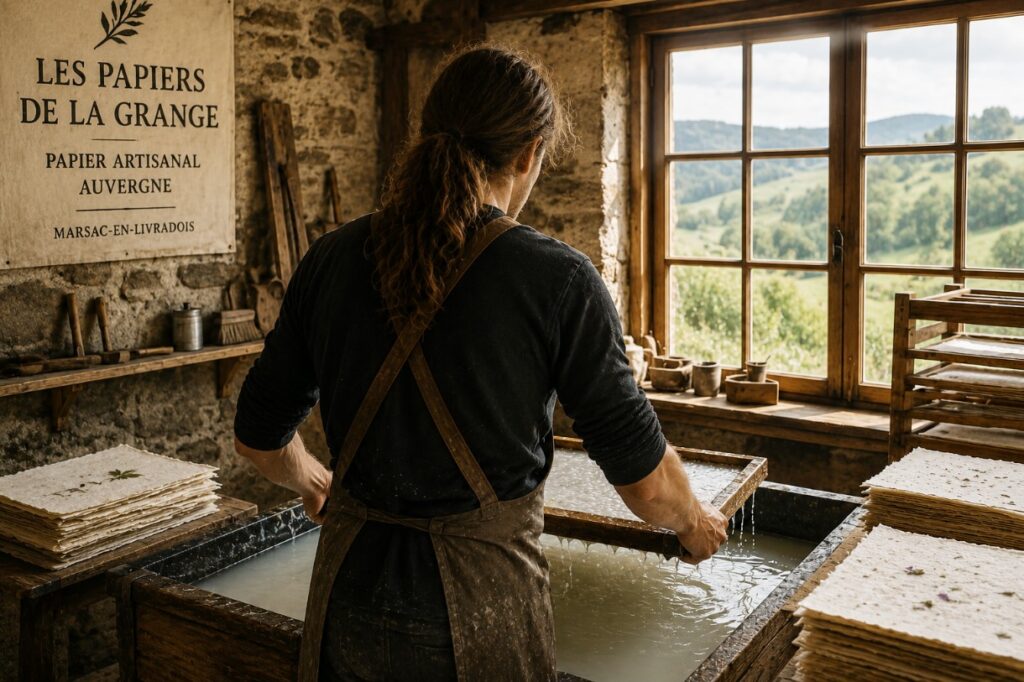
Etienne Gutfeld, in his early thirties, lives and works in the municipality of Marsac-en-Livradois within the Livradois-Forez Regional Natural Park. There, he slowly and carefully makes hand-molded paper sheet by sheet. Just as people did centuries ago.
In an era that measures everything by speed, this feels like an almost quiet act of resistance.
When you enter his workshop, you don’t hear the noise of machines. Conveyors don’t move, production lines don’t set a rhythm. Instead, water, wood, plant fibers, and many hands are at work.
The paper made here is not an industrial product; it is something that grows.
However, the journey was never straightforward. No one had long thought that Étienne Gutthardt would become a papermaker. His studies initially headed in a different direction, with sports playing an important role in his life. Travel was the same. Getting to know the world, gaining experience, and traveling seemed like his mission for a long time.
Then the year 2022 arrived.
The great stories of life often begin by chance.
Gutthardt met the traditional Richard de Bas. It is one of the last historic papermaking mills in France. This factory site is not a place where the past is displayed but one that is alive. Here, hand-made paper has been produced for centuries, long before industrial methods revolutionized manufacturing.
For the young Auvergne native, a door to an unknown world was opened.
Suddenly, he found himself in the midst of craftsmanship that requires patience. Precision, attention to details that have almost become unrecognized. But he learned to master it. Fiber preparation, sheet forming, pressing, drying,
and above all, he learned to wait.
Good paper cannot be rushed.
What started as professional experience quickly turned into a passion. He became fascinated by work that involved dealing with materials. Each fiber tells its own story, and the surface reacts differently to light, humidity, and touch.
You could say that he fell in love with paper.
And no matter how great the passion, there comes a time when just being an observer is no longer enough.
From employee to creator.
From learner to craftsman.
From craftsman to business owner.
He founded his own workshop, “Les Papiers de la Grange.” The name sounds modest and rustic, but behind it lies an ambitious project.
He wants to preserve old knowledge but has no intention of turning it into a museum.
He believes that is precisely the danger lurking in many traditional crafts. They are praised, photographed, and awarded, but are pushed out of daily life and turned into folkloric traditional arts.
Guttfarld has a different way of thinking.
For him, paper holds not only the past but also the future.
That is why he experiments with the material. In addition to traditional plant fibers, he also uses chiffon paper made from recycled paper and old textiles. Petals, grass, seeds, and sometimes small mineral elements derived from his homeland’s landscapes are mixed in.
In this way, paper that looks like a small landscape is created.
Not one of them is the same.
If you touch it, you can feel the unevenness, texture, and scars.
These are traces of the formation process.
While industrial products aim for uniformity, handmade paper comes to life through its individuality. It is the small irregularities that are its charm.
It somewhat reminds one of human faces.
Perfection often appears boring.
However, individuality remains memorable.
Customers are no longer just local. Artists order his paper for watercolors and prints. Bookbinders appreciate the special quality of its fibers, and designers seek materials full of stories. Wedding invitations are welcomed by brides and grooms who want something unique.
In a world flooded with standardized products, the longing for something one of a kind is increasing.
That might explain the success of many young art artisans.
Today, people no longer just buy things.
They buy stories.
And paper made from old fabric, local plants, and artisan techniques must surely weave the most beautiful stories.
But Goodfeld is not satisfied with just the workshop.
He wants to show the process of his work.
For that reason, he regularly takes up his camera.
Under the name “Le Dur de la Feuille (The Stubborn Paper),” we publish videos on social media explaining work processes that are almost unknown outside a small circle of experts.
Millions of people use paper every day, but most have never seen how paper is made.
Gottwald’s act of immersing the mould in water and slowly lifting it up looks like meditation. Fibers gather into a thin layer, and suddenly a sheet of paper is born from the cloudy liquid.
Almost like magic.
But it is real.
His videos resonate with people.
Not because of flashy effects,
but because of that slow pace.
While many platforms thrive on hustle and bustle, he shows processes that require time. Movements that demand focus, tasks that cannot be sped up.
It is an antithesis to the normalization of scrolling.
And probably also one answer to the fact that many people are tired of the constant stream of digital information.
Because watching things being created carefully is pleasant for everyone.
The response is unending.
A constantly growing community of artists, craft lovers, curious people, and collectors supports his work. Collaborations, exhibitions, and meetings are emerging.
Suddenly, a niche handicraft has become a topic of conversation.
This is noteworthy.
This is because papermakers have long been regarded as an almost extinct profession.
Today, this craftsmanship is experiencing a small renaissance.
Not only in France,
but across Europe, young people are working on rediscovering traditional techniques. They are seeking tactile work and professions where results can be felt in form.
The digital economy often produces invisible things, but papermakers create something that can be felt rubbing between the fingers.
The difference is significant.
The appreciation for Gutfeld’s work is steadily increasing. In 2025, he won the Craftsmanship Skills Award of the Auvergne-Rhône-Alpes region. This award values not just the quality of the product,
but also the approach.
The belief that tradition must not be a mere hindrance.
And that innovation does not necessarily have to stem from technology.
The future begins where people find old paths anew.
Today, even visiting his workshop does not evoke nostalgia. Gutfeld does not dream of a return to past centuries.
He utilizes social media,
collaborates with contemporary artists,
Once had an entrepreneurial spirit.
Yet, it preserves a respect for time that has been lost in many places.
A single sheet of paper requires attention,
each fiber has its place,
and each step of the process takes time.
That sounds simple, but it is not.
Modern society sees time as a resource to be used as efficiently as possible, but in the workshop of Marsac-en-Livradois, a different logic applies.
Time is not an obstacle,
it is part of the product.
Perhaps that is where the true charm of his work lies.
Handmade paper has no flashy value. It does not shine, does not send notifications, and does not update automatically.
Nevertheless, it tells a story about the world it was born into.
About water and plants.
About patience and skill.
About a young craftsman who resisted the invisibility of his material.
Sometimes a single sheet of paper reminds us that beauty is not born from speed,
but from attention.
Perhaps that is Étienne Gouttifard’s essential message.
As the world moves faster and faster, somewhere in the mountains of Auvergne, he sits in front of a tub full of fibers, making paper sheet by sheet.
Outdated?
Perhaps.
Up-to-date?
More than ever before.
Article: M. Legrand