
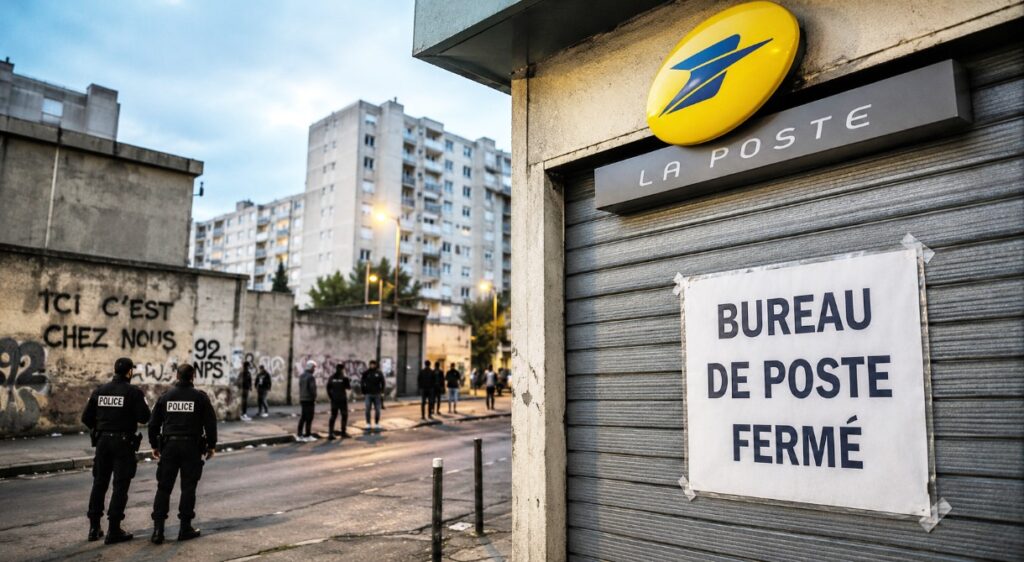
In Nîmes, the anger of many residents is concentrated on one building. At first glance, it is an ordinary-looking closed post office. But beyond the locked door lies a meaning beyond the simple end of administrative services. For many living in this area, this closure signifies that the state has stepped back, while at the same time marking the advance of forces already dominating daily life: drug organizations, violence, and threats.
Especially in neighborhoods with many socially vulnerable people like Pissevin or Valdegour, years of fear, frustration, and exhaustion have been boiling together. Many residents openly say that their neighborhoods are increasingly being entrusted to drug trafficking networks. What once sounded like exaggerated headlines is now an almost everyday reality.
The post office was considered by many residents as the last neutral place.
Older people received their pension documents there, families handled money transfers, and people who had difficulty accessing the internet got help with paperwork or administrative documents. Above all, the building held a greater meaning: it symbolized the visible presence of the state, order, and normality.
When such places disappear, it is not just a service gap that remains. A void is created.
It is precisely this void that criminal organizations move into. Residents report that drug dealers are at apartment entrances, youths act as lookouts, and nobody wakes up anymore to the gunshots at night. Some parents only take their children to school by detouring. Shops close early. A quiet tension, almost palpable, hangs in the streets.
“In the past, the people here all knew each other,” a shopkeeper said. “Now people rather look away.” Words that stay with you.
The situation in Nîmes no longer reflects only the problems of large cities like Marseille but a developing pattern. Drug trade has spread to medium-sized cities in France and become a professionally organized, violent, and economically profitable business. Investigators now talk about an organizational structure that functions almost like a corporation — with clear hierarchies, territorial control, and enormous threat potential.
The state usually responds with police deployments, raids, and short-term safety measures. In Nîmes, there have recently been intensified crackdowns and especially bans on minors entering dangerous areas. But many residents frankly say: this alone is not nearly enough.
Safety is not made by police cars alone.
Safety grows when schools operate properly, doctors remain, shops open, and public institutions are visibly present. In many places, this is exactly what is missing. When libraries close, clubs disappear, and even the post office no longer remains, the neighborhood loses social cohesion.
Then other forces take control.
Not officially, but clearly felt.
Therefore, the closed post office in Nîmes is more than just local news. It symbolizes how far the state can retreat and how much neighborhood communities can lose trust as a result. And regaining that trust is much harder than reopening the door.