
Back

Nachrichten.fr · May 22, 2026

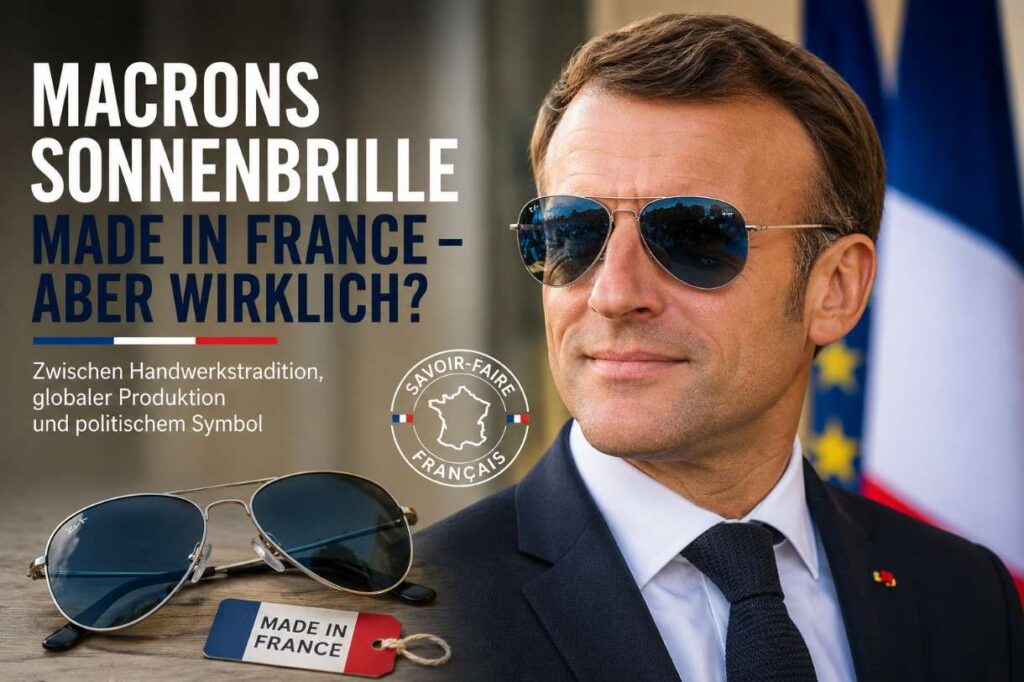
Macron’s sunglasses and the riddle of the ‘real’ Made in France Emmanuel Macron’s sunglasses have caused quite a stir — not because of their style but because they ignited a debate about what “Made in France” really means. The president was photographed wearing sunglasses during a public appearance. The label inside read “Made in Italy.” Immediately, critics and opponents mocked him: How can Macron promote French industry while wearing Italian sunglasses? The image quickly spread across social media, accompanied by accusations of hypocrisy. But the episode raises a deeper question: What do we mean when we claim a product is “Made in France”? Is it where the last assembly took place? Where most of the value was added? Or simply where the company is headquartered? French law requires that a product advertised as “Made in France” must have undergone its last substantial transformation on French soil. That sounds clear, but in a globalized economy the supply chains are complex. A pair of sunglasses can have lenses made in Germany, frames molded in China, surface treatment in France — and be assembled in France. Is that “French”? According to the legal definition, yes. Many consumers, however, interpret “Made in France” differently: they imagine raw materials and most of the production steps carried out domestically. Companies exploit these ambiguities. Some voluntary labels and certifications attempt to clarify: they list percentages of production value or trace individual components. Yet even these systems cannot fully capture the reality: parts cross borders several times, suppliers subcontract, and design and intellectual property may remain in yet another country. The political reaction to Macron’s glasses reveals more than mere opportunism. It exposes a gap between symbolic politics and economic realities. Politicians often demand support for national industry, but the levers to restructure global value chains are limited. Tariffs or subsidies can help in specific sectors, but they cannot instantly re-create entire domestic supply networks for everything from shoes to semiconductors. There is also an element of image politics. Elected officials are held to symbolic standards: if you champion local production, you are expected to embody it. That’s a fair expectation in terms of coherence. Yet it ignores practical constraints — including personal choices, limited availability of goods, and the multinational nature of many manufacturing processes. A constructive response would be twofold: clarify the rules and labels so consumers can make informed choices, and pursue industrial policies that genuinely strengthen domestic capabilities where feasible — for instance in strategic technologies, renewable energy components, or quality craftsmanship. Above all, politicians should avoid reducing industrial policy to mere posture and instead present realistic plans with measurable goals. Macron’s sunglasses are a useful reminder: in a connected world, the provenance of goods is complicated. Debates about “Made in France” matter, but they should be grounded in facts and accompanied by concrete policies rather than quick moralizing.

(Mit Hilfe von KI erstellte Illustration).

For several years now, Emmanuel Macron’s dark sunglasses have become something of a political uniform for the French president. These distinctive models, appearing at state visits, beach walks, military ceremonies and elsewhere, carry meanings beyond simple sun protection. In France, the sunglasses have become a small, symbolic political emblem — stylish, composed, and distinctly French.

At least at first glance.

But the same question is often raised about the president’s sunglasses: is this accessory really entirely made in France? The answer to that question is more complicated than the flawless photos staged at the Élysée Palace might suggest.

The models Macron often wears usually come from premium French brands in the Jura region. The areas around Morez and Oyonnax have been known for decades as the center of the French eyewear industry. There you will find manufacturers with proud traditions, small family businesses, and specialist workshops that continue to carry on the French craftsmanship of the industry to this day.

These images fit perfectly with the president’s political narrative.

Macron has long focused on visible symbols of French production. Custom suits, watches, leather shoes or bicycles — most should be domestically produced wherever possible. The underlying message is clear: France still has industry, craftsmanship and quality. This symbolism is especially important in a country that has suffered factory closures and many job losses.

But in the field of sunglasses the situation quickly becomes more complicated. Or more precisely: globalized.

Because even when a “Made in France” label is printed on the temple of glasses, often only a portion is actually produced in France. Some frames are entirely made in the Jura region — from cutting the acetate material to final assembly. Other models combine international supply chains. Hinges come from Asia, specific materials from Italy, lenses from other European countries, and only the final work is done in France.

Legally, it is possible in such cases to use the origin label “Made in France.”

This is precisely where the debate often ignites. Critics point out that the industry exploits a patriotic image while production is already internationally entangled. Supporters counter that in a globalized economy there are hardly any industrial products produced 100% in a single country.

In fact, Macron’s sunglasses say a lot about France beyond mere fashion. They reflect a country that proudly preserves historical artisan traditions while being deeply integrated into global production networks. “Made in France” in the 21st century emphasizes design, assembly, and brand identity more than complete national self-sufficiency.

Perhaps that’s why the president’s sunglasses are particularly appealing.

They are French — even if that history has already become European and global.

Author: Christine Macha