
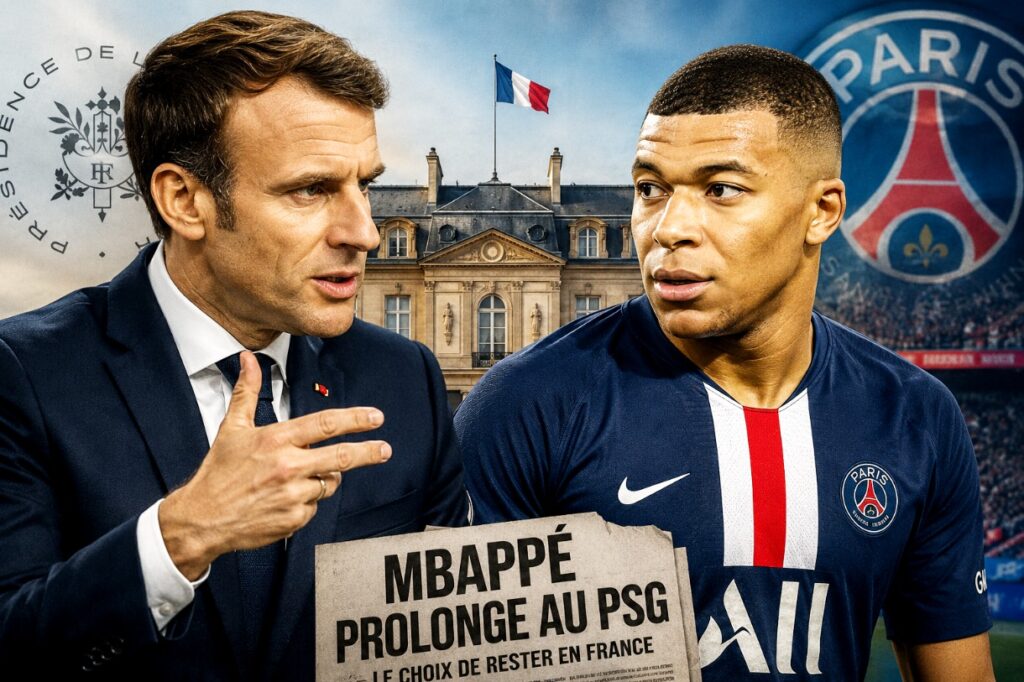
When Emmanuel Macron personally intervened in Kylian Mbappé’s future in the spring of 2022, it was no longer just about a flashy football transfer. At the Élysée Palace, the world champion was regarded not simply as an outstanding striker but as a symbol of French excellence. He was seen as the representative face of the nation’s sport and a figure with enormous influence beyond the football field. According to multiple reports and later statements from those involved, Macron considered Mbappé a kind of national strategic asset — a piece of national cultural heritage that should not be allowed to flow abroad.
The situation at the time already seemed predetermined. Mbappé’s contract with France’s prestigious club Paris Saint-Germain had expired, and almost all international sports media viewed his transfer to Real Madrid as imminent. In Spain, it was treated as a done deal. Many observers regarded Mbappé as the next global leading figure in football, following Messi and Ronaldo.
However, behind the scenes a significant political dimension was unfolding. Macron decided to intervene personally. The French president later confirmed that he spoke with Mbappé before making an official decision. He urged the player to continue his career in France for the time being. Macron justified this intervention by saying that, as head of state, it was appropriate to represent the national interest when a prominent figure faced an important decision.
The conversation apparently made an impression. Mbappé later said in various interviews that Macron had made it clear he wanted him to stay in France. The president emphasized not only the player’s sporting importance as a forward, but also that he contributed to the country’s international standing and the appeal of the French league. Mbappé himself acknowledged that the president’s words naturally carried special weight.
The Élysée Palace’s exceptional response can be understood in the context of the situation at the time. France was preparing several major international events, including the Paris Olympics, and the World Cup in Qatar was about to take place. The fact that Qatar’s sovereign wealth fund owns Paris Saint-Germain also affected the situation. If the country’s most famous footballer were to leave France, the impact would be significant not only in sporting terms but also symbolically. Macron, who has long taken a deep interest in the economic and social importance of sport, grasped the magnitude of Mbappé’s impact on the international standing of French football.
According to the player, the president did not simply plead for him to stay. Rather, he argued that a transfer abroad would be possible later and that France needed its star player Mbappé now. The core message was this: Real Madrid will exist for years to come, but France needs him now. This patriotic approach likely resonated strongly with Mbappé, who values his identity as a French player and has built a career closely tied to the Paris region.
But it is difficult to view this decision as solely the result of Macron’s influence. Negotiations with Paris Saint-Germain, the club’s sporting prospects, and the specific financial terms of the new contract were also important factors. Mbappé himself emphasized several times that many people were involved in the decision-making process. Nonetheless, he confirmed that the French president’s opinion was one of the voices he took seriously.
The announcement of his contract extension in May 2022 clearly revealed the political and symbolic dimensions of the process. In front of thousands of spectators, Mbappé declared he would stay in Paris and expressed his affection for his hometown and for France. His remarks had a noticeably statesmanlike tone and differed from the statements commonly seen when professional football contracts are extended.
In retrospect, this anecdote appears as an extraordinary moment at the intersection of sports, politics, and national identity. Although he transferred to Madrid later that year, the situation in 2022 shows how significant Mbappé was to France at the time. Recent European sports history contains few examples of a head of state intervening so directly in a particular player’s future.
This case also reveals a change in perception of elite sports. Global stars like Kylian Mbappé now act not just as athletes but as national ambassadors, shaping a country’s international image and holding economic and cultural value beyond the stadium. To Macron, Mbappé represented this new generation of global sports icons. His staying in Paris was not merely a football matter but one of national prestige.
Author: P. Tiko