
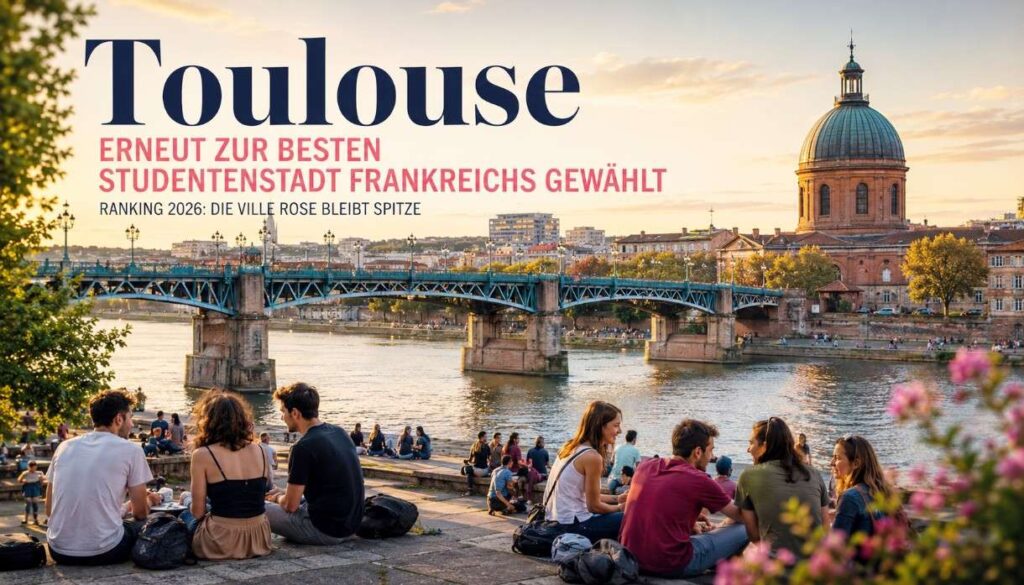
Some cities are just visited, while others are lived in for years and never fully left. Toulouse belongs to the latter.
Called the ‘Pink City’ because of its pinkish glow under the warm southern light, this city has once again been awarded the title of France’s best student city. Leading the national rankings for two consecutive years, it has long established its reputation beyond lecture halls and university boundaries. Toulouse has gone beyond being a mere place of study. The city seems to offer that rare balance sought by many young people. On one side, challenging education; on the other, quality of life.
Walking around the streets near Place du Capitole, this promise is visible everywhere. In the morning, students with coffee cups flock to seminars; in the afternoon, the hills by the Garonne River fill with people; and in the evening, squares and alleys transform into spontaneous meeting places. Studying is the center of daily life, but it does not determine all its rhythms.
This is precisely what makes this city special.
France has many centers of higher education with deep tradition and history. Paris leads with its reputation, Lyon with economic dynamism, and Grenoble with scientific excellence. But Toulouse remarkably combines several characteristics harmoniously. The city is home to more than 100,000 students, making it one of the most important university hubs in the country. Nevertheless, there is little impression of an anonymous educational factory.
Perhaps this is due to the streets, perhaps the climate, or perhaps the southern French leisure that is felt even during exam periods.
Many students describe Toulouse as an easy-to-handle metropolis. Everything seems close. Universities, concerts, favorite cafes, and nearby green spaces are usually just a few minutes away. While other big cities consume time and energy daily, Toulouse almost appears as the opposite model. Why spend hours on crowded public transport when life is right at your doorstep?
This proximity also influences cultural life.
Concerts, theater, festivals, and exhibitions are not extravagant luxuries but everyday urban events. Student culture and city culture mix, newcomers quickly find peers, and residents constantly discover new facets.
Additionally, Toulouse enjoys another advantage that is becoming increasingly important in an era of growing uncertainty: job prospects.
The city is considered the heart of the European aerospace industry. While future technologies are discussed elsewhere, here technology is often born directly on site. Research institutions, tech companies, and engineering offices shape the economic environment. Students majoring in technology, natural sciences, and business have access to a very dense network that leads to internships, projects, and employment.
In Toulouse, studying often doesn’t end at the university door.
Of course, Ville Rose also faces challenges. The housing market is under pressure, rising popularity drives up rents, and infrastructure must keep pace with the increase in new residents. But compared to the problems of other major French cities, these difficulties so far seem manageable.
This is precisely where greater change is reflected.
For a long time, Paris was a city with almost no alternative for ambitious students. The capital concentrated prestige, career opportunities, and academic reputation. Today, views on university life are changing. Young people are increasingly evaluating the location of universities based on criteria that were previously secondary. How much does housing cost? Is transportation efficient? Are there enough green spaces? Beyond studying, is there room to enjoy life?
It may sound obvious, but in fact, this change signifies a profound cultural shift.
Universities no longer compete solely on research achievements. Cities compete to attract talent. And talent looks for places where the future and present coexist harmoniously, not just libraries that are open 24 hours.
Toulouse currently seems to understand this demand better than many other cities.
For this reason, success in the current rankings is not surprising. This is less a prize for individual universities and more a praise for the urban ecosystem that connects education, work, leisure, and quality of life. Rennes and Montpellier closely follow, showing that medium-sized metropolitan areas are becoming increasingly important.
Nevertheless, Toulouse will remain the benchmark for the time being.
Sitting on the riverbank on a summer evening, watching students debate, musicians taking out their instruments, and the last sunlight casting a golden glow on the red brick facade, you quickly understand why. What good is the best university if the surrounding life cannot be shared?
Toulouse provides a surprisingly convincing answer to this question.
Written by: M. Legrand