
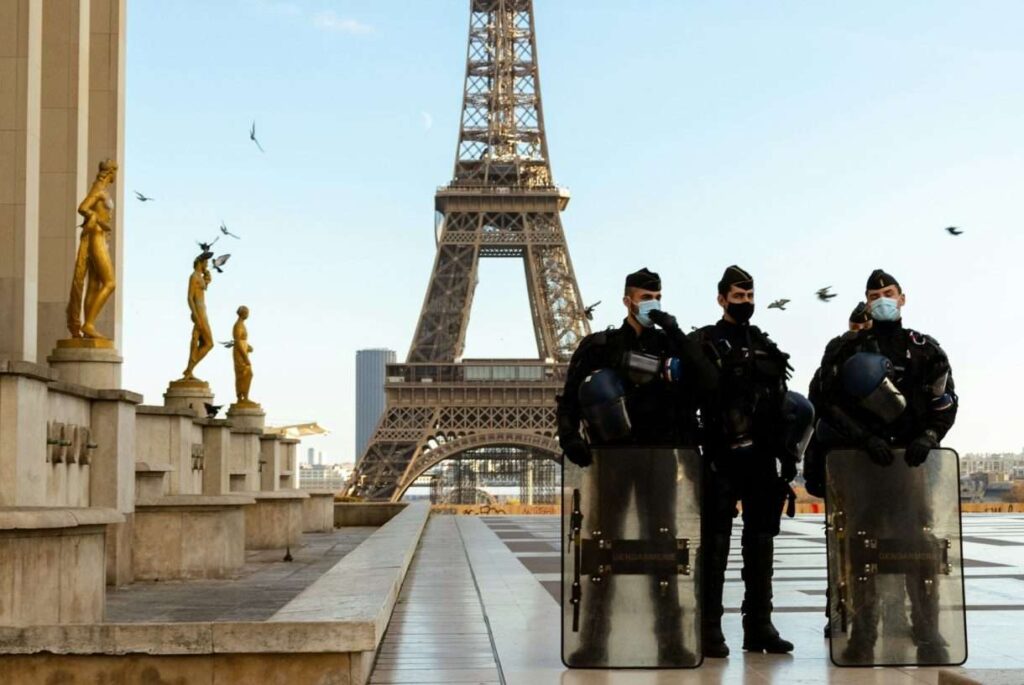
There are scenes that have already become a dark part of everyday life in France—burning trash bins, groups wearing masks, café doors quickly being locked, police sirens piercing the night. On the evening of May 21, 2026, that is, the early hours of May 22—just before the French Cup final between OGC Nice and RC Lens took place in Paris—the situation escalated again. This time, it was primarily OGC Nice fans who caused serious disturbances far beyond the usual rival fan scuffles.
According to French media reports, about a hundred violent individuals divided into several groups were roaming the northern part of the capital. The clashes occurred near train stations, bars, and places frequently visited by fans. Videos quickly spread on social media, resembling street battles in the city more than a sporting event: fireworks in the middle of public spaces, flying objects, and aggressive chases between rival groups.
The police responded forcefully using tear gas.
Several people were detained.
But the real shock runs much deeper.
France has been focused for months on discussing the reemergence of organized violence in the football scene. The Interior Ministry and security authorities have already warned that ultra and hooligan groups are re-forming, are much more professionally organized than before, and connected through digital networks, making them much more confrontational.
Paris in particular holds major symbolic significance. When street violence occurs in the capital, the debate immediately extends beyond the sports pages and spreads into national politics. The conservative forces once again bring up the term ‘ensauvagement (barbarization),’ referring to the moral decay across society. This word is now regularly used like a political battle term, appearing in television debates, editorials, and election speeches.
Left-wing commentators, on the other hand, warn against generalizing by lumping all fan groups together. Not all ultras are automatically thugs, and many fans maintain cheering choreography, local identity, and an almost folkloric club culture. This is true. Nevertheless, what becomes clear is that the core hardcore group no longer only desires the stadium atmosphere.
They seek confrontation.
Clearly targeting someone.
Security authorities have observed for years that violent groups deliberately organize outside the stadium. Meetings are held at short notice via encrypted chats, social networks, or spontaneous location changes. As a result, traditional stadium controls are losing their effectiveness. Whereas turnstiles and fan sections were once central, today the danger is increasingly shifting to urban centers, near stations, and public places.
Right there where daily life takes place.
This is why the issue becomes politically sensitive. France has the largest security personnel force in Europe, equipped with video surveillance, special police, large-scale deployed troops, and extensive intervention powers. Nevertheless, many citizens feel that public places are becoming increasingly uncontrollable. The scenes in Paris only fuel these concerns.
It is no longer just a football issue.
For some ultra groups, sport merges with local identity, street culture, and power display. Some clashes resemble almost ritualized territorial battles. They involve adrenaline, group pressure, and sometimes political extremism or a pursuit of intense tension. “Honestly, some just want to cause trouble,” said a former security officer who recently appeared on French television, summarizing exactly the problem authorities have failed to solve for years.
The state responds firmly: curfews, stadium bans, intensified crackdowns around stations, and deployment of massive police forces have become almost standard measures. But these measures seem to push many groups into more flexible and unpredictable violent organizations.
It is a game of hide and seek.
And it is happening in the heart of Europe’s second largest metropolis.
So the riots that broke out in Paris today are not simply a problem of sports fans. They touch on a sensitive question as to why French society, despite having a very large security organization, often seems to be losing control over certain public places.