
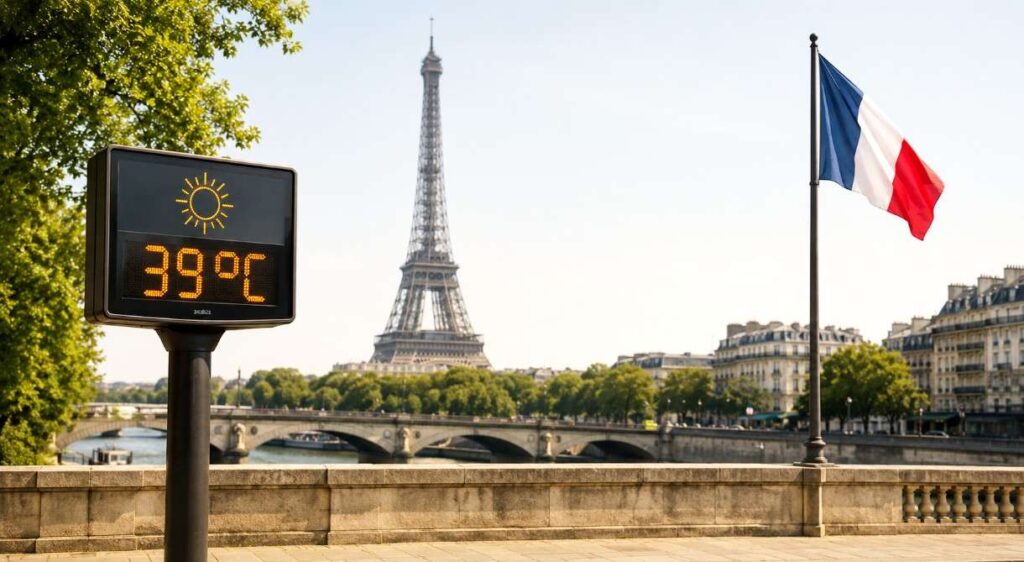
This Thursday, France is experiencing a political and social moment where seemingly separate events suddenly create a shared sentiment. An exceptional heatwave, the appeal trial of former President Nicolas Sarkozy, a new security debate within cities, concerns about purchasing power and energy, and hopes for a successful football summer are adding up to form national tension.
The French media now increasingly describe the nation not as a collection of individual crises but as a republic under continuous pressure. Particularly notable is how climate issues, public order, political authority, and national identity are closely interconnected.
The Heatwave as a Political Issue
The early and exceptional heatwave still dominates every news page. Temperatures rising to 39 degrees at the end of May are rare even in southern France. The Paris region is especially in focus, with reports leading on high ozone levels, overheated housing, increased burdens on the elderly, and pressure on emergency medical services.
Unlike a few years ago, French media no longer treat the heatwave as a peculiar weather phenomenon. Rather, it is seen as a visible sign of a new climate reality. Many commentators point to similarities with the 2003 heatwave disaster in France, where about 15,000 people died. At that time, it was perceived as a historical exception, but now the dominant perception is continuous climate change.
Therefore, the focus is increasingly shifting to structural questions:
- How well are French cities prepared for extreme temperature changes?
- Are heatwave precautions at schools and hospitals sufficient?
- How stable are electricity and water supplies despite frequent extreme weather events?
- What social impacts does urban overheating cause?
The problem is especially evident in Paris. High-density buildings and limited green spaces, along with hardened urban areas, strengthen the so-called ‘heat island effect.’ At the same time, criticism is growing about adaptation measures that have been delayed for years.
Sarkozy and the Crisis of the Old Political Order
Meanwhile, the appeal trial of former president Nicolas Sarkozy, related to the so-called Libya affair, continues to attract attention. In an emotional final statement, Sarkozy once again said, “I did not betray the French people.” However, French media are now discussing the historical significance of this trial more than the legal details.
This case is increasingly being interpreted as a symbol of the crisis of the traditional French right. Sarkozy once represented a strong and dynamic presidential image with almost monarchic authority. However, today his political era is overshadowed by allegations of exceeding institutional limits.
Many mainstream media see this simultaneously as a crisis of the entire Fifth Republic. The French presidential system traditionally concentrates enormous power in the head of state. The scandals of former presidents from Jacques Chirac to Sarkozy always imply institutional dimensions as well.
The conservative right appears even more weakened because of this. The centrist faction led by Emmanuel Macron is losing approval ratings, the National Rally continues to grow, while the existing Republicans lack convincing renewal.
Security Debate and Social Tensions
The heatwave simultaneously deepens social tensions in several cities. Some media report on damaged fire hydrants, impromptu street pools, and conflicts with police in suburban areas of major cities.
At the same time, tensions are rising ahead of the Champions League final and the expected security burden. Debates on drug crime, youth violence, and the condition of public spaces also continue.
Conservative newspapers in particular depict the state as increasingly losing control in certain urban areas. This narrative has a long tradition in France. Since the suburban riots of the 2000s, the issue of state authority in suburban areas has been regarded as a very sensitive political matter.
However, the connection between climate stress and social exhaustion is new. This debate is moving beyond simple crime issues to a broader discussion about social stability.
Energy Policy Between Mitigation and Transition
Another major issue is the introduction of a new electricity tariff called the so-called “heures super creuses.” Several providers are offering substantial discounts on nighttime electricity rates as incentives for households.
In the short term, relief for consumers is a priority. Considering the rise in living costs, even moderate savings carry political significance. In the long term, France’s attempt to make electricity consumption more flexible according to production peaks is crucial.
France still has the largest nuclear sector in Europe, but at the same time, it needs to integrate renewable energy efficiently. Flexible tariffs are considered a key strategy for the energy system of the future.
This debate touches a deep French consciousness. Since the oil crisis of the 1970s, energy policy has been regarded as an expression of national sovereignty. Nuclear power has symbolized independence and national planning capacity for decades. Now, the energy transition is fundamentally changing this model.
Football as a Symbol of the Republic
Meanwhile, interest in the French national football team is increasing ahead of the 2026 World Cup. President Emmanuel Macron’s visit to the Clairefontaine training center was also widely reported.
Sportingly, there is great hope for a third World Cup victory. But politically, this team also carries greater significance. Since winning the World Cup in 1998, the French national team has been regarded as a symbol of republican unity.
Especially during times of social division, football often replaces the integration function of the political system, which has become increasingly difficult to perform in France. President Macron also deliberately utilizes this symbolic power. National consciousness and major sporting events are often used as means for his social mobilization.
However, this unity is also unstable. The history of French football shows how quickly sporting enthusiasm can turn into social debates about identity, integration, and national representation.
Therefore, this Thursday France reveals itself as a country caught between adaptation and overload. The heatwave acts not just as a simple weather phenomenon but amplifies existing anxieties. Political scandals, insecurity in law enforcement, energy issues, and national symbols are increasingly merging into a single narrative about the resilience of the republic.
The key question is no longer whether France can overcome a single crisis. Rather, the core issue is whether the state and society can maintain sufficient stability, authority, and guidance ability in the long term to handle multiple crisis drivers simultaneously.