
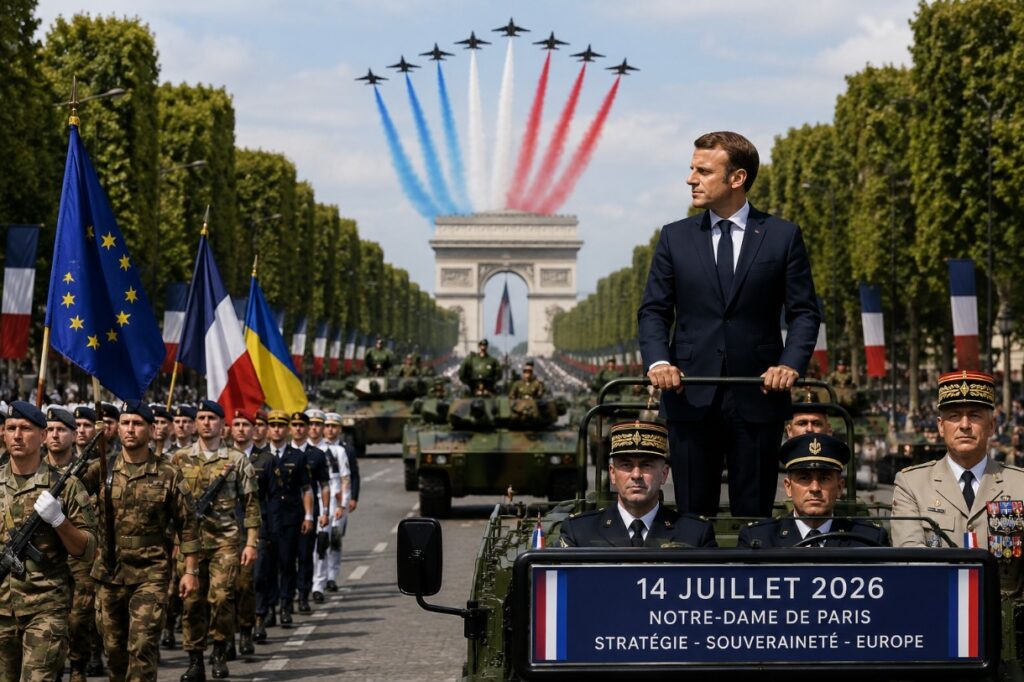
France’s national holiday on 14 July 2026 was far more than the traditional military parade on the Champs-Élysées. With this parade, Emmanuel Macron reviewed the troops for the tenth and final time as President of the Republic, also symbolically marking the end of his role as commander-in-chief of the French armed forces. The event became an impressive demonstration of French military power and European unity. The message was clear: France sees itself as Europe’s leading military power and claims a central role in the security of the continent in the face of the changing geopolitical situation.
In advance, the Élysée Palace had already announced that this national holiday was to be “historic.” In his traditional address to the armed forces, Macron spoke of Europe’s “strategic awakening.” Indeed, the parade differed significantly from previous editions. Rather than primarily celebrating military traditions, it placed the current security reality at the center.
Europe at the heart of the staging
For the first time, it was not a single guest country that was the guest of honor at the parade, but the “coalition of the willing” — those countries that support Ukraine militarily and politically. Around thirty heads of state and government had traveled to Paris. Among them were Ukrainian President Volodymyr Zelensky, NATO Secretary General Mark Rutte, and numerous European leaders. Together, they watched the parade from the honorary stand at Place de la Concorde.
A political signal was sent right at the opening. Soldiers from 35 partner countries led the procession on the Champs-Élysées. Nearly 500 members of allied armed forces marched together through central Paris, symbolizing European rapprochement. The appearance of the Ukrainian soldiers was followed particularly closely and welcomed by spectators with prolonged applause.
The parade directly followed on from the previous day, when Paris had hosted a summit of countries supporting Ukraine. Diplomacy and military symbolism thus merged into a deliberately staged demonstration of European resolve.
Record participation underscores leadership ambitions
The scale of the military parade also underscored the political ambition. A total of 6,686 soldiers marched down the Champs-Élysées. They were accompanied by 315 military vehicles, including numerous armored systems, 98 aircraft, 31 helicopters, and 193 horses from the Republican Guard. This made it the largest military parade of Macron’s presidency.
In the sky, the Patrouille de France traditionally opened the air parade. It was followed by fighter jets, transport aircraft, and helicopters of the French armed forces, as well as aircraft from several European partners. Two Mirage fighter jets with Ukrainian trainee co-pilots drew particular attention, another symbol of military cooperation.
On the ground, the French Army presented its most modern weapons systems. Leclerc tanks, Caesar artillery, Griffon and Jaguar vehicles, as well as modern drones illustrated the technological transformation of the French armed forces. For the first time, cruise missiles were also presented publicly in order to highlight the progress made in modernizing France’s deterrence and precision capabilities.
The message: Europe’s security begins in Europe
The guiding theme of the entire event was Europe’s “strategic awakening.” This expression has run through Macron’s speeches on foreign and security policy for several years and describes his ambition to make Europe more independent from the United States and more resilient in the face of military threats.
Since the Russian attack on Ukraine, France has consistently realigned its defense policy. Defense spending has been gradually increased, the arms industry strengthened, and cooperation with European partners intensified. At the same time, the idea of European autonomy in defense has gained considerable political importance.
In this context, the military parade was far more than a traditional national display. It became a political मंच from which France made its leadership ambitions within Europe visible. The combination of French armed forces and international contingents was intended to show that European security is increasingly being organized collectively.
A personal farewell after two terms
For Emmanuel Macron, this national holiday also had a personal dimension. Since taking office in May 2017, he had reviewed the troops every year on July 14 as President of the Republic. The 2026 event was his tenth and final parade in this role.
As the French Constitution allows only two consecutive terms, his presidency will end in spring 2027. Many observers therefore saw this national holiday as a symbolic assessment of his defence and security policy.
During his presidency, the defence budget has been continuously increased. With the update of the military programming law, a total of €436 billion has been allocated to the armed forces for the 2024–2030 period. The aim of these investments is a comprehensive modernisation of all branches of the armed forces, from nuclear deterrence and cyber defence to drones, space capabilities and conventional weapons systems.
The military parade thus presented the image of an army that has modernised technologically and now cooperates more closely than ever with its European partners.
Maximum security measures
Given the numerous international guests and the tense global situation, exceptionally strict security measures were in place. Access to spectator areas along the Champs-Élysées was only possible with personalised QR codes and identification documents. Major checkpoints, restricted zones and the massive deployment of police officers shaped the face of the capital.
The security measures reflected the growing challenges France has faced since the terrorist attacks of recent years, as well as in the context of international tensions.
The combination of a military presence and extensive domestic security clearly showed that protecting the country has long ceased to be regarded as the sole mission of the armed forces, but rather as a joint effort by the military, police, gendarmerie, and civil protection.
For more than a century, the military parade on the French national holiday has been among the Republic’s most important state ceremonies. However, it has rarely reflected the political challenges of its time as clearly as it did in 2026. Where national tradition, republican pride, and historical remembrance had previously predominated, European defense, deterrence, and international solidarity took center stage this time.
For Emmanuel Macron, this final Bastille Day became a political legacy. He used this globally watched platform to once again emphasize his vision of a sovereign European security architecture. Whether this strategic direction will be pursued after his departure from the Élysée Palace is likely to be among the central issues of the 2027 French presidential campaign.
Author: P. Tiko