
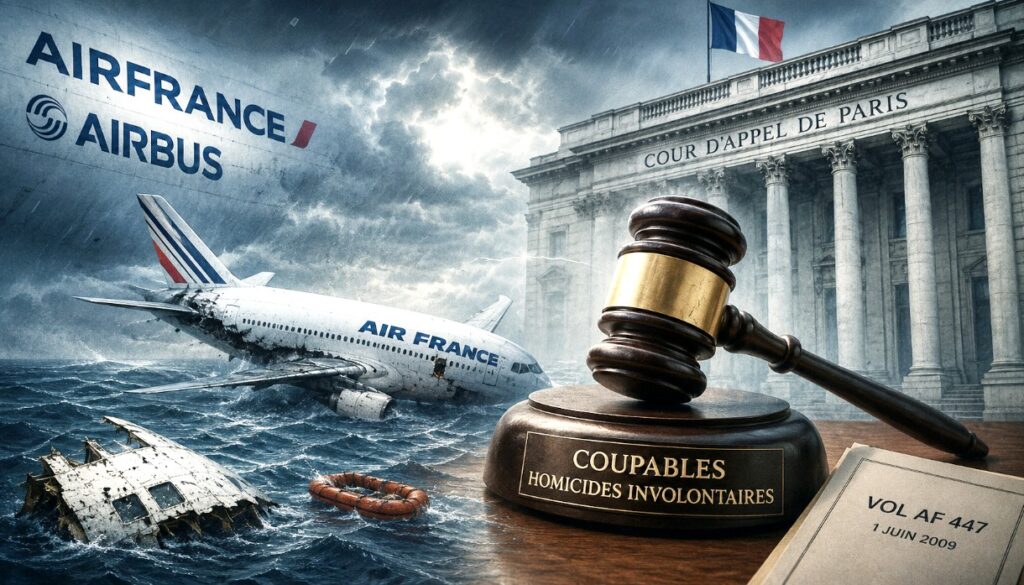
Some disasters never truly disappear from a country’s collective memory. The crash of Air France flight 447 between Rio de Janeiro and Paris is one of those wounds in France that remains open nearly two decades later.
The Court of Appeal in Paris recently issued a ruling that goes far beyond aviation: Airbus and Air France were convicted of manslaughter. For many relatives of the 228 victims, this decision marks a late moment of recognition — and at the same time the end of an almost endless legal marathon.
The crash on the night of June 1, 2009, is still considered one of the most mysterious and harrowing accidents in modern aviation. The aircraft disappeared over the Atlantic Ocean in a thunderstorm area from the radar. It was only years later that investigators managed to recover the wreckage and the flight data recorders from several thousand meters deep. A drama like from a novel — unfortunately bitterly real.
At the center of the investigation were frozen Pitot probes, small sensors on the outside of the Airbus A330. They measure the airspeed. It sounds technical, almost trivial. But these data are a crucial orientation point for pilots. When the sensors transmitted incorrect values, the cockpit entered a state of maximum overload within seconds.
Warning signals went off. Automatic systems partially switched off. The pilots lost control of the aircraft in the darkness above the Atlantic Ocean.
It later became clear: indications of problems with certain Pitot probes were already known to both Airbus and Air France before the crash. This is where the legal reasoning of the court is focused. The judges concluded that known risks were underestimated and necessary responses were implemented too late.
As a result, the earlier 2022 verdict, in which both companies were acquitted in criminal law, is overturned. The new judicial decision therefore has enormous symbolic value. Because in France, Airbus and Air France were long considered almost untouchable institutions — as technological and national prestige objects.
For many French people, Air France is more than just an airline. The carrier is part of the country’s self-image, comparable to the high-speed trains of the SNCF or the space industry in Toulouse. Airbus, on the other hand, symbolizes European engineering, industrial strength, and the dream of technological sovereignty vis-à-vis the US.
Precisely for this reason, the verdict feels like a quiet breaking of a taboo.
It is no longer only about individual errors in the cockpit. The case reveals the vulnerabilities of highly complex systems, where technology, training, safety culture, and economic decisions are intertwined. Guilt is often dispersed like fog — hard to grasp and hardly assignable clearly to a single person.
And exactly that makes the AF447 case so unsettling to this day.
Because the crash was not merely the result of a single wrong action. It arose from a chain of small oversights that together led to the disaster. A bit like a domino effect where no one believes that the first stone can really cause everything to collapse.
For the relatives, only one thing counts: the state officially acknowledges that more lay behind the accident than just tragic fate. Many families have been fighting for years against the feeling that their deceased have been lost in a sea of technical reports and legal nuances.
There is now at least a verdict.
However, the pain remains.