
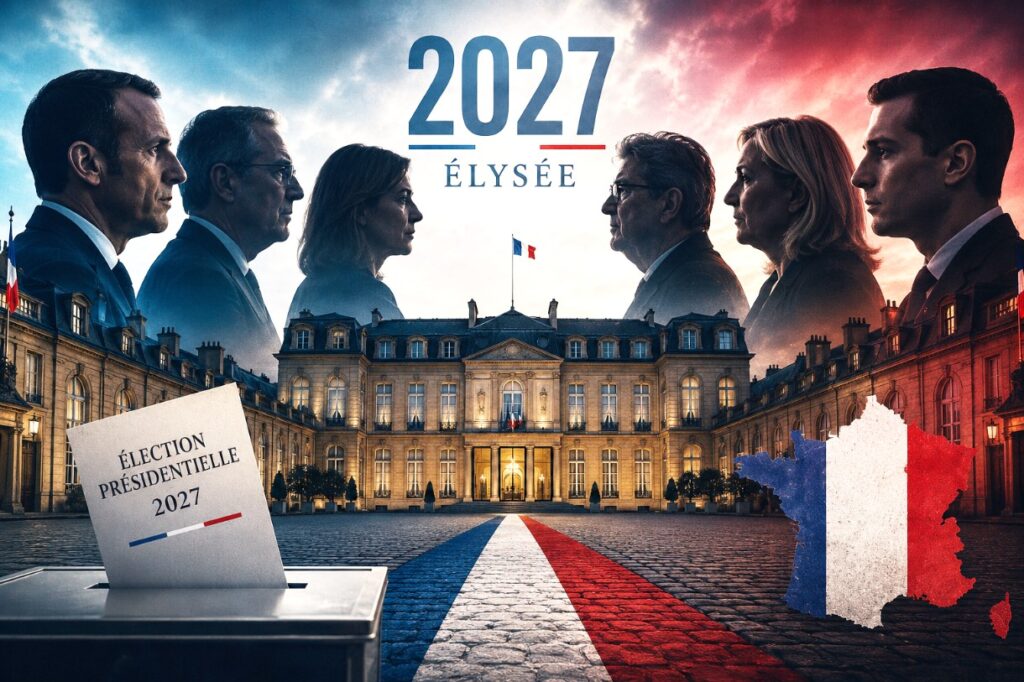
The French presidential election will take place in the spring of 2027, but political Paris is already in election mode. Candidates have announced their runs, party organizations are mobilizing, and the first large events are used as measures of political influence. At first glance, this may seem like an unusually early campaign, but it reflects a fundamental reorganization of the French party system. The era of clear political camps is over. What is replacing it is an increasingly fragmented landscape, with no political force clearly establishing itself as President Emmanuel Macron’s successor.
The Right Seeks Unity
On the conservative side, preparation has already taken a concrete form. Interior Minister Bruno Retailleau has been nominated as the presidential candidate by The Republicans party members, representing an attempt to regain influence after the party’s political decline. At the same time, Xavier Bertrand maintains his ambition, and David Lisnard, mayor of Cannes, has also entered the race following his departure from The Republicans.
Many conservative candidates illustrate the core dilemma of the French right. On the one hand, they hope to return to being a major political force, but on the other hand, there is the risk of vote splitting. Since the traditional People’s Party declined in 2017, The Republicans have not been able to establish a convincing leader who can continuously unite the various currents.
A more significant influence on the outcome of this election will likely be exerted by the National Rally (Rassemblement National). Marine Le Pen remains the leading figure in her political camp despite legal uncertainties. If she is unable to run for legal reasons, Jordan Bardella is expected to emerge as the most likely successor. The 30-year-old party leader has significantly raised his political profile in recent years and is regarded by many voters as a trustworthy representative of the new generation of the right-wing.
Left-wing, between hopes for unity and competition
The situation on the left side of the political spectrum is more complicated. Jean-Luc Mélenchon has reaffirmed his intention to run for president for the fourth time, pursuing the continuity of his political project. At the same time, a considerable portion of moderates and ecological left hope for a joint candidacy that goes beyond Mélenchon’s camp.
Several prominent politicians support the idea of a primary election. Marine Tondelier, François Ruffin, Clémentine Autain, Benjamin Lucas, and others see an opportunity to decide on a consensus candidate through an open primary. This vote could take place in the autumn.
This discussion recalls past attempts by the French left to overcome chronic divisions. However, political experience over the past few years shows that organizational integration does not necessarily lead to policy alignment. There are significant differences regarding European, economic, and security policies. Nevertheless, a successful primary election can at least establish the premise for maintaining competitiveness in the first round of voting.
Macron Camp, Searching for a Successor
The trends within the political center are particularly noteworthy. Emmanuel Macron, having served two terms, cannot run again, so for the first time in ten years, the question of his political successor has arisen.
Gabriel Attal has officially announced his candidacy, positioning himself as the natural successor to Macronism. The former Prime Minister has high name recognition and seeks to combine political renewal promises with achievements over the past few years. His challenge is to find a balance between continuity and differentiation. Being too close to Macron can be a burden, while being too far can harm the cohesion of the government camp.
At the same time, interest in Raphaël Glucksmann is also growing. As a Member of the European Parliament, he has clearly refined his political profile over the past few years, attracting voters who do not belong to the left-wing opposition camp or traditional Macronism. His public activities and planned large-scale events will be a test of whether his popularity can develop into a genuine presidential candidacy.
The Importance of Early Endorsements
Political alliances play a central role in the early stages of this campaign. Endorsements from mayors, members of parliament, regional officials, and prominent figures go beyond a mere symbolic gesture. They demonstrate political competence and build the trust of potential voters.
Historically, this dynamic has often been decisive. Emmanuel Macron quickly gathered prominent supporters in 2017 to legitimize what was then a young movement. Nicolas Sarkozy and François Hollande also relied on their broad networks within their political camps before being elected.
There is also a practical aspect. In France, presidential candidates must submit support endorsements from a certain number of elected officials. Building a strong network early on can improve both public perception and the organizational starting point.
The Changing Political Landscape
The 2027 presidential election is likely to be one of the most open and unpredictable elections in the history of the Fifth Republic. Unlike previous election cycles, there is no clear front-runner dominating the current political landscape. Traditional parties are trying to reclaim lost ground, and new political movements are seeking a sustainable base. At the same time, economic uncertainty, geopolitical tensions, and growing social distrust toward established institutions are transforming the societal atmosphere.
The coming months will be characterized more by strategic positioning than policy debates. Only those who can form alliances, overcome intra-party competition, and develop a credible vision for the future will hold a decisive advantage. The one thing certain right now is this: even if the actual campaign has not yet begun, the political race toward the Élysée Palace started long ago.
Author: P. Tiko