
No.
We do not.
Heat can be endured for a few days. Accepting weeks of exhaustion as the new normal is something entirely different.
Yet that is precisely what is happening.
The exception becomes routine.
Warnings become background noise.
Outrage becomes a shrug.
That may be the greatest achievement of our time: we get used to crises faster than we develop solutions.
Instead of discussing how cities could finally become cooler, homes better insulated, or working hours organized more flexibly, we would rather debate whether 39 degrees is still hot or already “quite warm.”
France now seems to have developed an astonishing talent for managing symptoms.
A drinking fountain here.
A shady park there.
A press conference.
A few brochures.
Done.
As if recommending that a patient with a broken leg be a little more careful when walking in the future.
It becomes especially grotesque when people in air-conditioned ministries talk about how well the population has adapted.
Of course it has.
What other choice does it have?
Those who live in top-floor apartments adapt.
Those who work on construction sites adapt.
Those who work in agriculture under the blazing sun adapt.
Those who cannot sleep a wink at night adapt as well.
Adaptation sounds like strength.
In truth, it often means nothing more than this: there is no choice.
Perhaps we should stop celebrating ourselves for this capacity to suffer.
After all, a society does not prove its strength by silently accepting ever more hardship.
It proves it by recognizing grievances before resignation becomes a reason of state.
That is why the most dangerous sentence this summer is not: “Today, temperatures will reach 40 degrees.”
The most dangerous sentence is: “You get used to it.”
Because once a society begins to get used to the unacceptable, it loses the ambition to change it.
And that is exactly when the heat wins.
Not outside.
But in our minds.
Andreas M. Brucker
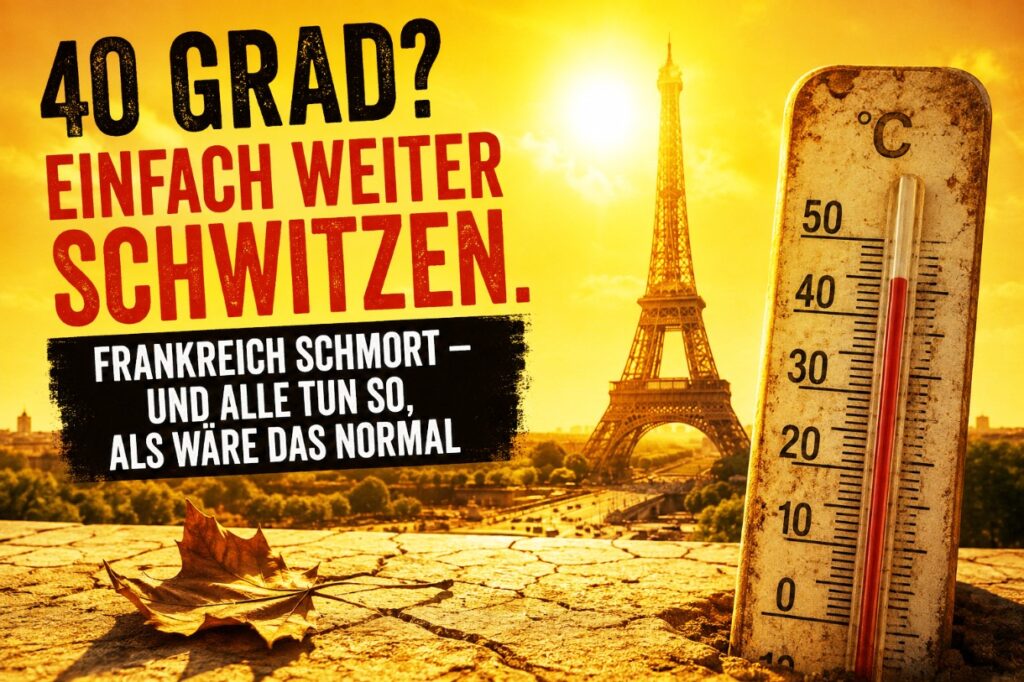
France is sweating. Again.
Actually, that is the wrong way to put it. France is no longer sweating – France is cooking. Slowly. Steadily. Over a low flame. And the official response now resembles a waiter politely explaining to a guest in a burning restaurant that the soup is unfortunately a little hotter than usual today.
43 departments under heat warnings. Maybe more tomorrow. Maybe fewer the day after. So what? The main thing is that the warning app still works before the smartphone gives up due to overheating.
By now, everyone knows the ritual by heart.
The meteorologists warn. The politicians appeal. The media show pictures of children in fountains. Someone interviews an ice cream seller who is pleased about the good business. Then an expert, wearing a serious expression, explains that people should avoid physical exertion between noon and 4 p.m.
Really?
The roofer is deeply grateful. So is the road worker. The care worker without air conditioning on their ward will no doubt also receive this information with great interest.
Some advice is about as helpful as the suggestion that one should try to stay dry in the rain.
What is particularly fascinating, however, is our ability to rationalize any nonsense.
38 degrees?
“We had that in the past, too.”
40 degrees?
“It was only one day.”
Third heatwave?
“Summers have always been warm.”
Of course. There used to be dinosaurs, too. That still does not make them a suitable means of transport.
The truth is more uncomfortable.
It is not the individual heatwave that is changing France.
It is its persistence that is changing France.
People used to wait for summer.
Today, they wait for it to finally disappear again.
People sleep badly. They work worse. Nerves are frayed. Apartments turn into ovens. Cities store the heat like a battery that has forgotten how to discharge. Even at night, the air feels as if it were coming straight from the hairdryer of an overenthusiastic hairdresser.
And yet, you still hear this sentence.
“We simply have to endure it.”
Andreas M. Brucker
Andreas M. Brucker
No.
We do not.
Heat can be endured for a few days. Accepting weeks of exhaustion as the new normal is something entirely different.
Yet that is precisely what is happening.
The exception becomes routine.
Warnings become background noise.
Outrage becomes a shrug.
That may be the greatest achievement of our time: we get used to crises faster than we develop solutions.
Instead of discussing how cities could finally become cooler, homes better insulated, or working hours organized more flexibly, we would rather debate whether 39 degrees is still hot or already “quite warm.”
France now seems to have developed an astonishing talent for managing symptoms.
A drinking fountain here.
A shady park there.
A press conference.
A few brochures.
Done.
As if recommending that a patient with a broken leg be a little more careful when walking in the future.
It becomes especially grotesque when people in air-conditioned ministries talk about how well the population has adapted.
Of course it has.
What other choice does it have?
Those who live in top-floor apartments adapt.
Those who work on construction sites adapt.
Those who work in agriculture under the blazing sun adapt.
Those who cannot sleep a wink at night adapt as well.
Adaptation sounds like strength.
In truth, it often means nothing more than this: there is no choice.
Perhaps we should stop celebrating ourselves for this capacity to suffer.
After all, a society does not prove its strength by silently accepting ever more hardship.
It proves it by recognizing grievances before resignation becomes a reason of state.
That is why the most dangerous sentence this summer is not: “Today, temperatures will reach 40 degrees.”
The most dangerous sentence is: “You get used to it.”
Because once a society begins to get used to the unacceptable, it loses the ambition to change it.
And that is exactly when the heat wins.
Not outside.
But in our minds.
Andreas M. Brucker