
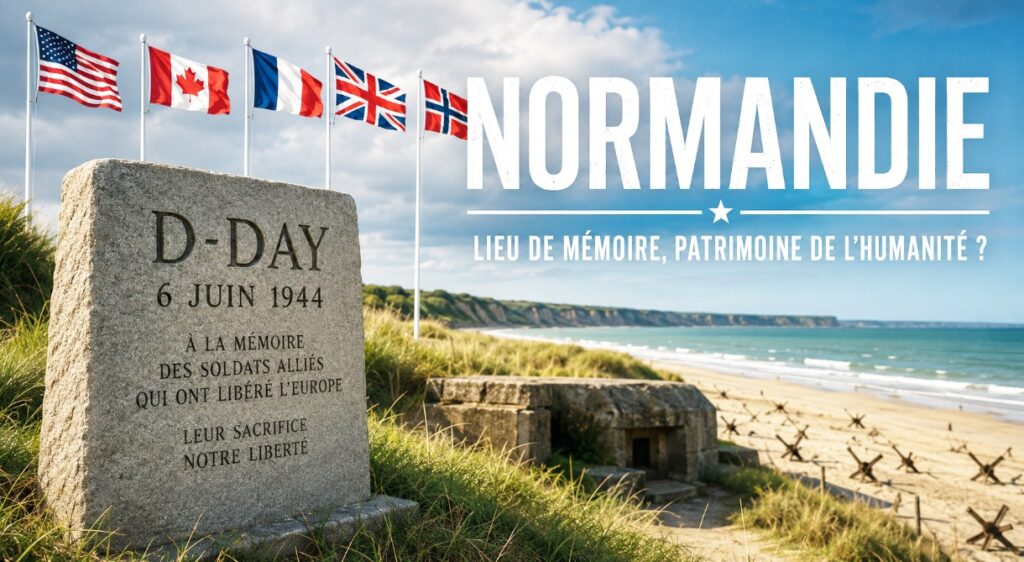
They bear names that have long become part of the collective memory: Utah Beach, Omaha Beach, Gold Beach, Juno Beach and Sword Beach. On June 6, 1944, tens of thousands of Allied soldiers landed here to open a new front in Western Europe against Nazi Germany. More than eight decades later, Normandy’s beaches may receive a new historic distinction: they are on the verge of being recognized as a UNESCO World Heritage Site.
The decision will be made at the end of July 2026 during the 48th session of the UNESCO World Heritage Committee in Busan, South Korea. The prospects are considered excellent. A draft decision now before the committee explicitly recommends inscribing the “D-Day Landing Beaches, Normandy, 1944” on the World Heritage List as cultural heritage of outstanding universal value. However, the final decision will only be made once the committee votes.
An application nearly two decades in the making
The path to possible recognition has been long. As early as 2008, the Normandy region began preparing a nomination together with the French state, the municipalities concerned, historians and heritage conservationists. In 2014, the landing beaches were added to France’s tentative list, a prerequisite for a later UNESCO application. The actual dossier was submitted in early 2018.
The scale of the application illustrates the scope of the undertaking. The main document comprises around 500 pages, supplemented by more than 18,000 pages of maps, expert reports, historical evidence, photographs and administrative records. Nevertheless, the process stalled.
The reason was not any doubt about the historical significance of D-Day. Rather, UNESCO first had to answer a fundamental question: under what conditions can sites of more recent wars and armed conflicts be granted World Heritage status?
This debate had far-reaching implications. Places of war remembrance always carry the risk of privileging national perspectives or placing military achievements at the forefront. UNESCO therefore developed guidelines under which such sites are understood not as symbols of victory, but as places of remembrance, historical reckoning and international reconciliation.
Only after these fundamental issues had been resolved was France able to update its application. The dossier was revised, the management plan expanded and the application resubmitted in early 2025. Over the following twelve months, international expert bodies reviewed the documentation and assessed its outstanding universal value.
More than a stage for military history
The application focuses not solely on the military operation of June 6, 1944. Rather, the landing beaches are described as an interconnected cultural landscape in which the traces of two opposing military systems have been preserved to this day.
Numerous remnants of the Atlantic Wall, with its bunkers, gun emplacements and defensive installations, can still be found along the coast. Opposite them are relics of the Allied invasion: artificial harbor facilities, sunken ships, military roads, landing sites and numerous archaeological traces on land and underwater. This heritage is complemented by military cemeteries, museums, memorial sites and historic locations such as Pointe du Hoc and the artificial harbor at Arromanches.
The application deliberately avoids glorifying military achievements. Instead, it views the landscape as a symbol of the struggle against the Nazi dictatorship, the liberation of Europe and the difficult path toward reconciliation after the war. It is not victory itself that is to be honored, but a place where remembrance, warning and peacebuilding come together.
This idea has been visible in Normandy for decades. At the annual commemorations, delegations from the United States, the United Kingdom, Canada, France and Germany take part together. Former adversaries have become partners. Veterans, relatives and visitors from around the world meet at a place that today stands less for military triumph than for shared remembrance.
Five beaches tell world history
The proposed World Heritage Site encompasses the five major landing sectors along the coast of the Manche and Calvados departments. Utah Beach and Omaha Beach were assigned to American forces, Gold Beach and Sword Beach to British formations, while Juno Beach was assaulted by Canadian troops. The site also includes cliffs, dune landscapes, coastal towns and numerous military and archaeological remains.
Omaha Beach in particular remains a symbol of the heavy losses suffered on D-Day. American soldiers came under intense German defensive fire immediately after landing. Hundreds died in the water or on the open beach. Above the coast, the American military cemetery at Colleville-sur-Mer, with its endless rows of white grave crosses, commemorates the victims of that day and ranks among Europe’s most striking memorial sites.
Yet the other beach sectors also represent decisive chapters of the invasion. Utah Beach provided the link to airborne operations inland. At Juno Beach, Canadian formations fought to secure their bridgehead, while British and French units advanced from Sword Beach toward Caen. Only the entirety of these sites conveys the scale of a military operation involving forces from numerous nations, whose success decisively influenced the further course of the Second World War.
World Heritage status brings responsibility
For Normandy, inscription on the World Heritage List would be far more than a symbolic honor. The designation entails extensive obligations to protect the historic landscape. Future construction projects, tourism developments and interventions in the coastal region would have to be coordinated even more closely with heritage protection requirements.
This task is gaining importance in the face of growing challenges. The landing beaches are among France’s most visited sites of remembrance. At the same time, tourism infrastructure, hotel capacity and holiday accommodation are expanding in many places. The effects of climate change must also be considered. Coastal erosion, rising sea levels and more frequent extreme weather events are already threatening individual historic remains.
While UNESCO recognition could attract additional visitors, it would also create better opportunities to manage tourism sustainably, protect sensitive areas and further develop the interpretation of history. World Heritage status is not a one-time distinction; it entails a lasting commitment to careful conservation and regular review of the protection strategy.
Remembrance without eyewitnesses
The possible decision comes at a time of historical transition. Only a few D-Day veterans are still alive today. The generation of Normandy civilians who experienced occupation, bombing and liberation firsthand is also steadily disappearing.
This is also changing the form of remembrance. Where personal accounts once took center stage, historic sites, museums, archives and educational work now take on the task of keeping the events alive for future generations. The landing beaches thus become authentic testimonies to a past whose direct eyewitnesses are scarcely still present.
For this very reason, possible recognition by UNESCO carries particular significance. It would honor the beaches not exclusively as French or Allied heritage, but as part of a shared history of humanity. They stand for the consequences of dictatorship and war as much as for the value of freedom, democracy and international cooperation.
Thus, 82 years after D-Day, the issue is no longer the celebration of a military success. The focus is on how Europe and the international community wish to preserve the memory of war, oppression and liberation. Normandy’s beaches are far more than a coastal landscape. Beneath their sand, in their cliffs and among the remnants of the Atlantic Wall lies a place where Europe’s fate took a decisive turn.
Should the World Heritage Committee decide on inscription at the end of July, it would be less a belated award than a mandate for the future. The memory of the victims of D-Day and the price of freedom would then be placed permanently under the special protection of the global community.