
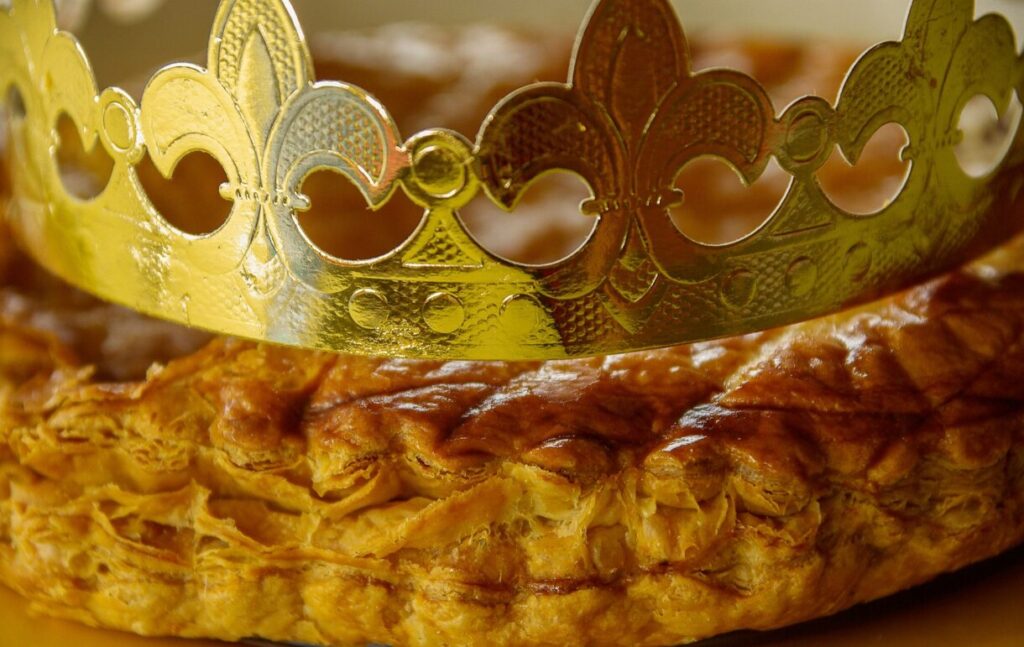
French families celebrate the end of the holiday season with a pastry fit for kings. Here is the story of the Galette des Rois – a cake that can make you feel like a king.
As with many festivals in France, the Epiphany also has a special meal.
While Christmas and New Year’s revolve around oysters and foie gras, January 6th is all about the Galette des Rois (Cake of the Kings).
What is a Galette des Rois?
Basically, it is a frangipane tart made of dough, butter, ground almonds, and a few extra ingredients that strain an already full waistline one last time before the January diet begins.

It is eaten every year on January 6th to celebrate the Epiphany – when the three kings appeared to bring gifts to the baby Jesus.
The tradition of eating this cake dates back to the 14th century. According to legend, the cake was meant to attract the kings for the Epiphany celebration.
Interestingly, during the French Revolution, the name was changed to Gâteau de l’égalité (Equality Cake) because being a king was not really fashionable at the time.
But it’s just a cake?
The Galette des Rois is not just about having a cup of tea and something sweet. There is an ancient protocol to follow, and it all has to do with the little magic the bakers hide inside the cake.
First, the youngest child must hide under the table and tell the person cutting the cake who should get which piece.
The person who finds the lucky charm, also called the Féve, in their piece (as long as they don’t swallow it) gets to put on the crown that comes with the tart, and then names their king or queen.
Then everyone sits down and simply eats it – usually accompanied by cider or champagne.
Is there only one type of Galette?
Non, non, non. While traditionalists, and there are quite a few in France, insist on the original recipe and shape, French pâtissiers are becoming ever more inventive when it comes to these galettes.
Even though no two galettes are exactly alike in pâtisseries anyway, some have worked especially hard to stand out from the crowd.
In recent years, one of the most prestigious pâtisseries in Paris, Fauchon, created a galette shaped like a giant pair of lips. Of course, they couldn’t stick to the original recipe and added passion fruit, raspberry, and rose petals.
Competitor Dalloyau named their own creation the “Crystal Galette,” which comes with a touch of bitter orange and vanilla from Papua New Guinea. They even added crystals to the crown.
New recipes are constantly being created, including galettes with chocolate chips and nuts, caramelized apple and dried fruits, or almond, pear, and chocolate.
And of course, Richard Legay, the famous baker from the Parisian Marais district, is always reliable when it comes to preparing the galette in his own way. His Boulangerie Legay Choc is known for creating pastries in the shape of penises.
What is this all about?
It is, of course, tradition. According to the newspaper Direct Matin, the originally pagan custom dates back to Roman times, when festivals honoring the gods were held between late December and early January.
Masters and slaves ate together, and a bean (fève) was placed in one of the dishes. Whoever got it was crowned the king of the festival.
When the church introduced the Epiphany to celebrate the arrival of the Three Wise Men, the tradition of the bean in the cake remained.
I would hate to find a bean in my cake…
Fortunately, around 1870 the bean was replaced by a variety of figures made of porcelain or – more recently – plastic, although the fève used to be an actual bean.
These figures used to be shaped like babies to represent Jesus, but today they can be just about anything, from a car to a shoe.
True Galette des Rois fanatics collect these figures year after year and build up a fine arsenal of little trinkets. A man named Bernard Joly reportedly has over 1,200 pieces according to France TV.
Some bakers, fearing legal action if someone chokes, now place the figures outside the galette and leave it to the buyer to hide them.
So everyone in France will have their cake and eat it today?
Pretty much. Bakeries in France love this time of year as their sales get a boost from the galette’s popularity.
Only Emmanuel Macron does not have the chance to become “king” on this day.
The French president, due to etiquette rules, is not allowed to “become king” on Epiphany. “That is why a traditional galette without a figurine and crown is served in the Élysée Palace.”
