
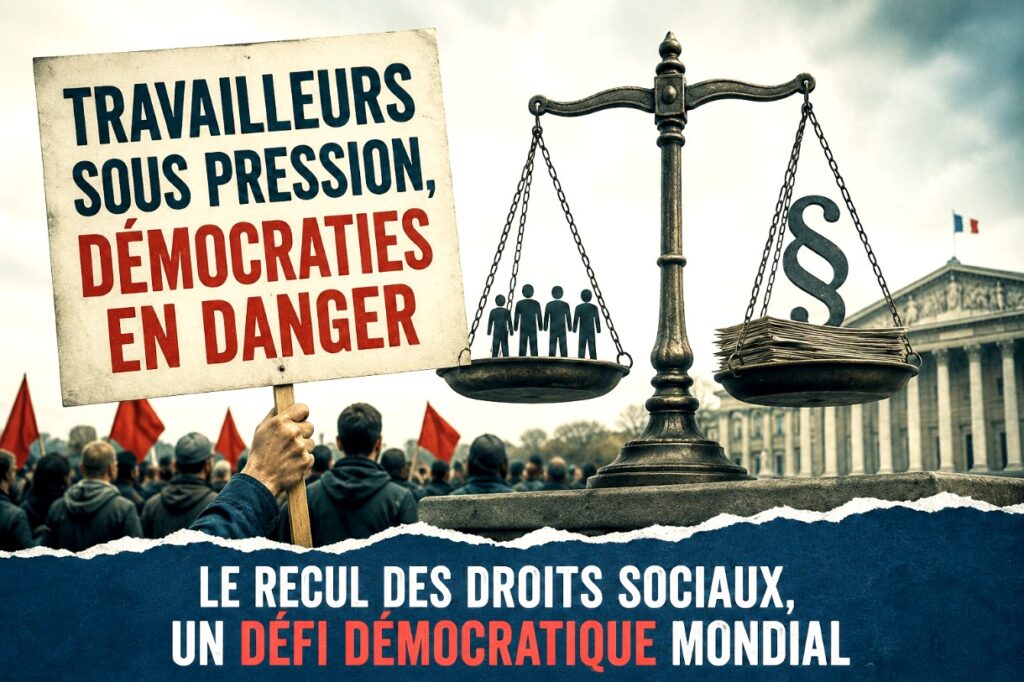
Workers’ rights are often seen as established achievements in Western democracies. Unions are institutionally anchored, collective bargaining is part of everyday economic life, and the right to strike is regarded as a natural component of the social market economy. But this impression is deceptive. The latest global union index by the International Trade Union Confederation (ITUC) paints a different picture: workers’ rights are coming under pressure worldwide – increasingly even in places where they were long considered secure.
The ITUC’s diagnosis is remarkably sharp. The organization does not speak of isolated setbacks or regional misdevelopments, but of a “systemic crisis.” This refers to a development that goes far beyond labor law issues. Because where employees lose their rights to organize, collectively bargain, or strike, the power balance within society also changes.
The Gradual Dismantling of Social Freedoms
The numbers are alarming. By 2025, 87 percent of the countries examined violated the right to strike. In four out of five countries, collective bargaining was restricted. Almost three-quarters of states made it harder for workers to access the judiciary. What initially may seem like a technical debate about labor law actually touches on fundamental principles of democratic order.
Modern labor law historically emerged as a corrective to economic concentration of power. Individual workers generally have a weaker bargaining position against companies. Unions and collective agreements are meant to balance this inequality. When these instruments are weakened, the balance of power shifts in favor of employers and state authorities.
This dismantling rarely happens openly. Strike opportunities are often made more difficult through administrative requirements, demonstrations restricted, or more and more professional groups classified as “essential,” making work stoppages practically impossible. The intervention then appears technical and pragmatic – but its political effect remains the same.
Europe’s Uncomfortable Reality
Particularly remarkable is that the ITUC does not limit its criticism to authoritarian states. Although some of the worst countries in the world remain regimes such as Belarus, Myanmar, or Egypt, Europe, traditionally regarded as a stronghold of social rights, also shows a continuous deterioration according to the index.
The development is surprising at first glance. Europe’s welfare states have strong labor law institutions, high union membership rates, and established systems of social partnership. Nevertheless, unions observe increasing restrictions on strike rights, as well as a tougher stance by state authorities toward labor disputes.
France exemplifies this tension. The country has a long tradition of social mobilization, from 19th-century labor movements to mass protests against pension reform in recent years. Precisely for this reason, it is striking that state bodies increasingly resort to instruments that used to be exceptional. Forced obligations for certain employee groups or an expanded definition of indispensable services gradually change the conditions for collective protest.
The question is not whether a state may protect critical infrastructure. Of course, ensuring the population’s supply is essential. What matters is whether exceptions become the rule. Where that happens, the right to strike loses its character as an effective pressure tool and becomes a symbolic right without practical enforceability.
Unions as Democratic Institutions
The political significance of this development is often underestimated. Unions are not merely representatives of workers’ interests. They are among the central intermediary institutions of modern democracies.
Political scientist Robert Dahl once described pluralistic organizations as indispensable components of democratic systems. They create countervailing power, bundle societal interests, and prevent the concentration of political or economic authority. Unions fulfill exactly this function.
Historically, authoritarian regimes almost always regard independent workers’ representation as a threat. From fascism in Europe to military dictatorships in Latin America to today’s autocracies in Asia or Africa: the elimination of free unions regularly ranks among the first steps in political power consolidation.
The connection is understandable. Those who organize at the workplace learn collective action, political articulation, and institutional resistance. Unions thus produce social capital that extends far beyond wage issues.
The New Power Question of Globalization
At the same time, economic globalization changes the conditions for union influence. Digital platforms, international supply chains, and transnational corporations complicate traditional forms of collective organization.
While capital today is almost freely mobile, workers’ rights largely remain nationally organized. Companies can relocate production sites or offer services across borders. Employees have significantly fewer alternatives. This increases pressure on governments to interpret labor standards flexibly in international competition.
There is also a structural shift in power relations. In many economies, capital returns have risen more strongly than wages in recent decades. At the same time, union membership has declined in many countries. This development does not necessarily mean a decline in living standards, but it does imply a change in bargaining power.
This is precisely where the ITUC’s warning comes in. The organization sees a connection between growing economic concentration and the weakening of collective workers’ rights. Whether one fully agrees with this diagnosis or not: the question of balancing economic efficiency and societal participation remains central.
Democracies are measured not only by free elections or independent courts. Equally crucial is the ability of their citizens to articulate interests and balance power. The right to strike, collective bargaining autonomy, and freedom of association are therefore more than labor law tools. They form part of the democratic infrastructure that processes social conflicts peacefully and institutionally.
When this infrastructure erodes, it usually happens gradually. No democracy is shaken by restricting a single strike. But the ongoing erosion of collective rights changes political culture in the long term. Workers lose influence, civil society loses room to act, and economic power becomes harder to control.
The global union index reminds us that social rights are not historical givens. They must repeatedly be defended, justified, and adapted to new economic realities. Where this does not happen, not only the position of workers is at stake, but the resilience of democratic societies themselves.
Author: Andreas M. Brucker