
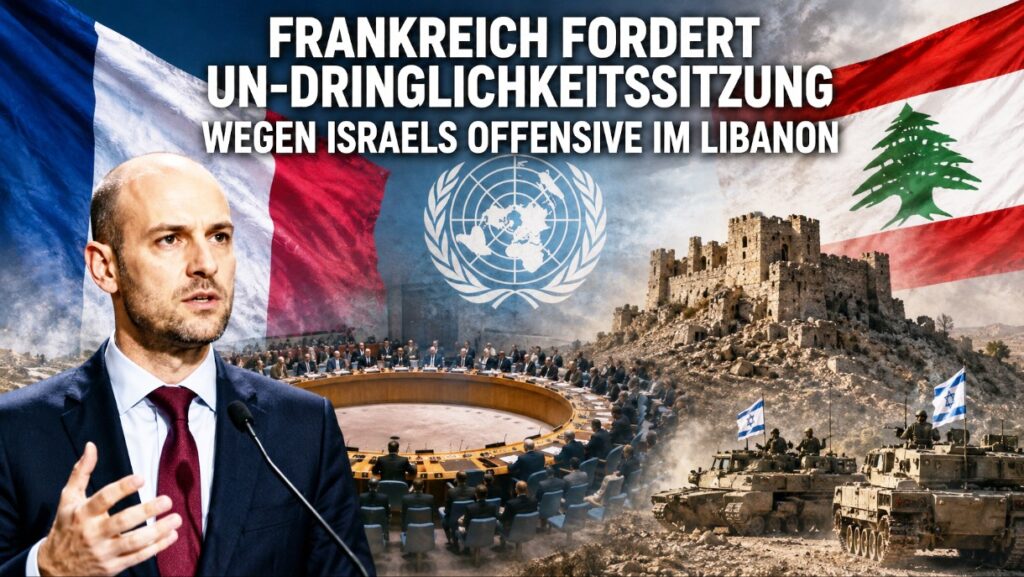
France has requested an emergency meeting of the UN Security Council after Israel significantly expanded its military operations in southern Lebanon. Foreign Minister Jean-Noël Barrot described this as a “serious mistake” by Israel, marking one of the sharpest French reactions to the recent developments in the Israeli-Lebanese conflict.
Paris continues to emphasize Israel’s right to self-defense against attacks by Hezbollah. However, according to the French government, the current Israeli offensive goes far beyond this objective. Barrot stated that nothing can justify the continuation of military operations in Lebanon and the ever-deeper presence of Israeli troops on Lebanese territory. From France’s perspective, the actions violate both the existing ceasefire and international law.
The diplomatic initiative was triggered by the Israeli army’s capture of the strategically important Beaufort Fortress, also known as Chqif. The medieval site is situated on a hill overlooking large parts of the Litani Valley and holds both military and symbolic significance. Observers interpret the conquest as a sign that Israel intends to expand its control in southern Lebanon.
The French government views this as a breach of the ceasefire effective since April 17. Barrot argues that Israel had committed to limiting its military activities. Therefore, the recent territorial gains contradict international agreements designed to prevent further escalation.
The Security Council meeting requested by France is to address the situation and discuss possible diplomatic measures. However, the prospects for far-reaching resolutions are considered limited. As in past conflicts, the United States, as a permanent Security Council member, could block resolutions that sharply condemn Israel or propose concrete actions.
The choice of words by the French Foreign Minister is notable. In recent months, Paris had tried to adopt a balanced stance: supporting Israel’s security interests on one hand, while criticizing military overreactions and violations of international humanitarian law on the other. By terming the situation a “serious mistake,” France is visibly toughening its tone.
Underlying this position is concern about further destabilization of the Middle East. French diplomacy fears that an expansion of fighting between Israel and Hezbollah could engulf all of Lebanon and trigger new regional tensions. For Paris, not only the adherence to existing agreements is at stake but also whether the painstakingly built diplomatic efforts of recent months will endure.
France’s initiative also underscores the country’s ambition to continue playing an active diplomatic role in the Middle East. As a traditional partner of Lebanon and a permanent member of the UN Security Council, Paris seeks to influence the dynamics of the conflict and prevent further escalation. Whether the emergency meeting will yield concrete results remains open. Politically, the move sends a clear message: France views the recent military developments as a threat to regional stability and calls for a swift international response.
Author: P. Tiko