
Why actually?
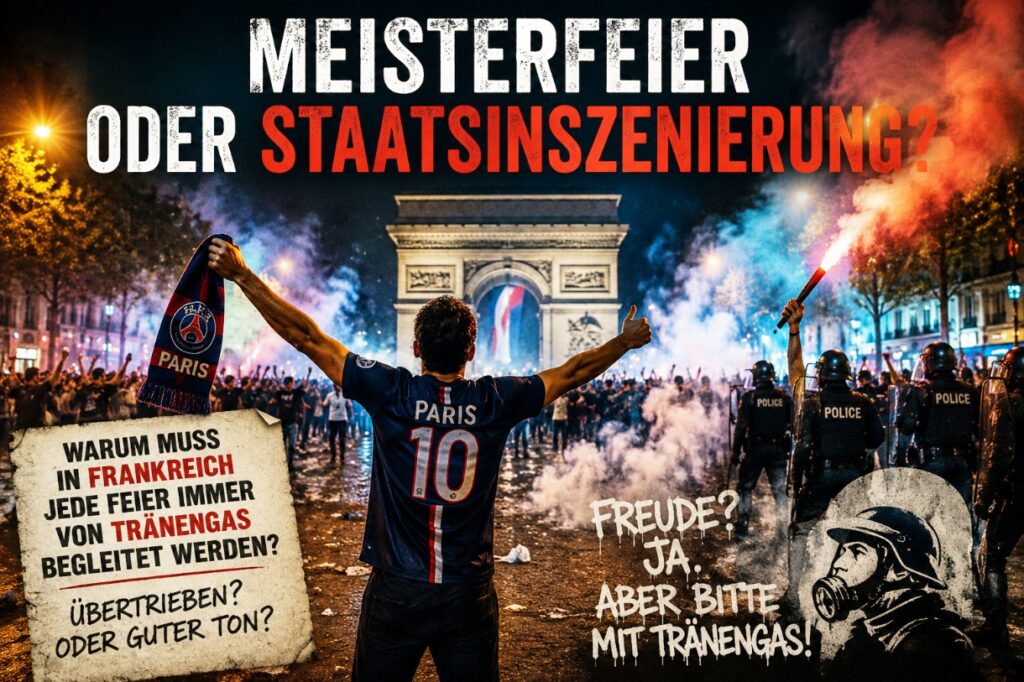
Why does nearly every large gathering in France sooner or later turn into a major security experiment? Why isn’t it enough for hundreds of thousands of people to simply celebrate, cheer, sing, and go home? Why does it always seem that someone believes the scent of tear gas is an indispensable part of the national event calendar?
Paris Saint-Germain wins the Champions League. A historic moment for many fans. The streets fill with joy, emotion, and enthusiasm. For a brief moment, one might think the people are simply celebrating together.
But then what happens is something that has almost become ritualistic in France.
Sirens.
Police lines.
Smoke clouds.
And of course, the inevitable political debate about who is actually to blame.
Sometimes one wonders if the operational plans include the sentence: “As soon as a certain number of joyful citizens is reached, the maximum escalation level must automatically be initiated.”
Of course, there are violent offenders. Of course, there are troublemakers who use every opportunity to set cars on fire, smash shop windows, or attack police officers. No one with common sense will defend that.
But that is exactly why the French reflex reaction often seems so odd. Instead of targeting the troublemakers specifically, the impression regularly arises that entire crowds are being treated as if under general suspicion. Families, teenagers, football fans, tourists – all suddenly caught in a situation more reminiscent of a state of emergency than a sports celebration.
And then people are surprised about tensions.
Who could have guessed?
When people stand amid flares, barricades, and tear gas clouds, a relaxed festival atmosphere rarely develops. Surprisingly, people don’t always respond to pressure with gratitude.
Particularly noteworthy is the political routine. Some defend every measure of the security forces as if it were about saving the republic. Others act as if only the authorities are responsible for the riots. In between, reality disappears somewhere in the fog—sometimes literally.
The real question should be: Why do other countries regularly manage to let large crowds celebrate without it turning into a societal stress test?
In France, on the other hand, every major event seems to follow an unspoken script. First the euphoria. Then the escalation. Afterwards the TV debates. Finally, the mutual blame.
And a few weeks later, it all starts over again.
Maybe that is the real tragedy. Not the violence of some rioters. Not the political quarrels. But the fact that many French people have long since come to expect it. As if it simply belongs.
A championship celebration without police controversy?
Without tear gas?
Without burning trash bins?
Almost suspicious.
Sometimes one wants to shout to those responsible: just let the people celebrate. Not every crowd is a security risk. Not every cheering mass is a threat to the state. And not every night full of emotions has to inevitably end in a cloud of smoke and political outrage.
But maybe that is now precisely France’s problem: exaggeration is no longer an accident.
It has become a habit.
By C. Hatty