
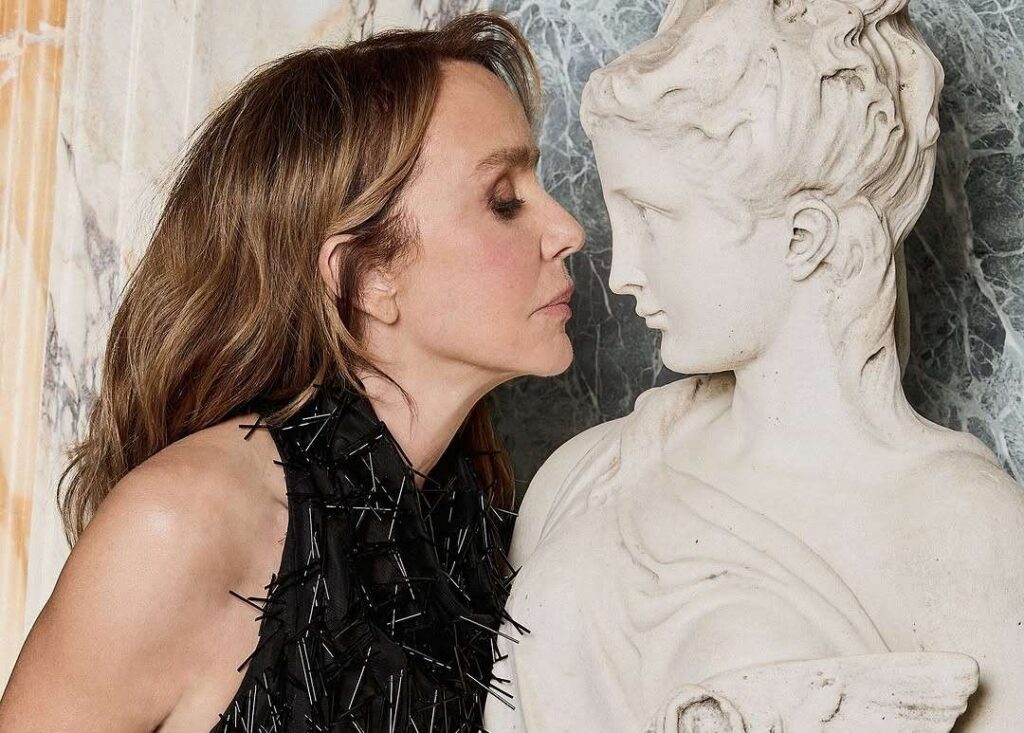
There are people who seem to have decided one day to stop chasing the noise of the world. Philippine Leroy-Beaulieu appears to be one of them.
At 63, the French actress suddenly finds herself at the center of a cultural phenomenon that goes far beyond fashion, television series, or glamour. Millions of people know her as Sylvie Grateau in the series Emily in Paris — cold, elegant, with a sharp tone. A woman with poise. But the real fascination does not come from designer blazers or French chic. It comes from something much rarer.
Inner calm.
Or at least the attempt to achieve it.
Because when Philippine Leroy-Beaulieu talks about self-confidence, it sounds pleasantly imperfect. No stock phrases. No toxic positivity. No “you just have to believe in yourself enough.” Instead, she talks about boundaries, contradictions, and the exhausting work of putting up with oneself.
And that is precisely why so many people are listening to her today.
Perhaps because the subject of self-confidence now seems completely overdone.
Everywhere, guides, podcasts, and motivational videos await, explaining how to become the best version of yourself. Meditate in the morning. Take cold showers. Think your way to success. Smile more. Doubt less. Modern life sometimes resembles an endless optimization course.
Those who do not keep up quickly feel like a defective device.
Philippine Leroy-Beaulieu counters this with something that seems almost old-fashioned: serenity.
And honesty.
She openly says that self-confidence does not suddenly fall from the sky. Not at twenty. Not at forty. Perhaps never completely. Rather, it develops slowly — like a landscape that changes over the years. Through experiences. Through disappointments. Through moments when one realizes that constantly adapting eventually becomes exhausting.
She speaks particularly clearly about saying no.
A small word.
And for many women, a permanent construction site.
Because entire generations learned early on to remain pleasant. Not to offend. To restore harmony. To mediate. To be considerate. But anyone who constantly tries to be loved by everyone eventually loses touch with their own voice. That is precisely what Philippine Leroy-Beaulieu warns against.
She says that she did not consciously make certain compromises over the course of her career — even if this led to professional disadvantages. At first, it sounds like the classic pose of an artist. But in her case, it seems less like rebellion than self-preservation.
How often do we betray ourselves out of fear of disappointing others?
This question runs like a thread through many of her remarks.
And suddenly, it is no longer just about an actress.
But about a mindset.
Perhaps this also explains why it is mainly women over forty who react so strongly to her. Philippine Leroy-Beaulieu embodies a form of femininity that has become surprisingly rare on social media. She does not present herself as an eternal teenager. She does not conceal aging behind filters or artificial youth.
She rather resembles someone who has understood that beauty eventually changes character.
At twenty, beauty often functions as an entry ticket.
Later, more as an attitude.
The face suddenly begins to tell stories. Fatigue. Joy. Losses. Irony. Perhaps even liberation.
Of course, Philippine Leroy-Beaulieu remains an exceptionally attractive woman. But the true radiance arises elsewhere. In the way she speaks. In that mixture of distance and warmth. In the impression that she no longer has anything to prove to anyone.
And that is precisely what irritates many people today almost more than perfection.
For our age thrives on constant proof.
You have to be visible.
Present.
Relevant.
Every thought is published, every meal photographed, every success documented. Even doubts now often appear as small marketing campaigns. “Authenticity” has long been part of the business model.
Philippine Leroy-Beaulieu, by contrast, seems almost anti-digital.
Not demonstrative.
Not moralizing.
Rather like a woman who one day decided to stop directing all her energy exclusively outward.
It sounds simple. But it isn’t.
Anyone who truly lives independently of other people’s judgment pays a price for it. You are misunderstood. Not always appreciated. Sometimes even excluded. Many people underestimate how closely self-confidence can be linked to loneliness.
Philippine Leroy-Beaulieu also speaks about this surprisingly openly.
She does not say that vulnerability disappears. On the contrary. The strongest people are often particularly sensitive. It is just that some people eventually learn to protect themselves better without becoming completely hardened.
Perhaps that is where true maturity lies.
Not becoming invulnerable.
But remaining open without constantly losing yourself.
It almost recalls old French films, where characters smoked, remained silent, and did not immediately label their complicated feelings in therapeutic terms. Back then, a look was often enough for an entire dialogue. Today, on the other hand, every emotion is immediately analyzed, named, and discussed online.
That is why people sometimes long once again for personalities like Philippine Leroy-Beaulieu.
People with nuance.
With contradictions.
With wrinkles that do not seem erased like unwanted typos.
It remains interesting that her success is reaching its peak precisely now. In an industry that has treated youth like a religion for decades.
Hollywood and much of the fashion world long told women the same story: visibility has an expiration date. With age, many actresses disappear from leading roles, magazine covers, and advertising campaigns — as if attractiveness had a biological expiration date.
Philippine Leroy-Beaulieu refutes this narrative with an almost effortless elegance.
Not combative.
Not loud.
Rather through presence.
That is what makes her impact so powerful.
Because she does not preach revolution. She simply shows another possibility through her example.
And perhaps people need that today more than ever.
Not perfect role models.
But credible people.
People who do not constantly pretend to have life completely figured out.
In interviews, Philippine Leroy-Beaulieu often speaks about authenticity. A word that now sounds rather overused. With her, however, it takes on a different meaning. Being authentic apparently does not mean displaying every emotion publicly. But living in inner harmony with oneself.
A quiet form of clarity.
Someone who accepts themselves automatically seems more convincing. Not because everything suddenly works perfectly. But because there is no longer a constant inner war being fought.
Others sense it immediately.
Everyone knows people who are objectively beautiful yet still seem insecure. And others who walk into a room and immediately draw attention—without classical perfection.
Charisma rarely comes from perfection.
Rather, from sincerity.
Philippine Leroy-Beaulieu seems to have understood exactly that.
Perhaps that is why she fascinates younger generations. Not despite her age, but precisely because of it. In an era full of digital self-optimization, someone who seems more or less at peace with themselves appears almost radical.
Of course, much about her is also staged. After all, actresses make a living from it. But even her elegance never seems sterile. More like an old cashmere sweater that has been worn for years and has character precisely because of that.
A little wrinkled.
But authentic.
And perhaps that is precisely the real conclusion of this story.
Self-confidence does not mean feeling great.
Often, it simply means not constantly questioning yourself.
Not having to win every room.
Not trying to please everyone.
Not fighting every wrinkle as if one’s dignity depended on it.
It may seem trivial.
But it is terribly difficult.
Because the modern world thrives on keeping people in a state of permanent insecurity. Those who accept themselves consume fewer desires. Fewer promises. Fewer artificial lacks.
Perhaps this is why Philippine Leroy-Beaulieu appears to many as an antidote.
Not perfect.
Not unattainable.
But free.
And freedom probably remains the most appealing form of self-confidence.
Who does not wish to reach the point one day where the judgment of others becomes weaker than one’s own inner voice?
Philippine Leroy-Beaulieu seems to be quite close to that state.
At least, that is the impression it gives.
And honestly—just that alone seems almost revolutionary today.
An article by M. Legrand