
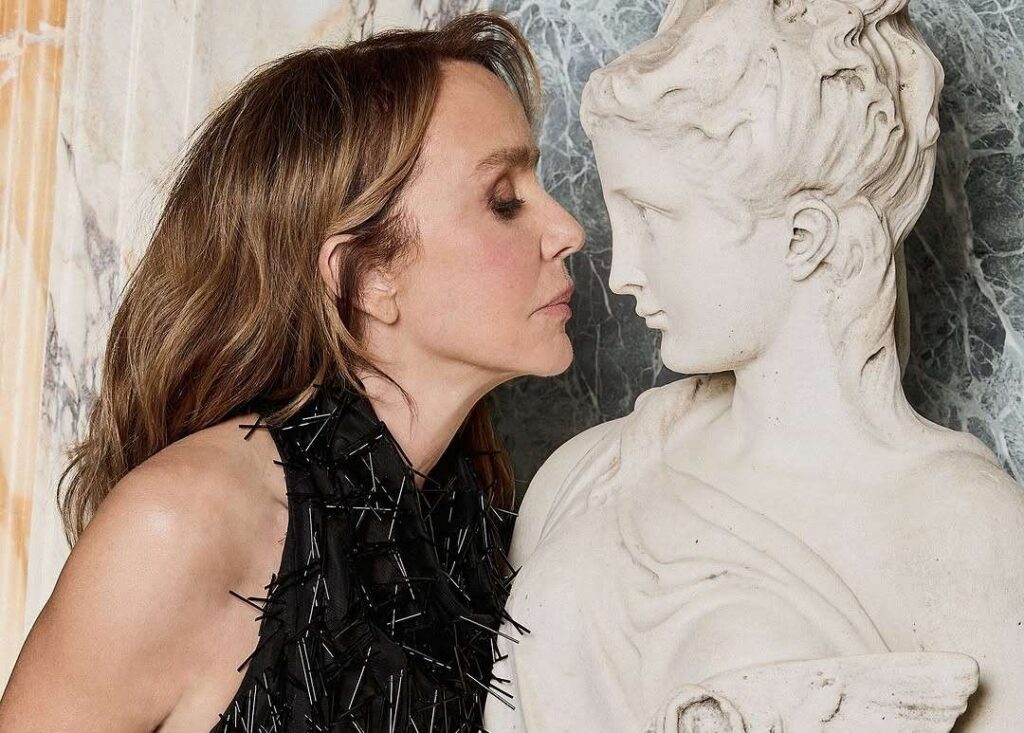
There are people who seem to have decided at some point to just stop trying to keep up with the world’s hustle and bustle. Philippine Leroy-Beaulieu appears to be one of them.
This 63-year-old French actress suddenly finds herself at the center of a cultural phenomenon far beyond fashion, drama, and glamour. Many know her as Sylvie Grateau from “Emily in Paris”—cool, elegant, and sharp. A woman with poise. But the real charm is not born from designer blazers or French chic. It comes from something rarer.
Inner calm.
Or at least the attempt at it.
When Philippine Leroy-Beaulieu talks about confidence, it sounds comfortably imperfect. There are no clichés. No toxic positive thinking. No phrases like “you just have to strongly believe in yourself.” Instead, she speaks about boundaries, contradictions, and the painstaking effort to endure oneself.
That is why now many people are listening to her.
Perhaps because the theme of self-trust is now being excessively hyped.
Everywhere there are guides, podcasts, and motivational videos hidden, preaching “how to become your best version.” Meditate in the morning. Take cold showers. Think about success. Laugh more. Doubt less. Modern life sometimes sounds like an endless obstacle course of optimization.
Those who can’t keep up with it quickly feel like a broken machine.
Philippine Leroy-Beaulieu, in contrast, presents something that seems almost old-fashioned: calmness.
And honesty.
She frankly says that confidence does not suddenly fall from the sky. Whether at 20, at 40, it may perhaps never fully arrive. Rather, it is born slowly—as a landscape that changes over many years. Through experience. Through disappointment. Through the moment of realizing that constantly adapting wears a person out over the years.
She speaks clearly, especially about saying “no.”
A small word.
And a lifelong challenge for many women.
For generations, people have been taught from an early age to be kind. To avoid causing waves. To create harmony. To mediate. To be considerate. If you constantly strive to be liked by everyone, you will eventually lose your connection to your own voice. This is exactly what Philippine Leroy-Beaulieu warns about.
She says that she deliberately made no compromises in her career — even if it brought disadvantages at work. At first, it might sound like a classic artist’s pose. But in her case, it seems closer to self-preservation than defiance.
How many times does a person betray themselves out of fear of disappointing others?
This question runs as an undercurrent through many of her statements.
And suddenly, it is no longer just a story about an actress.
Rather, it is about a sense of how to live.
Perhaps that is why women especially over forty react strongly to her. Philippine Leroy-Beaulieu embodies a form of femininity that has become surprisingly rare on social networks. She does not portray herself as an eternal girl. Nor does she hide her age behind filters or artificial youth.
Instead, she seems like someone who has understood that beauty will eventually change character over time.
In your twenties, beauty often functions like a ticket of entry.
After that, it becomes more like an attitude.
The face suddenly begins to tell a story. Fatigue. Joy. Loss. Irony. Maybe even liberation.
Of course, Philippine Leroy-Beaulieu remains an extraordinarily charming woman. But the true aura comes from somewhere else. In the way she speaks. In the blend of distance and warmth. In the impression that she is not trying to prove anything to anyone.
And that is what today confuses many people more than perfection.
Because our present is built on constant proof.
Being seen is demanded.
Showing presence.
Being important.
Every thought is made public, every meal photographed, every success documented. Even self-doubt can now sometimes seem like a small marketing campaign. “Authenticity” is already part of a business model.
In contrast, Philippine Leroy-Beaulieu almost appears anti-digital.
Not showing off.
Not preaching.
Rather, like a woman who decided that one day she would no longer completely direct her energy outward.
It sounds simple, but it is not.
Those who truly live independently of others’ evaluations pay a price. They are misunderstood. They are not always liked. Sometimes they are even excluded. Many people underestimate how closely confidence and loneliness are connected.
Philippine Leroy-Beaulieu speaks surprisingly frankly about this aspect as well.
She does not say vulnerability disappears. On the contrary, she says that the strongest people are often especially sensitive. But some learn how to better protect themselves someday without completely hardening.
Perhaps that is where true maturity lies.
It is not about becoming invincible.
Rather, it is about maintaining transparency without constantly losing oneself.
It is reminiscent of old French films. A time when characters smoked, kept silent, and did not immediately therapeutically classify complex emotions. Once, dialogue could consist of just one glance. Today, every emotion is instantly analyzed, named, and debated online.
That is why, from time to time, people seek out figures like Philippine Leroy-Beaulieu again.
People with subtle intermediate tones.
People who carry contradictions.
People who have wrinkles that are not retouched and do not look like unloved typos.
She does not say vulnerability disappears. On the contrary, she says that the strongest people are often especially sensitive. But some learn how to better protect themselves someday without completely hardening.
Perhaps that is where true maturity lies.
It is not about becoming invincible.
Rather, it is about maintaining transparency without constantly losing oneself.
It is reminiscent of old French films. A time when characters smoked, kept silent, and did not immediately therapeutically classify complex emotions. Once, dialogue could consist of just one glance. Today, every emotion is instantly analyzed, named, and debated online.
That is why, from time to time, people seek out figures like Philippine Leroy-Beaulieu again.
People with subtle intermediate tones.
People who carry contradictions.
People who have wrinkles that are not retouched and do not look like unloved typos.
What is interesting is that right now, her success is at its peak. In an industry that has treated youth like a religion for decades.
Hollywood and much of the fashion world have long told women the same story: visibility has an expiration date. As they age, many actresses disappear from leading roles, magazine covers, and advertising campaigns—as if attractiveness had a biological shelf life.
Philippine Leroy-Beaulieu almost effortlessly overturns that narrative.
She is not struggling.
Nor is she loud.
Rather, it is through her presence.
That is what strengthens her influence.
She is not preaching a revolution. She is simply living and showing another possibility.
And perhaps people today need that more than ever before.
Not a perfect model.
Reliable people.
People who do not always pretend to fully understand life.
In interviews, Philippine Leroy-Beaulieu often talks about authenticity. It is now a rather overused word, but in her case, it takes on a different meaning. Being authentic seems to mean not exposing all emotions publicly, but living in alignment with oneself internally.
A quiet kind of clarity.
People who accept themselves naturally have presence. It’s not because everything suddenly falls perfectly into place. It’s because they no longer have to fight a constant internal battle.
That immediately comes across to others as well.
Everyone knows someone who looks objectively beautiful but still seems anxious. And there are also people who draw attention just by entering a room without the classic perfection.
An aura rarely comes from flawlessness.
It rather comes from authenticity.
Philippine Leroy-Beaulieu seems to understand exactly that.
Perhaps that is why she appears attractive even to the younger generation. Not despite her age, but rather because of it. In an era filled with digital self-optimization, people who are somewhat at peace with themselves often appear almost radical.
Of course, she probably has a lot of staging as well. After all, that is how actresses make a living. But even her elegance never looks sterile. It resembles an old cashmere sweater worn for many years, and therefore has character.
A little wrinkled.
But genuine.
And perhaps therein lies the true point of this story.
Confidence is not about feeling wonderful about yourself.
In many cases, it simply means not constantly questioning yourself.
You don’t have to win in every situation.
You don’t have to try to be liked by everyone.
You don’t have to fight every wrinkle as if your dignity depends on it.
It may sound ordinary.
But it is truly difficult.
The modern world is built by placing people in constant anxiety. People who accept themselves consume desires less. They seek promises less. They no longer seek artificial flaws.
Perhaps that is why, to many people, Philippine Leroy-Beaulieu appears like an antidote.
Not perfect.
Not unapproachable.
Rather, free.
And perhaps freedom is the most attractive form of confidence.
Is there anyone who wouldn’t want to reach a point where the opinion of others becomes quieter than their inner voice?
Philippine Leroy-Beaulieu seems to be quite close to that state.
At least, that’s how it appears.
And honestly — just that alone feels almost revolutionary today.
Article: M. Legrand