
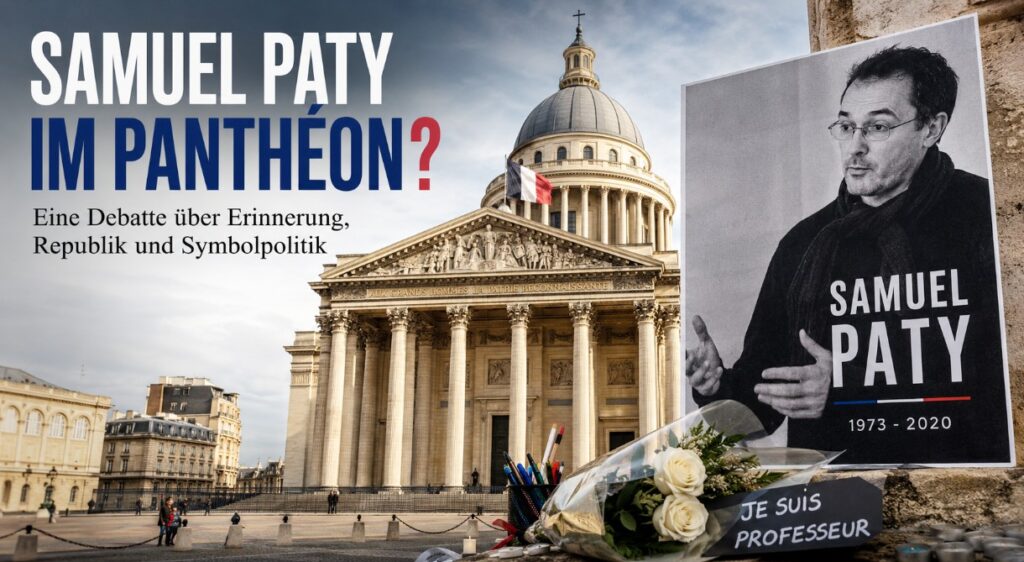
The question of whether Samuel Paty should be inducted into the Panthéon touches much more than the recognition of a single person. It leads right into a fundamental debate about how France narrates its recent history, whom the Republic counts among its heroes, and how it responds to Islamist terrorism that struck at the heart of the public school system.
For supporters of Panthéonization, it is beyond doubt that Samuel Paty has long become a symbolic figure. The history teacher was murdered on October 16, 2020, after he had discussed freedom of expression and the Mohammed cartoons in class. His death deeply shook the country and shaped the national consciousness as profoundly as the attacks on Charlie Hebdo.
His sister Mickaëlle Paty is particularly committed to this recognition. From her perspective, an induction into the Panthéon would not only preserve the memory of her brother but also highlight the Republic’s fundamental pillars: freedom of expression, secularism, and education. This position is supported by several prominent politicians, including former Prime Minister Édouard Philippe.
In this interpretation, Samuel Paty embodies a civil servant who lost his life because he fulfilled his duty. He taught critical thinking and republican values—precisely the principles that extremists fight against. His supporters therefore argue that the Panthéon was created especially for personalities whose personal fate gains greater national significance.
But this is exactly where the contradiction begins.
Many educators find the idea of Panthéonization uncomfortable. In a widely noticed statement, several history and geography teachers expressed unease about the increasing heroization of their murdered colleague. Samuel Paty did not die because he wanted to be a martyr. He was murdered simply because he was doing his job.
This distinction weighs heavily. Numerous teachers fear that the symbolic elevation of their colleague could create the impression over time that teachers must be willing to risk their lives for republican values. Many reject this firmly. They see themselves not as heroic figures but as professionals who deal daily with staff shortages, bureaucratic burdens, and social tensions.
Here lies another point of criticism. A solemn ceremony in the Panthéon could easily give the impression that the state honors a deceased teacher with great pathos while leaving the structural problems of the education system unresolved. Some critics see this as the danger of symbolic substitution.
Politically, the debate does not follow classic party lines. Conservative and centrist forces often view Panthéonization as a strong statement against Islamism and attacks on secularism. Others point out that most personalities in the Panthéon became famous through scientific, literary, or political achievements. Samuel Paty, by contrast, would be honored primarily as a symbol.
Ultimately, it comes down to a fundamental question: What should the Republic celebrate? A person, a story of victimhood, or the values he unwillingly represents?
That is why the discussion remains so emotional. It is not only about Samuel Paty. It is about France’s self-conception, its culture of memory, and the role that school, freedom, and secularism play in the republican ideal.
Author: Andreas M. Brucker