
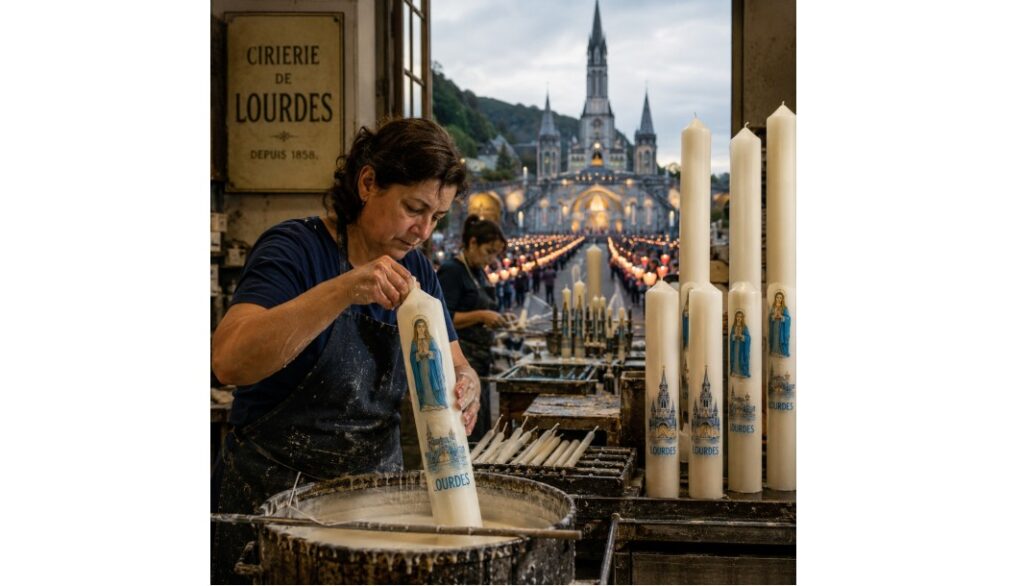
The morning in Lourdes is filled with an indescribable smell. A hint of warm paraffin, a faint sootiness, and the heavy air rising from workshops where the same handcrafted movements have been repeated for decades. Outside the first pilgrims are already walking along the Boulevard de la Grotte, and behind those unassuming facades a work belonging to the soul of the town is beginning—indispensable like the tolling of bells or the whisper of prayers.
There, women gather around long workbenches, threading wicks through molten wax again and again. Over and over. Their movements precise, like a rehearsed dance.
Some have worked here for thirty years.
Others for forty.
Their hands have long since learned to think for themselves.
Lourdes lives on hope. It sounds grand and stirring, almost like a line from a Sunday sermon. But in this small town at the foot of the Pyrenees, the concept takes on a surprisingly concrete form: in the shape of a candle. Each year millions of visitors come here to light small candles at the Grotte de Massabielle, to carry parade candles metres high at night, or to place a flickering light for the dead. Candles are more than religious objects; they extend people’s longings.
And between prayer and commerce, an impressively durable craft has grown here.
Visiting these workshops, you will not see folkloric performances staged for tourists, nor the elegant romance of a museum; you will see work. Real work. The rooms look purely functional, sometimes almost rough. Metal racks. Wax drippings on the floor. Heat. Large vats of molten material. Among them women in aprons, rarely looking up, every movement required to be exact.
Because pilgrimage candles must not be handled carelessly.
Especially the giant candles carried in Marian processions require fingertip experience. The wax must be neither too hot nor too cool, and the wick must maintain precise tension. Any slight unevenness will cause it to burn crookedly or unstably afterwards. Outsiders often only see a simple product, but in Lourdes the manufacturing process is more like a silent ritual.
“This is not learned from books,” a worker said in a local TV report, wiping wax spots from the skin with the back of his hand. The sentence sounds plain, yet it reveals much about France.
For years the country has been discussing lost industries, fading trades and an increasingly digital working world. Between artificial intelligence, start-up culture and automated supply chains, places like Lourdes have become almost time capsules: gestures, repetition and muscle memory still matter.
Or, as the French put it eloquently: avoir le métier dans les doigts.
To have the craft in the fingers.
What a beautiful expression.
It describes not a technical qualification, but a bodily wisdom — knowledge engraved over years of movement. The hands of these women will remember temperature, resistance and the tension of materials, much like a musician remembers chords. Those who have been pulling candles for a long time seem even able to judge the right consistency just from the sound the wax makes. Almost unbelievable, isn’t it?
The city of Lourdes often seems to exist between two realities: on one hand the spiritual—pilgrims holding rosaries, patients in wheelchairs, hymns echoing across the square at night; on the other hand a highly organized faith economy: inns, souvenir shops, restaurants, religious goods stores. Faith creates demand, demand creates work.
The candle factory is one of the unassuming engines of that town.
When you light a candle at dusk, few people think of this place.
Yet many people’s livelihoods depend on it.
An older resident of Lourdes once said that in the past almost every family knew someone involved in the pilgrimage in some way: someone ran pilgrimage buses, someone sewed religious banners, someone made candles. The whole town was like a small cosmos revolving around spirituality. Today, many things are changing. Cheap imports depress prices, young people flock to big cities, traditions quietly fade away, often without drama.
For that reason, seeing these workshops is especially moving.
Because there, some things that have already disappeared elsewhere still continue.
Of course, candle production also has modern elements: safety standards, supply logistics, machinery for certain processes. No one would romanticize twelve-hour workdays in steaming paraffin vapors. Yet the core has surprisingly been preserved: many actions are still done by hand. Especially for large procession candles, people trust experienced women workers more than fully automated processes.
There, routine nearly replaces all theory.
The making follows a rhythm close to meditation. Dip the wick, pull it out, cool it, then coat it with a new layer of wax. Dip again, rotate again. For hours. The process almost evokes the repetitious rituals of worship. Perhaps because of this, a unique link forms between production and spirituality. Even the work itself seems to be influenced by the tempo of the pilgrim city.
Outside, people walk down the streets singing.
Inside, the candles grow taller by the centimeter.
Sometimes, the two worlds blur into one another.
The nighttime processions are particularly striking. Thousands of small lights move slowly through the darkness, looking from afar like a glowing river. Those who have taken part do not easily forget the scene. The giant candles at the front are almost theatrical: flames tremble in the wind, wax drips slowly, sounds echo across the square.
But before that image appears, somewhere on the outskirts of town, women at workbenches inspect those candles inch by inch.
It is a hidden labor.
Perhaps that is why it is so fascinating.
In France there is a deep cultural respect for savoir faire, that hard-to-translate word somewhere between skill, experience and style. You feel it with bakers, winemakers, tailors or cheesemakers. Lourdes adds a spiritual dimension to this tradition: the craft here does not produce luxury items for gourmets, but objects charged with emotional meaning.
In Lourdes, few people simply buy a candle casually.
It almost always carries a story.
A prayer for a seriously ill mother.
A remembrance of a deceased father.
A hope for recovery.
Or just the wish for a moment of comfort.
Perhaps it is this weight of stories that explains the seriousness of the work in the workshop. Nothing produced there is an arbitrary consumer good. Every candle later disappears into a personal narrative. The workers know this. Some have accompanied the same pilgrimage seasons, the same summer peaks, the same processions for decades. They seem to be living through an annual cycle traced by light.
Yet there is little discussion about them.
Pilgrims take photos of the cathedral,
but few people press the shutter for these workshops.
And these places happen to tell some of today’s European stories: about regions striving to maintain identity between tourism and tradition, about professions whose value cannot be measured by productivity alone, and about the female labor that has long been overlooked yet supports an entire economy.
In Lourdes, candle production is mainly carried out by women. It is a matter of generations. Many start very young, sometimes directly after school. The work demands endurance, concentration, and very high precision. Hands show age earlier here; heat and wax leave their marks on the skin. At the same time, a tacit solidarity often forms among colleagues: they know each other’s movements, take over with mutual understanding, and together carry heavy molds.
A small world.
Almost like a family.
Today, traveling across France, you will frequently feel the acceleration of cultural rhythms. City centers become homogeneous, small shops disappear, traditions turn into tourist decoration. By contrast, Lourdes appears oddly resilient. Of course there are neon signs and plastic souvenirs here too, but beneath the surface some ancient things continue.
These candle-making women are part of that continuity.
Their work is not glamorous: no charm, no halo of rediscovery by the city’s artisanal-fashion trend. No one is filming a Netflix series about the wax factory beneath the Pyrenees. Perhaps that is where their dignity lies. They do not work for fashion, but for continuity.
Day after day.
One flame after another burns.
It can be said: as the outside world grows ever more hurried, Lourdes maintains a slower sense of time. It holds to repetition, ritual and patience. Perhaps for that reason many come here seeking solace. Not only out of religion, but for that increasingly scarce experience of constancy.
A candle burns very slowly.
It does not flicker.
It does not send push notifications.
It needs attention.
Perhaps there is a mute contemporary lesson in this.
In an era of continual acceleration, the workshops of Lourdes are almost subversive: there, experience matters more than self-display; products are not produced in seconds but accumulate layer by layer across shifts; there, hands still carry weight.
Who would have thought a little candle could tell so much of France’s story?
About faith.
About labor.
About memory.
And about those whose names are almost unknown—without them, Lourdes’s famous torchlight processions would not have the same effect.
When nightfall makes the flames dance along the church’s outline and pilgrims raise their candles to the night sky, the workshops are no longer visible. No one thinks of melted wax or heavy metal molds anymore. What is visible is only the light.
Perhaps that is enough.
An article by M. Legrand