
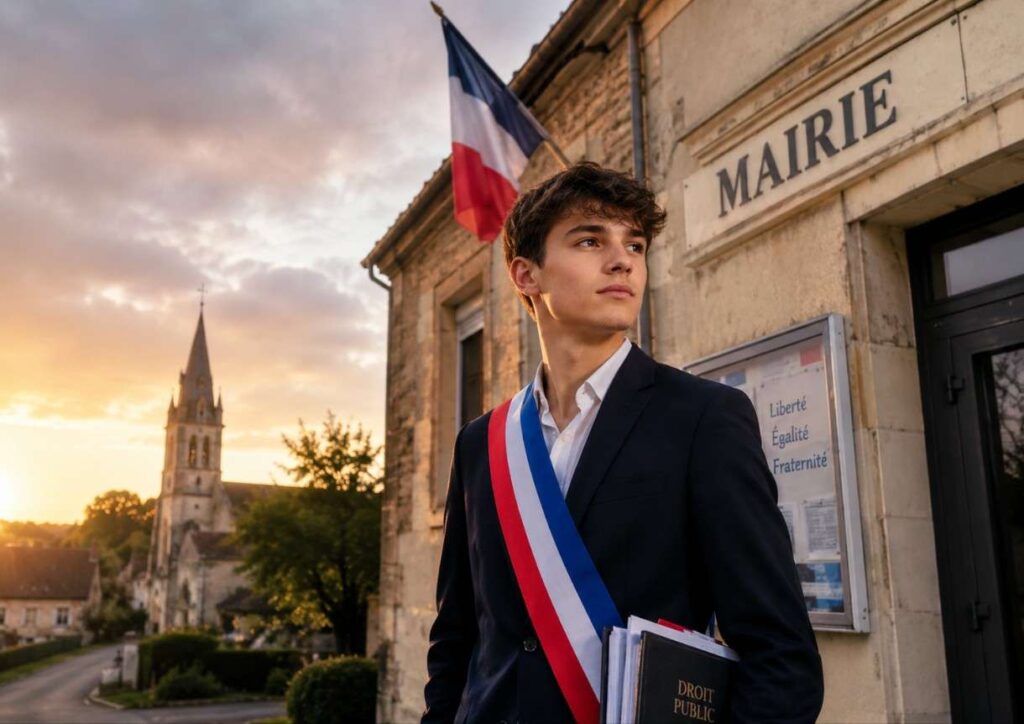
Sometimes political change does not begin in Paris, not under the golden dome of the National Assembly, but in a village with a few hundred inhabitants, located amidst fields, ring rural roads, and mailboxes, where time passes more slowly than in other places.
This place is called Pré-Saint-Evroult.
It is located in the Eure-et-Loir department in France — quiet, rural, inconspicuous. That is why the story of Bryan Pellerin resembles a small political parable with strong symbolic meaning. The young man is nineteen years old. Others at this age are still thinking about whether to enter graduate school or move to Bordeaux, but Pellerin is already managing the municipality. The mayor, who wears a sash, keeps minutes of meetings, and bears responsibility.
France is watching this with surprise.
Because the republic ideologically cares about the youth, but in practice often regards them with polite doubt. Young talents are celebrated in sports, music, startups — but political responsibility? Usually, it is left to the generation with gray hair at the temples. The average age of mayors in France belongs precisely to those who still remember phone booths.
What if there’s a law student there.
During the day he deals with municipal affairs, and then goes to university classes. Meetings, documents, lectures, exams. You can almost naturally imagine such a scene: a young man in a lecture hall opens his laptop, with classmates next to him drinking coffee — between administrative law and the city budget, the phone suddenly rings: there is a problem with road works in the village.
It sounds a bit crazy.
That is exactly why it is so attractive.
This story has a deep French flair. This country values political symbols almost as much as good cheeses and lengthy evening discussions during dinner. The nineteen-year-old rural mayor seems to contrast with France, which has long lamented political apathy, loss of trust, and division between the capital and the provinces.
Because in many small towns, fewer and fewer people want to run for office.
Mayors of small towns often bear a silent burden. They resolve neighborhood disputes, repair broken streetlights, organize village festivals, respond to complaints about garbage collection or potholes. The responsibility is great, the glory few, sometimes almost unrecognized.
High politics on television is brilliant and glamorous.
And local politics smells like document folders and cold coffee in the meeting room.
Perhaps this is what makes Pré-Saint-Évroult unexpected: a young man voluntarily takes on this role, even though his generation is often described as detached from politics, distracted by the digital world, impatient, and unready for great responsibilities.
And then this phrase appeared.
„J’ai confiance en cette génération.“
I trust this generation.
A simple phrase. Almost imperceptible, which is why it reveals strength. It comes from one of the villagers, a teacher. Not a grand political statement, not an ideological manifesto, but rather a silent observation from everyday life.
Trust.
Today this word is so rare.
In political debates, the opposite is heard more often: doubts about youth, concerns about their work ethic, complaints about TikTok, smartphones, and declining attention spans. Many talk shows survive by creating generational conflict: older against younger, experienced against vulnerable.
And now the village has handed over management to a nineteen-year-old.
It almost seems subversive.
Of course, there is also a bit of French romanticism in this story. In France, there is a tradition of portraying devoted young republicans. Even the Great Revolution glorified young people who participated in politics with ideals and passion. Emmanuel Macron’s early success is partly connected to the satisfaction of the desire for renewal.
But there is a big difference between the presidential palace and a small village with a modest population.
In Pré-Sainte-Évroult they discuss not geopolitical strategies or television debates, but whether the street lamps are lit and if the rural community center needs repairs. Maybe that is why everything seems more plausible and closer.
Almost touching.
Family relationships also add a special atmosphere to this story. Pelerin’s mother also works in the city council. This can be seen as a French tragedy with comedic elements: political disputes over the family dinner table, disputes between mother and son over the budget, doors slamming after the meeting.
But the mother quite calmly states: during the meetings, he is no longer her son, but the mayor of the village.
A phrase filled with a sense of republican discipline.
France loves such expressions.
They evoke an almost ritual connection between the republic and public service. The position is higher than the person, higher than relationships, higher than family, at least ideally so.
Despite this, behind all the political symbols remains the human question: how does a nineteen-year-old person live with such responsibility?
People recall their lives at this age. Uncertainty, searching, coping with hardships. Many at the age of nineteen didn’t even know which furniture to buy, let alone how to manage a town.
But perhaps this is where the strength lies.
Young politicians often lack political linguistic inertia. There are no refined formulations, no automatic evasions. They seem more straightforward, sometimes awkward, occasionally naive — but many citizens actually find comfort in this. Politics in many parts of Europe has become a perfectly tuned communication machine. Every word is tested, every move calculated.
The young mayor from the village seems almost like a person from another era.
Authentic.
Or at least closer to the political image that citizens expect.
Of course, one cannot idealize the whole story. Youth alone does not solve structural problems. A mayor needs experience, patience, and administrative knowledge. Enthusiasm cannot replace budget planning. But people feel that at such a moment, France seems to show a contrast to its weary state.
Because this country seems exhausted by a prolonged crisis.
The “yellow vests” movement. Protests against pension reform. Polarization. Anger. Retreat. Distrust.
So, the village that handed over the keys of the community to a student almost became a small republican hope.
Almost too good to be true.
But perhaps politics needs precisely such stories. Not as fairy tales, but as a reminder: democracy is not only great speeches, but those who take responsibility, even knowing that it will be difficult.
Today, becoming the mayor of a small French town is rarely for prestige, more for service, closeness to the people, and the ability to always stay connected. Mayors of small towns often remain the last directly accessible representative of the state. When problems arise, the anger initially falls on them.
This makes Pellerin’s example even more important.
Because while many peers seek attention on social networks, he takes on work that likely brings hidden rather than visible benefits. Administrative tasks instead of self-presentation. Piles of documents instead of influencer aesthetics.
In a certain sense, it is truly incredible.
Maybe that is exactly why this story touches many. It disproves the common belief that the younger generation only strives for speed, self-improvement, and digital attention. Instead, the young man in the village cares about local politics — perhaps the most moderate form of politics.
And in this lies dignity.
Perhaps even the future.
Because the problem of democracy in Europe often begins not from the top, but from the bottom. In those small towns where citizens feel ignored. Where no one wants to run for office. Politics becomes a tiring duty for older volunteers.
When young people take responsibility in such places, it changes not only the average age of the city council.
The atmosphere changes.
The notion of who politics belongs to.
Is politics the exclusive domain of professional politicians? Or is it still a joint project, open to those who do not yet have many years of political career?
Pré-Saint-Evroult gives a silent answer to this.
Its symbolism is almost like in a literary work: a young law student walks between the university and the city council, and the older residents trust him. This could very well be a French film — a calm movie with many pauses, long looks out the train window.
Somewhere, a song by Charles Aznavour might be playing.
But setting aside all the poetry, this story shows one very real thing: democracy depends on people feeling responsible. Not someday later, but now.
Perhaps this is the true message of this young mayor.
It is not just his age that is important.
But the desire not only to express opinions but also to take responsibility.
In times when political debates often resemble a continuous wave of anger, such a position seems a bit old-fashioned, but in the best sense of the word.
French philosopher Raymond Aron once roughly said that politics is the art of reasonable response to an imperfect world. Perhaps this art sometimes begins not in ministries, but in villages like Pré-Saint-Évry.
There, politics still has a face.
The mayor knows the residents whose streetlights do not work.
Democracy is no longer abstract, but smells of the rural cultural center.
Perhaps that is why France is currently watching Bryan Pellerin especially closely. Not only because of his age, but also because his election touched a thirst that goes beyond the small village.
A thirst for politics closer to the people.
Perhaps also a little younger.
But most importantly — more humane.
Author of the text: M. Legrand