
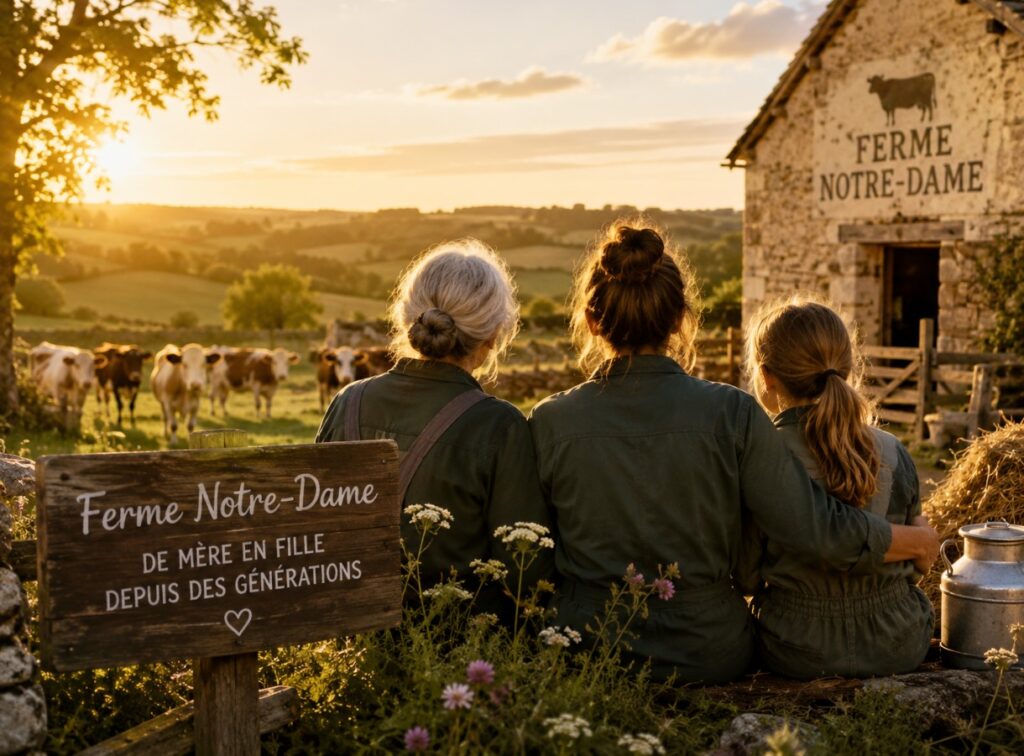
Early in the morning, over the hills of the French department of Lot, a thin veil of fog still floats. The limestone landscapes of Quercy seem almost unreal and silent at this hour. Only somewhere, behind the small country roads, a tractor is already buzzing, and from a stable comes the muted scraping of hooves on the concrete. It is precisely here, in the heart of the Causses du Quercy Natural Park, where the Ferme Notre Dame is located, near Belfort du Quercy. A farm like many others, one might think.
But this farm tells a story that in recent months has touched many people in France.
Because here agriculture is passed down from women to women for generations.
From mother to daughter.
And again to the next daughter.
While farms elsewhere close because no one wants to take on the profession, here three women stand firm every morning in the stable. Isabelle Lavergne and her daughters Solenne and Isaure Ferrer Diaz run the farm together. They milk cows, organize sales, receive visitors, and take care of the daily work that on a farm never ends.
So it is not a romantic postcard life.
But real rural life.
With cold winter nights, long days and hands that reveal the work.
Anyone who visits the farm soon notices that the atmosphere is different from that of some heavily industrialized operations. The buildings are simple, the routes short, the animals calm. Instead of large machinery parks or sterile halls, closeness prevails here. Closeness to the animals. Closeness to the landscape. And also closeness to the people who visit the farm.
Perhaps this is the secret behind the great attention that Ferme Notre Dame has received in recent months.
France has been discussing the future of its agriculture for years. Small farms are disappearing. Young people are moving to cities. Many farmers cannot find successors. Increasingly often, buildings that once fed entire families remain empty.
And suddenly this story emerges from the Lot.
Three women.
Several generations.
A farm that continues.
It almost sounds like an old family novel.
But the day-to-day is far from any idealized nostalgia.
The alarm clock rings early. Very early. Even before the sun rises over the dry hills of Quercy, the first work in the stable begins. The cows do not wait. The animals do not understand Sundays, holidays, or sleeping in after a long night.
Solenne Ferrer Diaz has described in interviews and on social media several times to what extent her life is shaped by the rhythm of the animals. Milking, feeding, bedding, organizing, repairing: the tasks constantly change. Sometimes everything proceeds calmly. Other times, a single sick cow is enough to disrupt the plan for the entire day.
And yet many young people remain on the farm.
Why, really?
Who today voluntarily chooses a profession with little free time, physical work, and financial insecurity?
Perhaps precisely those who see in it more than just a job.
At the Ferme Notre Dame, agriculture does not seem to be just a business model. The farm seems to be part of a family identity. Handing over the farm there does not just mean delivering buildings or plots. It is about memories, habits, and knowledge that many times were never written down.
How do you detect in time if a cow is going to get sick?
What hay is best after a particularly dry summer?
When does the sky over Quercy announce a storm?
Those things no one learns completely from books.
They are passed down from generation to generation.
And it is precisely this traditional feminine line that fascinates many people in France today. Because the image of agriculture is still very much marked by masculinity. For decades, people almost automatically spoke of the “farmer,” even when women on farms worked just as hard.
Many farmers’ wives kept the accounts, cared for animals, helped in the fields, and raised the children, all without officially appearing as responsible for the farm.
Women worked.
Men were considered the heads.
It was usually that simple.
The story of Ferme Notre Dame suddenly reverses that perception. Here women occupy a visible place at the center. Not as marginal figures. Not as helpers.
But as those who hold up the entire farm.
That provokes reactions.
Especially at a time when many people are once again looking for authentic stories.
Real biographies.
Places that don’t look polished like advertising brochures.
Visitors don’t come just for dairy products. Many want to see what agriculture is like today. On the farm there are guided milking times. Children watch the animals fascinated. Adults ask questions about feeding, prices, or the routine of a dairy farm.
Some are surprised by the amount of work behind a simple liter of milk.
Others realize how far removed they are from the origin of their food.
In the supermarket milk is cold and neatly arranged on the shelf.
On a farm it starts with work at five in the morning.
The cows at Ferme Notre Dame live largely on pasture. They are fed mainly with hay and cereals of their own production. This more traditional model fits with the philosophy of the farm: regional, manageable, and direct.
No one here seems to be seeking a large industrial expansion.
And that makes the farm seem sympathetically old-fashioned to many.
Naturally, visitors sometimes romanticize rural life. Those who spend only a couple of hours on a farm rarely see the concerns behind it. And yet, small dairy farms in France permanently deal with rising costs, price pressure, and bureaucracy.
The list of problems is long.
Feed prices are rising.
Energy prices fluctuate.
Droughts are multiplying.
On top of that, new regulations are constantly added.
Some farmers half-jokingly say they spend almost more time on paperwork than with their animals.
Also in Lot, farmers clearly notice climate changes. Summers are warmer and drier. The meadows suffer from lack of water. That disrupts the entire planning of a farm.
Before, you could rely more on the seasons.
Today many things feel more uncertain.
Precisely for this reason, the story of these three women serves as a counterpoint to the general climate of crisis.
It does not show a perfect agriculture.
But a resilient agriculture.
And perhaps that is what moves people.
On social media, posts about the Ferme Notre Dame gathered thousands of reactions. Many users wrote that the family reminded them of their own childhood in the countryside. Others praised the courage of the younger generation.
One word appeared very frequently:
Passion.
Because without passion it is difficult to maintain such a pace.
The farm also thrives on direct contact with consumers. More and more small farms in France are betting on short marketing channels. They sell directly on site or at regional markets. This way, more value stays on the farm itself.
At the same time, trust arises.
Those who know the people behind a product tend to see food differently.
Suddenly, it is not just about a price.
But also about faces.
About stories.
About relationships.
A visitor said after a guided tour that for the first time they understood how emotional agriculture can be. “The cows are not production machines,” they said, “but animals with their own character.”
And indeed many farmers talk about their animals almost like family members.
One cow remains calm.
Another gets nervous.
A third always gets into mischief.
Wow — apparently every farm has little divas.
The emotional bond also explains why many farmers do not want to give up their profession despite economic difficulties. Farming is rarely just a way to make a living. It deeply affects personal identity.
Those who take on a farm usually also take on their family’s history.
That is especially true at Ferme Notre Dame.
There it seems that each generation silently agrees with the women before them.
We carry on.
That thought has something almost poetic about it.
Perhaps that is why some recent reports even spoke of an exceptional story in rural France.
Because every year thousands of small farms really disappear. Especially livestock farming is perceived by many young people as something discouraging. The days are tough, the income often insecure. Added to this is the social pressure around environmental and animal welfare issues.
Many farmers feel misunderstood.
Amid political debates, consumer demands, and economic reality, there often arises a feeling of a constant need to justify oneself.
It is precisely for this reason that the story of the women of Belfort du Quercy generates so much sympathy. It seems sincere. Without artifice. Without big staged scenes.
Perhaps today people long for more stories like this because much in modern life has become interchangeable.
A small farm with a family tradition suddenly appears as a counterpoint to the fast-paced world.
Almost out of its time.
And yet fully relevant.
Because the questions it raises affect all of France.
How can agriculture be maintained in rural regions?
How can successors be found for the farms?
How can the value of food be restored?
The Ferme Notre Dame does not offer great political answers.
But it shows a possible direction.
Today many small farms try to make themselves visible through their personality. It’s not about the mass, but about trust and closeness. Visitors want to understand where their food comes from. This creates an opportunity for many family farms.
Of course, friendliness alone is not enough to survive economically. Agriculture remains a tough market. Nevertheless, in France many new ideas are emerging around direct marketing, agritourism, and regional products.
The women of Lot are active in the midst of this development.
Without much fuss.
Simply in a pragmatic way.
The farm opens up to visitors, shows daily life, and fosters encounters. It seems almost simple, but precisely this simplicity moves many people.
Above all, city people often experience a small culture shock on these farms. There, the speed of a smartphone doesn’t matter, but the rhythm of the animals and the seasons does.
A cow cares very little about online trends.
She wants to be milked on time.
Period.
And maybe that is where an unexpected form of calm resides.
Anyone who looks out over the landscape of Quercy soon understands why many families remain deeply rooted there. The region is somewhat rough and at the same time peaceful. Dry stone walls run along the hills. Small villages cling to the roads. In summer the air smells of dust, grass, and hot rock.
It’s not spectacular.
But it is compelling.
La Ferme Notre Dame fits perfectly into that environment. It is not a farm with a shiny image, but a farm that has remained part of its landscape.
And maybe that is why it seems believable.
Public attention has probably already changed the family’s daily life. Sometimes visitors recognize the women from television programs or social networks. The media request interviews. Comments pile up online.
But despite this new notoriety, the core of the farm seems to remain the same.
The work, in any case, is still waiting every morning.
After all, cows do not know media breaks.
That is precisely what makes the story likable. Behind the reports, there is no marketing plan of a large corporation, but a family living their daily life.
With successes.
With worries.
With tiredness.
And with remarkable persistence.
The female transmission of the farm thus acquires almost a symbolic power. France has been experiencing a more visible female role in agriculture for years. More and more farm holders are women, starting projects or taking on responsibilities.
But the old perception disappears only slowly.
Even today, it surprises some to see women driving tractors or managing livestock farms.
As if agriculture were automatically a man’s business.
The women of La Ferme Notre Dame quite naturally show how obsolete that stereotype already is.
They do not constantly talk about feminism.
They simply work.
Maybe that is what has the greatest effect.
Because sometimes stories change people more than political debates.
A farm in the Lot.
Three women.
Suddenly nothing more is needed.
While France debates agricultural crises, falling incomes, and the future of rural areas, there emerges a discreet narrative of transmission, solidarity, and rootedness.
There is no staging of heroines.
There is no cheesy farm romance.
But a family that continues.
Day after day.
And that is why the Ferme Notre Dame remains in many people’s memory.
Because it reminds us that agriculture in the end is always human.
Not abstract.
Not theoretical.
But linked to faces, voices, and stories.
Perhaps that is why so many people now look with curiosity towards Belfort du Quercy.
Because this small farm in southern France embodies something that has become rare:
Continuity.
In a world that constantly changes.
An article by M. Legrand