
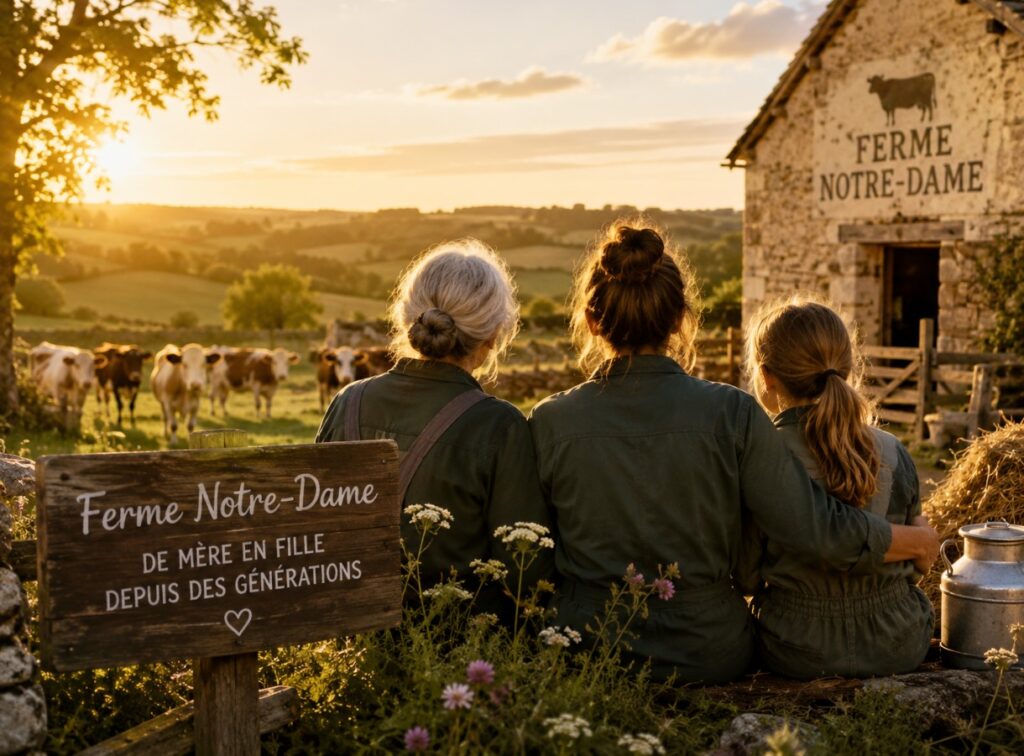
Early in the morning, the hills of the Lot département in France are still veiled in a thin mist. The limestone landscape of Quercy at this time of day exudes an almost surreal tranquility. Somewhere beyond the small farm road, a tractor is already rumbling, and from the cowshed comes the dull sound of hooves on concrete. Right there, in the middle of the Causses du Quercy Natural Park, Ferme Notre Dame is located in Belfort du Quercy. One might think it is just one of many farms.
However, this farm tells a story that moves many people in France today.
Here, agriculture has been passed down from women to women for generations.
From mother to daughter.
And then to the next daughter again.
While in other places farms close due to lack of successors, here three women stand in the cowshed together every morning. Isabelle Lavergne and her daughters Solenne and Isaure Ferrer Diaz run the farm together. They milk the cows, manage sales, receive visitors, and take on the never-ending daily work on the farm.
It is never a postcard-like romantic daily life.
Rather, it is real country living.
Life with cold winter nights, long days, and hands roughened by work.
When visiting the farm, you notice a different atmosphere compared to highly industrialized agricultural operations. The buildings are simple, the pathways are short, and the animals are calm. Instead of gigantic machines and sterile halls, here “closeness” shapes everyday life. Closeness to the animals. Closeness to the landscape. And closeness to the people visiting the farm.
Perhaps this is the secret behind the great attention that Ferme Notre Dame has been gathering in recent months.
In France, there has been ongoing discussion about the future of agriculture for many years. Small farms are disappearing. Young people move to urban areas, and many farmers are unable to find successors. Buildings that once supported families are increasingly becoming vacant.
And suddenly, this story emerged from Lot.
Three women.
Multiple generations.
A farm that continues.
It may almost sound like an old family novel.
But everyday life is never nostalgically idealized.
The alarm rings early. Very early. Before the sun rises over the dry hills of Quercy, the first work in the cowshed has already begun. The cows do not wait. For the animals, there is no Sunday, no holiday, and no sleeping in after a long night.
Solenne Ferrer Diaz has repeatedly spoken in interviews and on social media about how much her life is strongly influenced by the rhythms of the animals. Milking, feeding, bedding, scheduling, repairs—the work is constantly changing. Sometimes everything proceeds calmly. But a single sick cow can throw off the entire day’s plan.
Nevertheless, many young women remain on this farm.
Why is that?
Who today chooses a profession with little free time, physical labor, and economic instability?
Perhaps they are people who find more than just a job there.
At Ferme Notre Dame, agriculture does not appear as merely a business model. The farm seems rather like a part of a family identity. The succession of management is not just about taking over buildings and land. It includes memories, customs, and often unwritten wisdom.
How to recognize early a cow that is about to get sick?
Especially after a dry summer, which hay is more suitable?
When will the sky in Quercy announce a thunderstorm?
No one can fully learn these things just from books.
They are passed down from generation to generation.
It is precisely this female line of succession that is currently captivating many people in France. This is because the image of agriculture is still strongly shaped in a masculine way today. For decades, the word “farmer” has been used almost automatically, and even though women worked just as hard on the farm, they were less visible.
Many farmers’ wives handled the bookkeeping, took care of the animals, helped in the fields, and raised children, yet they were rarely formally recognized as managers.
The women worked.
The men were regarded, so to speak, as the people responsible.
It was often a very simple structure.
The story of Ferme Notre Dame changes that perception completely. Here, women stand visibly at the center. They are neither peripheral figures nor helpers.
They stand as the main bearers responsible for the entire farm.
That is causing something to happen.
Especially in an era when many people have come to seek authentic stories.
Real biographies.
Places that are not decorated like promotional brochures.
Visitors do not come just for dairy products. Many want to actually experience what agriculture is like today. Here, there are guided milking times, children observe the animals with interest, and adults ask questions about feed, prices, and the daily life of dairy farming.
Some people are surprised by how much work goes into a simple one-liter bottle of milk.
Some realize how far removed they have become from the source of their food.
At the supermarket, milk is neatly arranged in refrigerated shelves.
On the farm, milk production starts with the work at five in the morning.
The cows at Ferme Notre Dame are mainly pasture-raised and fed mostly on home-produced hay and grains. This solid model also fits the philosophy of the operation: local, manageable in scale, and direct.
It seems no one here is aiming for large-scale industrial expansion.
This is what makes the farm feel somewhat charmingly old-fashioned to many people.
Of course, visitors sometimes romanticize rural life. Visiting the farm for just a few hours makes it hard to see the anxieties and problems behind it. In reality, small-scale dairy farmers in France constantly struggle with rising costs, price pressures, and bureaucracy.
The list of problems is long.
Feed prices are increasing.
Energy prices fluctuate.
Drought periods are becoming more frequent.
Additionally, new regulations keep being introduced one after another.
Some farmers now half-jokingly say that they spend more time on paperwork than with the animals.
Farmers in Lot also strongly feel the impact of climate change. Summers have become hotter and drier, causing pastures to suffer from water shortages. This changes the overall planning of the farm.
In the past, one could rely more on the seasons.
Now, many things feel uncertain.
That is why the story of the three women likely resonates as a contrasting image to the general sense of crisis.
It does not depict perfect farming.
However, it shows perseverance.
And perhaps that is what strikes a chord with people.
Posts about Ferme Notre Dame collected thousands of reactions on social media. Many users wrote that it evoked memories of their family’s countryside, and there were voices praising the courage of the younger generation.
One word appeared especially frequently:
Passion.
Without passion, such a daily life probably could not continue.
The farm also lives through direct contact with consumers. In France, an increasing number of small-scale operations are focusing on short supply chains. By selling products directly on site or at local markets, more added value remains with the farm side.
At the same time, trust is created.
Knowing the people behind the products often changes how one views food.
Suddenly, the issue is no longer just about price.
Faces are involved.
Stories are involved.
It involves relationships.
One visitor said that after a farm tour, they understood for the first time how emotional agriculture really is. Cows are not production machines; each is an animal with its own personality.
In fact, many farmers speak of their animals as if they were family members.
One cow is very calm.
Another cow is nervous.
The third cow is always mischievous.
Apparently, every farm has its little diva.
These emotional bonds explain why many farmers do not want to give up their jobs despite economic difficulties. Agriculture is rarely just a means of livelihood. It is deeply connected to personal identity.
The person who takes over the farm often inherits the family history as well.
This is especially true at Ferme Notre Dame.
There, it seems as if each generation quietly nods to the women before them.
We continue.
This idea has an almost poetic resonance.
Perhaps that is why some reports have recently called it an exceptional story from this region.
In reality, thousands of small farms disappear every year. Livestock farming in particular tends to be avoided by many young people. Working hours are harsh, and income is often unstable. On top of that come environmental issues and social pressure around animal husbandry.
Many farmers feel misunderstood.
They sometimes feel forced to constantly justify themselves between political debates, consumer demands, and economic realities.
That is why the stories of the women of Belfort du Quercy resonate with many. Honest, unpretentious, without any exaggerated dramatization.
People may seek such stories because much of modern everyday life has become replaceable.
Small farms with family traditions appear as alternatives to a rapidly moving world.
They may even seem somewhat old-fashioned.
But at the same time very modern.
The question behind this concerns the whole of France.
How to maintain agriculture in rural areas?
How to secure successors for farms?
How to regain appreciation for food?
Ferme Notre Dame does not offer a grand political solution.
But it does point in one direction.
Small-scale operations today often try to maintain visibility through personality. Trust and closeness are valued over quantity. Visitors want to know where their food comes from. Many family businesses see opportunities in this.
Of course, you cannot survive economically on goodwill alone. Agriculture is a tough market. Still, many new ideas concerning direct sales, agritourism, and regional products are emerging in France.
The women of Lot are exactly part of this trend.
There is no exaggerated sentimentality.
Just straightforwardness.
The farm opens its doors to visitors, shows everyday life, and creates encounters. It almost seems simple, but it is this simplicity that touches many people’s hearts.
Especially people from urban areas often experience a small culture shock at such farms. There, the speed of a smartphone does not matter, but the rhythms of animals and the seasons do.
Cows have no interest whatsoever in online trends.
They just want to be milked on time.
That’s all.
Perhaps there is an unexpected form of peace in that.
Looking over the landscape of Quercy, it is easy to understand why many families have deeply rooted themselves in this land. The region has both ruggedness and tranquility. Small stone terraces run along the hills, and small villages nestle along the roads. In summer, you smell earth, grass, and warm stones.
It is not flashy.
But it is impressive.
Ferme Notre Dame fits perfectly into this environment. It is not a glossy farm operation but a farm that continues to be part of that landscape.
That is probably why they appear trustworthy.
Public attention has likely changed the family’s daily life. Visitors sometimes see the women on TV or social media, with requests for interviews and online comments coming in.
But despite this new fame, the core of the farm seems unchanged.
The work awaits every morning.
Because cows do not know about media breaks.
That is precisely what makes this story so likable. Behind the reporting, there aren’t corporate marketing plans but a family living their daily life.
There is success.
There are worries.
There is fatigue.
And there is perseverance that deserves attention.
The inheritance of the farm by women is beginning to take on almost symbolic power. In recent years, the visibility of women’s roles in agriculture has progressed in France. More and more women entrepreneurs publicly appear, launch projects, and take responsibility.
However, old perceptions are hard to disappear.
Even today, some people are surprised when women drive tractors or manage animal husbandry.
As if agriculture were automatically a man’s job.
The women of Ferme Notre Dame calmly demonstrate how outdated that old view is.
They don’t always talk about feminism.
Just working quietly and steadily.
Perhaps that is what creates the strongest effect.
Sometimes stories change people more than political debates do.
One farm, in Lot.
Three women.
And that alone is enough.
While France debates agricultural crises, falling incomes, and the future of rural areas, a quiet story about succession, solidarity, and integrity is being born there.
There is no heroic dramatization.
No tear-jerking ranch romance either.
There is only a family that continues.
Day by day.
That is why Ferme Notre Dame remains in the memories of many people.
Because it reminds us that agriculture ultimately always remains human.
It is not abstract.
Nor theoretical.
It is connected through faces, voices, and stories.
Perhaps that is why now many people are curious about Belfort du Quercy.
Because this small farm in southern France embodies something that has become rare:
Continuity.
In a world that is constantly changing.
Article by M. Legrand