
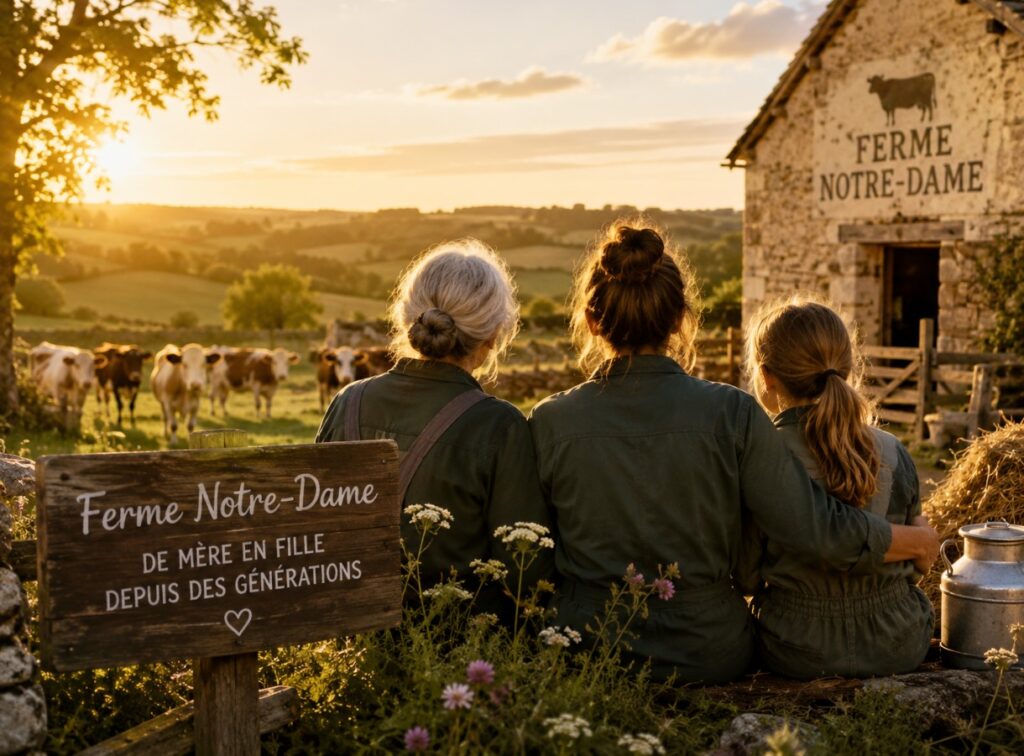
In the early morning, a thin veil of mist still hangs over the hills of the Lot department in France. The limestone landscape of Quercy looks almost unrealistically quiet at this hour. Somewhere beyond a small farm lane a tractor is already humming, and from a barn the sound of hooves echoing on concrete can be heard. Right there, in the heart of the Causses du Quercy natural park, Ferme Notre Dame is located in Belfort du Quercy. At first glance it may look like an ordinary farm.
But this farm tells a story that resonates with many people in France today.
Here, farming has been passed down from woman to woman for generations.
From mother to daughter.
And then on to the next daughter.
While in other places farms close because there is no successor, here three women walk to the barn together every morning. Isabelle Lavergne and her daughters Solenne and Isaure Ferrer Diaz run the farm together. They milk the cows, organize sales, welcome visitors, and take care of the everyday work on the farm that never ends.
This is not the postcard-romantic everyday life.
It is real rural life.
Cold winter nights and long days, hands showing the marks of hard work.
When you visit the farm, you quickly notice that the atmosphere feels different from some highly industrialized farms. The buildings are modest, the pathways short, and the animals calm. Instead of huge machines or sterilized warehouses, intimacy governs daily life. The distance to the animals is close, and the distance to the landscape is close. And the distance to the people who visit the farm is close too.
Perhaps this is precisely why Perms Notre-Dame has attracted so much attention in recent months.
France has been debating the future of its agriculture for years. Small farms are disappearing. Young people are leaving for the cities. Many farmers can no longer find successors. Buildings that once fed families are increasingly standing empty.
And then suddenly this story appeared in the Lot.
Three women.
Several generations.
A farm that continues.
It almost sounds like an old family novel.
But everyday life is never wrapped in nostalgia.
The alarm goes off early. Very early. Before the sun rises over the dry hills of the Quercy, the first work in the barns has already begun. The cows do not wait. For the animals there is no Sunday, no public holiday, and no right to sleep in after a long night.
Solen Ferrer Díaz has repeatedly spoken in interviews and on social networks about how strongly the rhythms of the animals shape her life. Milking, feeding, changing bedding, organizing, repairing—the tasks constantly change. Sometimes everything flows quietly. But a single sick animal can shake up an entire day’s schedule.
Nevertheless many young women remain on this farm.
Why?
Why today would someone voluntarily choose a job that entails little free time, physical labor, and economic uncertainty?
Perhaps because they see something beyond a simple job.
At Ferme Notre-Dame agriculture does not just look like a business model. The farm rather appears as part of a family identity. Passing the farm on is not just the handover of buildings or land. Often memories, habits, and knowledge that are not recorded in documents are transmitted as well.
From what signs do you know when a cow begins to get sick?
After especially dry summers which hay is more suitable?
When does the sky over the Quercy announce a shower?
These things are difficult to learn fully from books.
They are passed down from generation to generation.
And it is precisely this lineage of female transmission that is captivating many in France today. The image of agriculture still remains strongly male-centered. For decades people almost automatically called them ‘farmers’ (expressions like «Bauern»), and even though women were working just as hard on the farms, only men were visible.
Many farmers’ wives kept the books, cared for the animals, helped in the fields and raised the children, yet they were never officially seen as the heads of the farm.
Women worked.
Men were regarded as the ones in charge.
It was usually that simple.
The story of Ferme Notre-Dame overturns that perception. Here, women stand prominently at the center. Not peripheral figures, not helpers.
They stand as the agents who uphold the entire farm.
It resonates.
Especially in an era when many are seeking real stories again.
Real biographies.
Places not glossed over like advertising brochures.
Visitors do not come just for the dairy products. Many want to experience what agriculture actually looks like today. On the farm there are guided milking times, and children watch the animals with curious eyes. Adults ask questions about feed, prices, and the daily life of a dairy farm.
Some are surprised to see how much work goes into a single litre of milk.
Others suddenly realize how far removed they have become from the origin of their food.
In the supermarket, milk is neatly displayed chilled.
On the farm, milk starts with work at five in the morning.
The cows at Ferm Notre-Dame are mostly pasture-raised. Their feed is mainly hay and grain produced on-site. This modest model aligns with the farm’s philosophy: local, manageable, and direct.
No one seems to be pursuing large-scale industrial expansion.
So to many, this farm feels somewhat traditionally familiar.
Of course visitors sometimes romanticize rural life. Someone who only spends two hours visiting a farm will have difficulty seeing the hardships behind it. Small dairy farms in France in particular are constantly fighting rising costs, price pressures, and bureaucracy.
The list of problems is long.
Feed costs are rising.
Energy prices are volatile.
Periods of drought are increasing.
On top of that, new regulations keep being added.
Some farmers now half-jokingly say they spend more time on paperwork than with the animals.
Even in Lot, farmers feel the effects of climate change clearly. Summers are getting hotter and drier, and pastures suffer from water shortages. This changes the whole planning of the farm.
In the past, one could rely more on the seasons.
Today many things feel more uncertain.
That is why the stories of the three women seem like a contrasting image to the general mood of crisis.
It does not show perfect farming.
But it shows resilience.
Perhaps that is precisely what moves people.
On social networks, posts about Fermes Notre-Dame gathered thousands of reactions. Many users wrote that the family reminded them of their own rural childhoods, and others praised the courage of the younger generation.
One word appeared particularly often:
Passion.
To endure such a daily life, probably nothing less than passion will do.
Farms also live from direct contact with consumers. Many small French farms increasingly rely on shorter distribution channels. They sell products directly on site or at local markets. This leaves more added value on the farm itself.
At the same time, trust is created.
When you get to know the people behind the products, your view of food changes.
Suddenly it is not just about price.
Faces become important too.
Stories become important too.
Relationships become more important.
One visitor put it almost that way after a farm tour, saying he had come to understand for the first time how emotional farming can be and that the cows are not mere production machines but animals with individual personalities.
In fact, many farmers talk about their animals almost like family members.
Some cows are calm.
Some cows are anxious.
Another cow is always playful.
Well – every farm seems to have its little divas.
These emotional bonds help explain why many farmers do not give up the profession despite economic hardship. Farming is rarely just a means of livelihood. It permeates deeply into personal identity.
Passing the farm on often means taking on the family history as well.
That is especially true in Fermes Notre-Dame.
There, it seems as if each generation quietly nods to the women who came before.
We continue.
The thought has an almost poetic character.
Perhaps that is why some media coverage has even described the place recently as an exceptional story of rural France.
In reality, thousands of small farms disappear every year. In particular, livestock farming has become something many young people avoid. Working hours are harsh, and income is often uncertain. On top of that there is social pressure about environmental issues and animal welfare.
Many farmers feel misunderstood.
Caught between political debates, consumer demands and economic realities, farmers often feel they must constantly justify themselves.
That is precisely why the stories of the women of Belfort du Kersy are so appealing. They are honest, unvarnished and without exaggerated staging.
People may crave these kinds of stories more today. Much of modern everyday life has become interchangeable.
Small family-run farms suddenly look like an alternative to the fast-paced world.
They may seem a little out of step with the times.
Nevertheless, they are very timely.
The questions behind them are about the whole of France.
How can agriculture be maintained in rural areas?
How will farms secure successors?
How can respect for food be restored?
Perm Notre-Dame does not offer a huge political solution to this.
But it shows one possible direction.
Today small farms often try to stand out through personality and trust. What matters is not quantity but trust and intimacy. Visitors want to understand where their food comes from. It is at this point that many family farms find an opportunity.
Of course friendliness alone is not enough to survive economically. Agriculture remains a tough market. Nevertheless, in France many new ideas around direct sales, agritourism, and regional specialties are currently emerging.
The women of Lot are right in the middle of this trend.
Without much exaggeration.
Just practical.
Farms open their doors to visitors, show everyday life, and create encounters. It seems almost simple, but it is precisely that simplicity that touches many hearts.
City dwellers in particular often experience a small cultural shock on these farms. There, the speed of a smartphone is not important; the rhythms of animals and the seasons are.
Cows are not very interested in online trends.
They just want to be milked on time.
That’s all.
Perhaps it is precisely this that brings unexpected calm.
Looking out over the landscape of Quercy, it’s easy to understand why so many families have put down deep roots there. The region is rugged yet peaceful. Dry stone walls trace the hills, and small villages cling to the roadside. In summer the air is full of dust, grass, and the warm scent of stone.
It’s unassuming but striking.
Ferme Notre-Dame fits this setting perfectly. Not a glossy show farm, but one that remains part of its own landscape.
Perhaps that’s precisely why it feels trustworthy.
Public attention has likely already changed the family’s daily life. Visitors sometimes recognize the women from television or social networks. The press requests interviews, and online comments accumulate.
Still, the heart of the farm seems hardly changed.
Work, after all, waits every morning.
Cows, in the end, don’t know about media breaks.
That’s what makes the story more appealing. Behind all the coverage is not a corporate marketing plan but a family living its everyday life.
There is success.
There is worry.
There is fatigue.
And remarkable persistence.
The practice of passing a farm down to a woman carries almost symbolic power. In France, in recent years the role of women in agriculture has noticeably grown. More and more women farm owners are stepping forward publicly, launching projects or taking on responsibilities.
But old perceptions fade only slowly.
Some people are still surprised when a woman drives a tractor or runs a livestock farm.
As if agriculture were automatically a man’s domain.
The women of Ferme Notre-Dame now quite calmly show how outdated such stereotypes are.
They no longer talk about feminism.
They simply work.
Perhaps that simplicity has the strongest effect.
Sometimes stories bring more change to people than political debates.
A farm in Lot.
Three women.
Now that’s all there is.
While France discusses an agricultural crisis, falling incomes and the future of rural areas, there a quiet story of inheritance, solidarity and modesty is taking root.
There is no heroic staging.
No cheesy farm-romance.
Just a family carrying on.
Day by day.
That’s why Ferme Notre-Dame stays in many people’s memories.
Because it reminds us that farming, in the end, is always human.
Not abstract.
Not theoretical.
The face and the voice are connected to the story.
Perhaps that is why many people are looking at Belfort du Quercy with curious eyes right now.
This small farm symbolizes something that has become rare in southern France:
Continuity.
Perseverance in a constantly changing world.
Text M. Legrand