
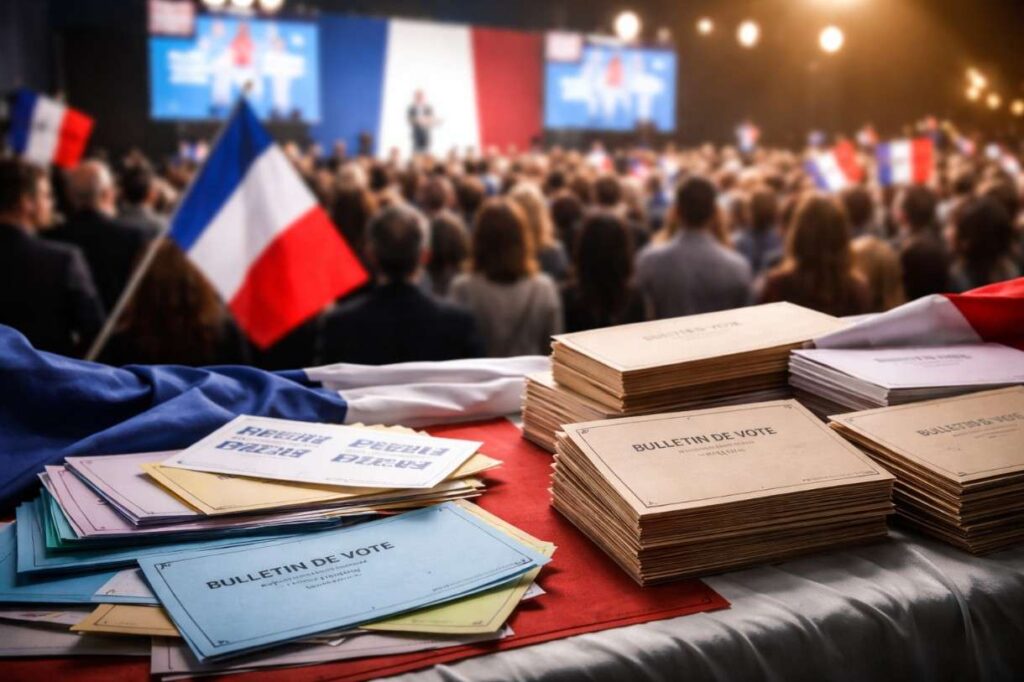
When the first results are released on the evening of a municipal election in France, the same terms always appear in the media: Triangulaire, Quadrangulaire, Fusion de listes, Maintien au second tour. To observers outside France this terminology can sometimes seem puzzling. Yet it describes a central moment of the French electoral system: the strategic week between the first and second round.
Especially in municipal elections, a political dynamic unfolds during this short phase that can fundamentally change the balance of power in a town. While the first round merely measures the political landscape, the second ultimately decides who will govern the commune for the next six years.
The period between the two rounds is therefore less a simple continuation of the campaign than a phase of intensive political negotiations, tactical repositioning and strategic alliances.
The French municipal electoral system
In communes with more than 1,000 inhabitants, the French municipal election follows a hybrid voting system that combines elements of majority and proportional representation.
Voters do not choose individual candidates, but complete lists. These lists usually represent political parties or local coalitions. The first round primarily serves to determine the balance of power among the political camps.
If a list already achieves an absolute majority in the first round, it wins immediately. In most towns this, however, rarely happens. As a rule, a second round follows one week later.
It is precisely this short interval between the two rounds that is decisive for the political dynamics of the election.
The decisive ten-percent threshold
French electoral law sets a clear threshold: only lists that obtain at least ten percent of the votes cast in the first round may stand independently in the second round.
This rule directly determines the possible constellation in the second round. Typically three scenarios arise:
- a duel, when only two lists are above the ten-percent mark
- a Triangulaire, when three lists exceed this threshold
- a Quadrangulaire, when four or more lists qualify
Triangular constellations are by no means unusual in France. They arise particularly in towns where several political camps have stable voter bases – for example left-wing parties, conservative forces and right-wing populist movements.
Quadrangular contests, on the other hand, remain rare. They require an unusually strong fragmentation of the local political landscape.
But even when several lists are formally qualified, it is often only in the days that follow that it is decided how many will actually run in the second round.
The role of smaller lists
In addition to the ten-percent threshold, there is a second important threshold: five percent of the votes.
Lists that obtain between five and ten percent may not run independently in the second round. However, they have another option: they can merge with a qualified list.
Thus begins a phase of intensive political negotiations. Within a few days the groups involved discuss central questions:
- the composition of a joint list
- the allocation of list positions
- programmatic compromises
- strategic objectives for the second round
Such talks can significantly change the balance of power in an election. A list that obtained only a few percentage points in the first round can, through a clever alliance, suddenly play a key role in the second round.
Especially at the municipal level these coalitions are often more pragmatic than in national politics. Local interests, personal relationships and concrete projects for a town can play a greater role than party loyalty.
List mergers – a French particularity
The so-called list merger is a characteristic element of the French municipal electoral system. It allows political forces to recombine their candidate lists between the rounds.
In practice this means that candidates from a smaller list can be integrated into another list. The newly formed list is then officially registered for the second round.
This often produces new political alliances:
- joint lists of several left-wing parties
- alliances of conservative and liberal forces
- cooperations between established parties and local citizen movements
This system favors strategic mergers intended to prevent the fragmentation of votes. At the same time it carries risks: some voters react skeptically to alliances they perceive as opportunistic or contradictory.
The political art therefore consists in forging alliances without damaging one’s own credibility.
Why triangular contests are particularly unpredictable
Triangular contests are considered particularly tricky by election strategists. While a duel represents a clear confrontation between two political camps, a three-way constellation opens up numerous possible scenarios.
For example, a list can win even though it mobilizes only a relatively limited voter segment, if the votes of the other candidates are split between two rival camps.
The behavior of voters between the rounds is also hard to predict. Some supporters of smaller lists deliberately opt for tactical voting to prevent a particular political force. Others stay away from the polls in the second round.
In towns with a highly polarized political landscape, triangular contests can therefore lead to surprising results.
The majority bonus – the decisive mechanism
The real key of the system, however, lies in another element: the so-called majority bonus.
The list that obtains the most votes in the second round automatically receives half of the seats on the municipal council. The remaining seats are distributed proportionally among all lists that achieved more than five percent.
This procedure pursues a clear goal: political stability. The winning list typically obtains a comfortable majority on the municipal council and can thus pursue a coherent municipal policy.
At the same time this rule greatly increases the strategic pressure in the second round. Even a relatively small lead in votes can decide who takes political leadership of a town.
In larger towns a difference of only a few hundred votes can be enough to secure control of the town hall for six years.
A week of intense political mobilization
The days between the two rounds often belong to the most intense moments of the entire campaign.
Parties and candidates try in a short time to mobilize as many voters as possible and to strengthen their political position. This includes:
- public meetings
- door-to-door campaigns and information booths
- intensive media appearances
- political negotiations about possible alliances
The tone of the campaigns often sharpens noticeably. Every vote can be decisive, and the strategic mobilization of one’s own supporters gains in importance.
At the same time many messages are targeted specifically at undecided voters or at supporters of lists that were eliminated in the first round.
Local politics and national dynamics
Municipal elections are traditionally considered the most local elections of the French Republic. Voters often choose candidates they personally know or whose projects for their town seem convincing.
But it is precisely the phase between the rounds that shows national political dynamics also play a role. Parties try to strengthen their strategic positions, consolidate political camps and achieve symbolic victories in important towns.
This creates a special mix of local politics and national strategy. Personal networks, local projects and political ideologies interact.
On the evening of the first round the result of an election often seems already tangible. But in reality the decisive phase frequently only begins at that moment. In France the political future of many towns is decided not only at the ballot box – but also at the negotiating table in the days that follow.
Author: P. Tiko