
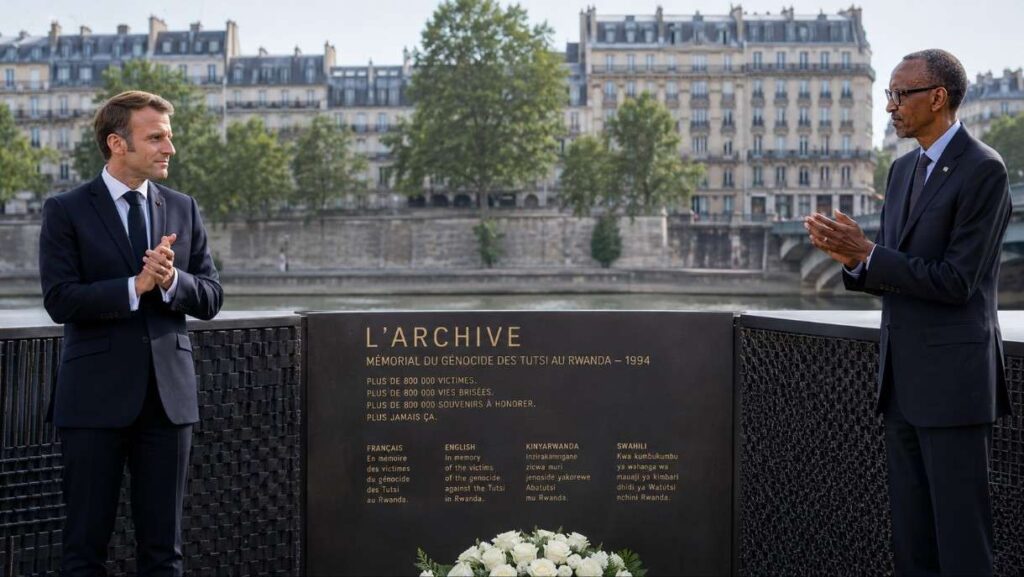
More than three decades after the Tutsi genocide in Rwanda, Paris is receiving a permanent place of remembrance for one of the most brutal crimes against humanity of the late 20th century. On June 2, French President Emmanuel Macron and his Rwandan counterpart Paul Kagame jointly inaugurated the new memorial “L’Archive” on the banks of the Seine. This ceremony symbolizes not only the honoring of victims but also a further rapprochement between France and Rwanda after decades of diplomatic tensions.
A monument against forgetting
The new monument was created by Portuguese-Angolan artist Grada Kilomba. Titled “L’Archive,” this work is conceived as a place of remembrance, reflection, and historical reckoning. It is intended to preserve the voices, memories, and experiences of the victims and survivors of the genocide and to make them accessible to future generations.
The memorial is located in an honored place in the public space of the French capital. Inscriptions in several languages – French, English, Kinyarwanda and Swahili – recall the events of 1994. This monument is conceived as a permanently open space that sustains the memory of more than 800,000 people killed over roughly one hundred days, most of whom belonged to the Tutsi ethnic group.
The 1994 genocide
Between April and July 1994 Rwanda experienced one of the most brutal genocides in modern history. After the plane carrying President Juvénal Habyarimana was shot down on 6 April 1994, a systematic campaign to exterminate Tutsi and moderate Hutu began.
The police, soldiers and state agencies participated in mass killings that took place at an astonishing pace. Within a few weeks hundreds of thousands of people were killed, often by neighbors, local militias or state security forces. The international community virtually did not intervene. The United Nations and numerous Western countries were later sharply criticized for failing to recognize the scale of the crimes in time or for not acting decisively.
The genocide ended only with the military victory of the Rwandan Patriotic Front (RPF) led by Paul Kagame, who later became the country’s president and still holds that position.
The complex role of France
The role of France before and during the genocide was particularly contentious in relations between Paris and Kigali. France politically and militarily supported the then-Rwandan government in the years leading up to 1994. Critics long accused Paris of supporting those responsible for the later genocide and of ignoring warning signs.
For decades mutual accusations poisoned bilateral relations. Rwanda accused France of being complicit in the events, while French governments rejected such claims.
The turning point was the publication of the so-called Duclert report in 2021. The historical commission, appointed by President Macron, concluded that France bears a “serious and heavy responsibility,” because political and military leaders misjudged the developments in Rwanda and supported the then-regime for too long. At the same time, the report stated that no evidence was found of France’s direct participation in the genocide itself.
Macron’s course toward recognition
During his historic visit to Kigali in May 2021, Emmanuel Macron drew political consequences from these findings. In a speech at the Genocide Memorial in the Rwandan capital, he acknowledged France’s responsibility for the events that led to the genocide.
Macron avoided the term of collective guilt, but spoke of serious political mistakes and gaps. His words were received by the international community as an important step in historical reckoning.
Paul Kagame then reacted extremely positively. He called the speech an important contribution to the truth and a basis for a new phase of relations between the two countries. Since then diplomatic contacts have significantly strengthened. France and Rwanda today cooperate closely in many areas, including the economy, culture, education and security policy.
Memory politics as part of diplomacy
The opening of “L’Archive” is much more than a cultural event. It symbolizes an attempt by both states to combine remembrance of the past with a partnership oriented toward the future.
In recent years French memory culture has increasingly focused on the crimes of genocide. The decision to build a national memorial in the very center of Paris underscores this shift. Already in 2023 the Élysée Palace announced the allocation of a permanently visible space in the public realm of the French capital for the victims.
At the same time the fight against historical revisionism and genocide denial is gaining importance. Rwanda regularly emphasizes that the memory of the events of 1994 is not just a national matter but part of a universal struggle against ideologies of hatred, ethnic violence and the political instrumentalization of identities.
More than thirty years after the mass killings, the joint unveiling of the memorial by Macron and Kagame demonstrates how closely memory politics and international relations are linked. The new monument on the Seine symbolizes not only the honoring of victims but also an attempt by the two states to overcome the burden of the past through acknowledgement, historical reflection and dialogue. At a time when issues of memory culture are increasingly politicized worldwide, this memorial takes on significance that reaches far beyond France and Rwanda.
Author: P. Tiko