
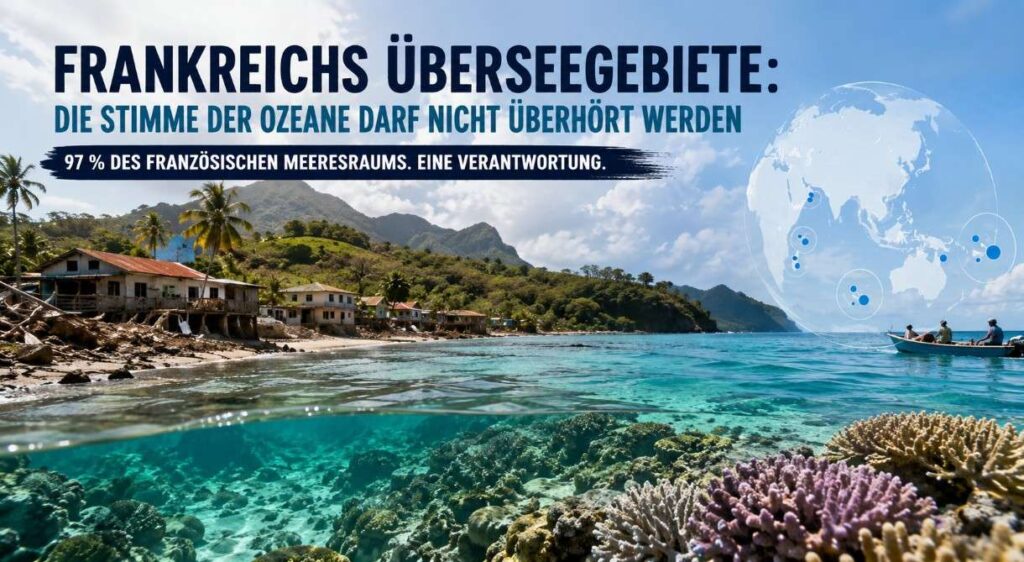
When talking about France’s maritime policy, many people first think of the Atlantic coast, Brittany, or the Mediterranean. However, France’s true maritime wealth lies thousands of kilometers away. Mayotte in the Indian Ocean, Guadeloupe and Martinique in the Caribbean, French Polynesia in the Pacific, and French Guiana on the northern coast of South America together form the pillars of France’s presence in the world’s oceans. About 97% of France’s maritime zones are located in these overseas territories.
At the United Nations Ocean Summit held in Nice in 2025, the so-called “Outre-mer” (overseas territories) became a focus. This is not surprising. After all, many of these regions are on the frontline of the climate crisis. Rising sea levels, increasingly intense hurricanes, coral bleaching, and worsening ocean acidification have become part of daily life there. Future scenarios often discussed in European capitals are already within reach on many islands.
This reflects a significant contradiction. The overseas territories often play a minor role in political debates in Paris. However, France’s status as a maritime power largely depends on these regions. Without these scattered territories distributed across the three major oceans, France would neither have one of the world’s largest exclusive economic zones nor wield such important influence in international maritime affairs.
However, with this scale comes responsibility. The overseas territories hold a significant part of France’s biodiversity. Coral reefs, mangroves, and fragile coastal ecosystems provide habitats for countless species of flora and fauna. At the same time, many people live directly near the coastline. For them, the condition of the ocean is not only a matter of nature conservation but also affects their income, diet, drinking water supply, and housing.
Therefore, for many years, many overseas territory representatives have been striving for more say. They not only want to be seen as a geographical extension of France but also wish to be recognized as political participants with their own experiences and interests. For many island communities, marine protection is not an abstract issue in international diplomacy but is closely linked to the future of their communities. In some places, discussions have already begun about whether parts of the coastline will still be suitable for living in decades to come.
At the same time, the overseas territories also show that they are not just victims of climate change. French Polynesia recently announced the establishment of a large marine protected area, attracting international attention. Such initiatives show that innovative solutions often arise in areas far from political centers. This region, considered marginal, is gradually becoming a laboratory for modern marine policy.
Therefore, the key question is not only how to protect the ocean, but equally important is who decides on protected areas, fisheries, resource extraction, and adaptation measures. As long as these decisions are mainly made in Paris, Brussels, or at international conferences, the role of the overseas territories is difficult to fully consider.
Overseas territories remind France of a simple fact: the greatness of a maritime power is measured not just in square kilometers, but also in its willingness to take responsibility and listen to the people who live daily with the impacts of changes in the ocean.
Author: Andreas M. Brucker