
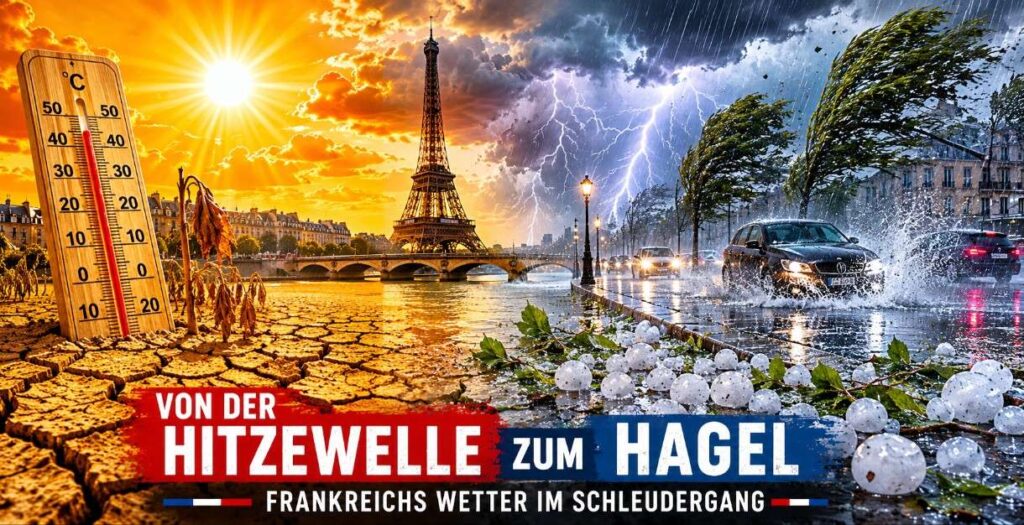
The meteorological summer in France began with a lesson that many experts have been announcing for years: extreme weather situations are occurring increasingly frequently. Just as the country experienced an unusually early heatwave at the end of May, thunderstorm fronts, heavy rains, and localized severe hailstorms arrived in many regions at the beginning of June.
What would once have been considered a rare weather event is increasingly becoming the new reality. In a few days, the weather situation changed from almost summer-like heat to a scenario reminiscent of the alternating weeks of April. Temperatures plummeted, humid air masses met warmed ground, and the atmosphere reacted with that explosive dynamic observed by meteorologists for years.
The sudden change is not accidental. Warmer air can store much more moisture. When this moist air meets cooler currents, the accumulated energy often releases in the form of intense thunderstorms. Large hailstorms, strong wind gusts, and localized floods are increasingly common during French summers.
The sector most affected is agriculture. For winemakers, fruit growers, and vegetable producers, a hailstorm is like Russian roulette. Months of work can be destroyed in a few minutes. Especially in France’s traditional wine regions, concern is growing over a development that could make crop losses the rule rather than the exception.
Cities are also facing new challenges. Sewer networks, designed for different amounts of precipitation, quickly reach their limits during heavy rainfall. Flooded streets, water-filled underpasses, and damaged infrastructure cause high costs. Added to this is a often underestimated health burden. Many people initially suffer from extreme heat and immediately afterwards have to face the consequences of severe storms.
However, the main problem is deeper. France is no longer simply experiencing hot days. The climate is changing the way weather forms and acts. Transitions become sharper, fluctuations more extreme, and predictability more difficult. What was considered exceptional yesterday is progressively becoming the norm.
The outlook for the coming months does not raise hopes for relief either. Meteorologists predict temperatures still above average, especially in the Mediterranean and alpine regions. The probability of another very hot summer is high.
The transition from the heatwave to hail may seem contradictory at first glance. In reality, both phenomena are expressions of the same development. A warmer climate does not just mean more heat, but more energy in the atmosphere, more humidity in the air, and thus a greater potential for extreme weather events.
France thus faces a challenge that goes far beyond daily weather forecasts. Weather is increasingly becoming a matter of infrastructure, agriculture, urban planning, and ultimately social adaptability. The sky above France already offers the clearest clues today.
Andreas M. Brucker