
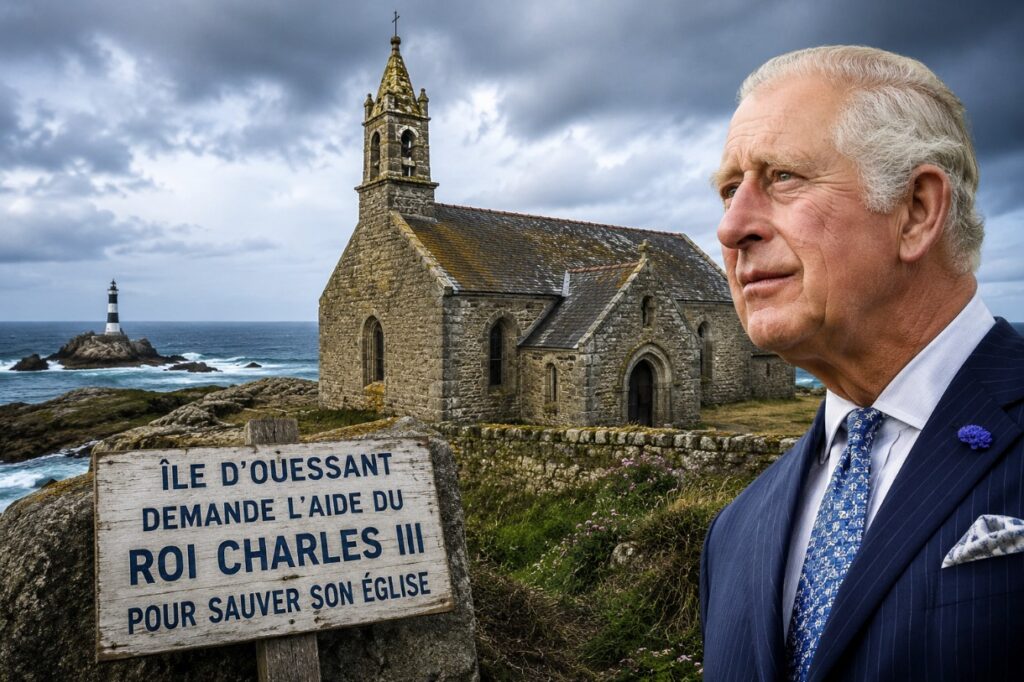
Far out in the west of Brittany, where France slowly disappears into the Atlantic, the small island of Ouessant is fighting wind, salt and time. The inhabitants of the rocky island, off the coast of Finistère, have now sent an unusual appeal to London — more precisely to King Charles III. The British monarch is being asked to help save the historic church of Saint-Pol-Aurélien, whose walls suffer from moisture, storms and decades of wear.
At first glance the story sounds like a quirky footnote from a coastal novel: a tiny French island asking the King of England for help. But behind this symbolic request lies far more than a mere bid for attention.
Only around 800 people live on Ouessant permanently. The island has always been known as harsh, remote and headstrong. Anyone who arrives there immediately feels the force of nature. The wind whistles through the narrow streets, the spray lays down a salty film on windows and walls. It is precisely this climate that is taking a heavy toll on the church.
For the inhabitants, Saint-Pol-Aurélien is far more than a religious building. It belongs to the island’s identity like the lighthouses, the black rocks and the roaring sea. Many families associate personal memories with the building — baptisms, weddings, farewells. In small communities, history and everyday life are often more closely intertwined than in large cities. When a building like this falls into disrepair, not just stone disappears. A piece of collective memory crumbles along with it.
The problem: the necessary restoration work costs sums that a small island community can hardly bear. France has been grappling with a similar dilemma for years. Thousands of historic churches in rural areas urgently need repairs. Roofs are leaking, bell towers are unstable, façades slowly decay under rain and frost. For many municipalities, preserving these buildings is like a bottomless pit.
So Ouessant is now seeking a path onto the international stage.
Charles III has long been regarded as a passionate defender of historic architecture. Long before he became king, he was involved in traditional building crafts, monument protection and artisanal restoration techniques. Old buildings and cultural landscapes are particularly close to his heart. On Ouessant people therefore hope that the request will not simply be filed away in Buckingham Palace.
And in a way the story actually fits together remarkably well.
There have been close ties between Brittany and the British Isles for centuries. Fishermen, traders and sailors regularly crossed the English Channel. Traces of this closeness remain to this day culturally as well. The Breton language belongs to the Celtic language family and has links to Welsh and Cornish. Those who live on Ouessant traditionally look not only to Paris, but always out to sea.
Of course the media effect also plays a role. A small community rarely attracts international attention for crumbling church walls. But once the British king comes into the picture, many more people suddenly sit up and take notice. That is exactly what makes the story so effective. It connects local cultural heritage with international symbolism.
One could almost say: Ouessant practices cultural diplomacy in the Atlantic wind.
Whether the appeal will actually result in financial help remains open. But already the island has achieved what many remote regions can hardly manage any more — visibility. Between Breton cliffs and the royal residences of London, an unexpected dialogue about memory, history and the value of old stones has suddenly emerged.
And while winter storms lash the coast outside, the inhabitants of Ouessant hope their church will withstand the Atlantic for a long time to come.
Andreas M. B.