
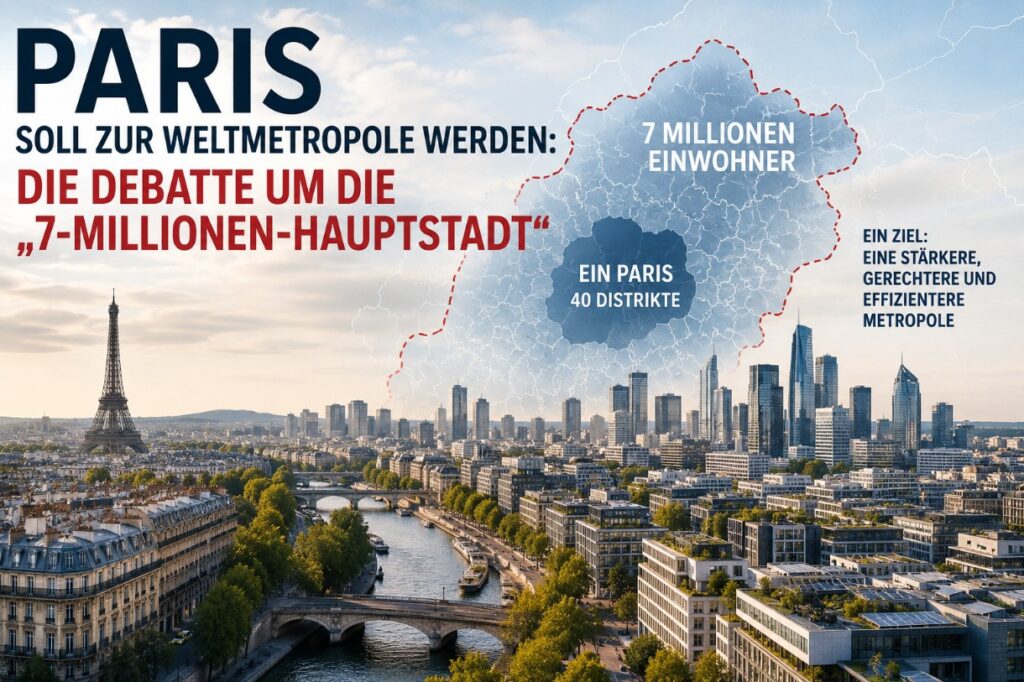
Paris is thinking big again. Very big indeed. A new reform proposal from the High Commissioner for Planning, Clément Beaune, is currently sparking intense debates in politics and administration. The vision: a capital city with seven million inhabitants, a unified administration, and the end of those municipal borders that have shaped the Greater Paris area for decades.
What at first glance appears to be a technocratic administrative reform actually touches on one of the central questions of French urban development: How can a 21st-century metropolis be governed if its political structures still date from a time when the suburbs were much smaller and the challenges more manageable?
A Metropolis That Has Long Since Grown Together
The official city limits of Paris today encompass around 2.1 million inhabitants. But the actual metropolis no longer ends at the Boulevard périphérique. Every day, millions of people flow from the suburbs into the capital and back again. Jobs, transport networks, the housing market, and the economy have for years formed a tightly interwoven organism.
Against this background, the existing administrative borders increasingly seem artificial. While economic reality has long created a common metropolis, political organization remains spread across numerous municipalities, departments, regional institutions, and state levels.
Beaune’s proposal targets exactly this point. Paris and the surrounding suburbs should merge into a single political entity. The current three departments of the so-called “petite couronne” – Hauts-de-Seine, Seine-Saint-Denis, and Val-de-Marne – would disappear. In their place would be larger city districts within a new overall metropolis.
The Battle Against Administrative Complexity
Supporters see this as a necessary modernization. Few European metropolises have as complex a mesh of responsibilities as Paris. Housing construction, public transport, economic development, or climate adaptation are often managed by different institutions whose competences overlap.
The problem is particularly evident in housing construction. While the capital suffers from chronic housing shortages, many suburban municipalities pursue their own strategies. A unified metropolis could accelerate planning processes and steer investments more purposefully.
Internationally, the idea also appears understandable. London or Berlin have significantly more centralized administrative structures. Paris, by contrast, remains institutionally highly fragmented despite its economic importance.
Between Solidarity and Self-interest
The political reality, however, makes implementation difficult. Many mayors see their municipal independence threatened. Particularly wealthy suburbs are skeptical about closer integration. They fear having to share financial burdens more with structurally weaker areas.
On the other hand, many Banlieue municipalities are concerned that in a huge capital administration, they would have even less influence than before. The discussion therefore touches not only organizational issues but also the sensitive relationship between the center and the periphery.
There is also an emotional factor. Many suburbs have developed their own identities over decades – often deliberately distinguishing themselves from the capital. The planned reorganization would therefore change much more than administrative boundaries. It would challenge established political and cultural self-images.
Paris in the Competition of Global Cities
Ultimately, behind the debate is a strategic question: How can Paris maintain its position among the world’s great metropolises?
The competition between London, Berlin, Madrid, or Milan is increasingly decided by infrastructure, innovation, housing, and international attractiveness. France’s capital has enormous economic and cultural appeal but simultaneously struggles with high housing costs, social tensions, and complex decision-making structures.
The idea of a “7-million capital” is therefore more than an administrative project. It is an expression of the attempt to adapt political organization to the actual size and importance of the metropolis.
Author: P. Tiko