
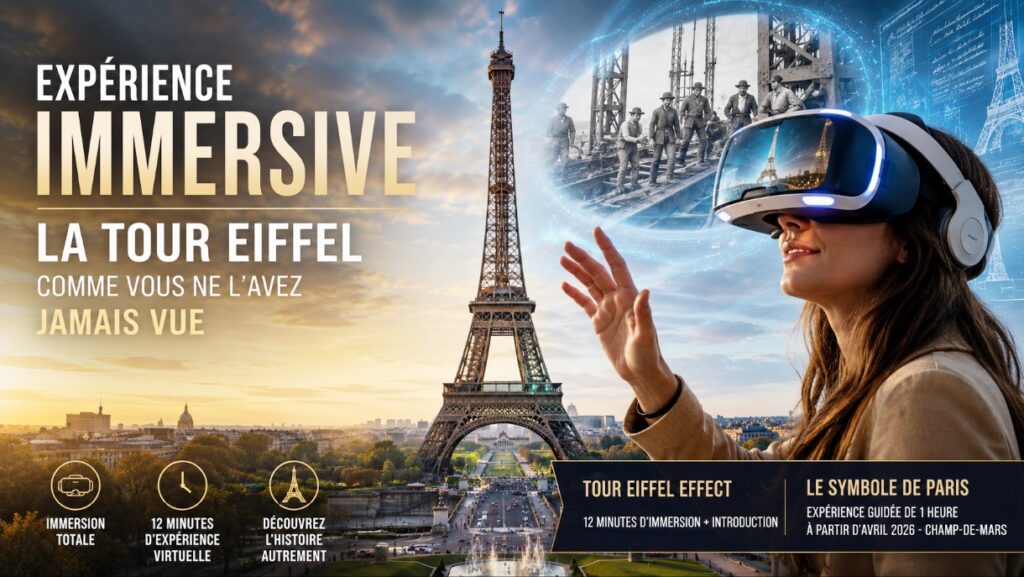
The Eiffel Tower is one of those monuments that everyone knows. It adorns travel guides, postcards, and millions of photos taken with smartphones. Few symbols represent Paris as much as the “Iron Lady,” the iron lady who has watched over the French capital for more than 130 years. And yet, it is precisely this famous global emblem that reveals a remarkable paradox: almost everyone has seen it, but few truly know its history.
This is where new immersive experiences come into play, presenting the Eiffel Tower not only as a viewpoint but as a journey through time. With modern virtual reality offerings, France’s most famous monument benefits from a digital extension that allows visitors to dive into its world in a whole new way.
Instead of simply taking the elevator to go up and admire Paris, visitors now enter a virtual world. There, they discover the history of the building’s construction, face the challenges of its design, and immerse themselves in the era when the tower was erected for the 1889 World’s Fair.
Technology offers fascinating possibilities. Where explanatory panels and historical photographs once sufficed, today three-dimensional scenes immerse the viewer right in the heart of the action. One suddenly finds oneself among the steel beams of the construction site, watching the busy workers or feeling the excitement of the time when many Parisians mocked the tower, then considered a monstrous construction error.
The connection between history and emotion is particularly appealing. Indeed, virtual reality does not only convey facts. It creates an atmosphere. Sounds, lighting moods, and animated images establish a closeness that traditional exhibitions often struggle to achieve.
Paris thus follows an international trend. Museums, castles, and historical sites increasingly seek ways to make the past tangible. Today, visitors expect more than information. They want experiences that surprise, move, and remain engraved in their memories.
Of course, this evolution also poses challenges. Not all digital stagings automatically create added value. When technology is used solely as a spectacular effect, history risks becoming mere decor. The quality of these projects is measured not by the number of pixels, but by their ability to make connections understandable.
For the Eiffel Tower, this concept seems particularly promising. The monument is much more than a tourist attraction. It embodies the genius of engineering, technical progress, and the optimism of an era that believed in the power of human innovation. Understanding its history means perceiving behind the steel beams a fragment of French identity.
Perhaps here lies the true value of the new virtual offers. They do not replace the real Eiffel Tower. They complement it. They offer a second perspective on a monument that many thought they already knew.
And it may well be that after removing their VR headset, visitors look up once again towards the top — and see the most famous tower in the world in a completely different light.
C. Hatty